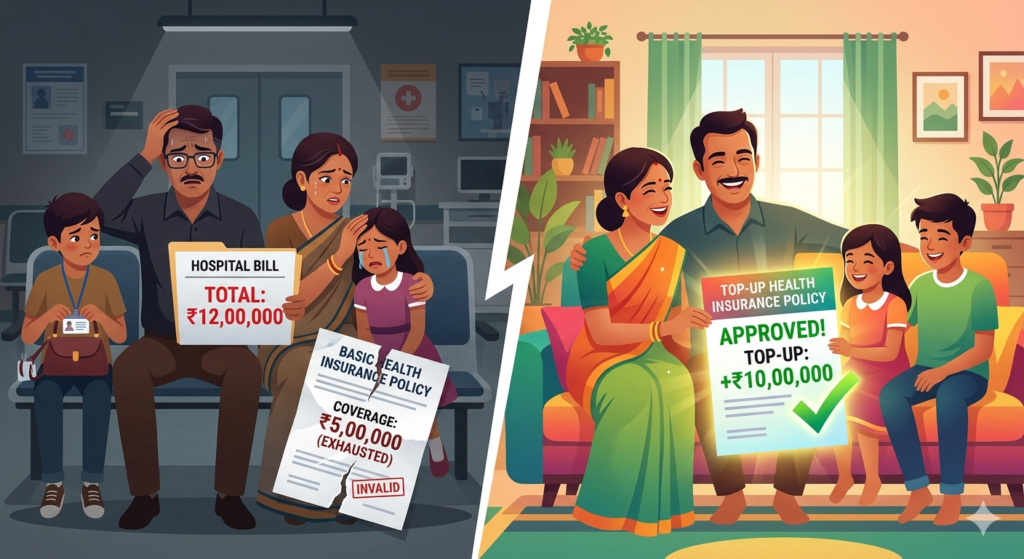

₹5 Lakh or ₹15 Lakh?
The Khanna Family’s Wake-Up Call
“The moment the nurse handed me the pre-surgery estimate — ₹9,85,000 — my legs gave way. We had a ₹5 lakh policy. Just ₹5 lakhs. My father, a retired teacher, lay in the ICU. My mother was crying silently. Then I remembered the top-up policy we had bought two years ago for just ₹2,899. That tiny decision turned our ₹5 lakh safety net into ₹15 lakhs. We didn’t sell our ancestral home. We didn’t borrow from relatives. The top-up saved us.”
This is not a fairy tale. It’s the reality of millions of Indian families who believe a ₹5 lakh health plan is enough — until a medical emergency strikes. Meet the Khannas: Ramesh Khanna (62), his wife Sunita (58), and their daughter Anjali (34). They had a family floater plan of ₹5 lakhs, purchased years ago. It felt adequate until Ramesh’s sudden cardiac arrest required immediate bypass surgery at a top hospital in Andheri. The total bill: ₹12.4 lakhs. But two years earlier, Anjali had read an article about top-up health insurance and bought a ₹10 lakh top-up with a ₹5 lakh deductible for just ₹2,899/year. That one decision changed everything.
💔 The Emotional Trap of “Just Enough” Insurance
Like the Khannas, nearly 65% of Indian policyholders still carry less than ₹5 lakh cover. But medical inflation is ruthless — a single angioplasty can cost ₹3-4 lakhs, cancer treatment crosses ₹15 lakhs, and a kidney transplant easily goes beyond ₹10 lakhs. When you only have ₹5 lakhs, you’re essentially underinsured. The moment a major illness hits, you either drain your life savings, borrow at high interest, or compromise on quality treatment. That’s where the humble top-up steps in — an affordable knight in shining armour.
📖 The Turning Point: From ₹5 Lakh to ₹15 Lakh for a Small Fee
Anjali had bought the top-up policy online after a colleague’s father faced a ₹7 lakh bill. The premium for ₹10 lakh extra cover was shockingly low — just ₹2,899 for the year (including GST approx). “I almost skipped it because we were already paying ₹8,500 for the base policy. But the agent explained: the insurer only takes risk after ₹5 lakhs, so the premium is minimal. It felt like a no-brainer,” she recalls.
When the hospital bill arrived, the base insurer paid ₹5 lakhs (exhausted the sum insured). Then the top-up plan stepped in. Since the bill was ₹12.4 lakhs, the amount above ₹5 lakhs was ₹7.4 lakhs — and the top-up covered it fully within the ₹10 lakh limit. Out-of-pocket: ₹0. The family paid nothing beyond deductibles and small co-pay clauses. They even got cashless treatment.
Base Policy
Top-up (₹10L)
Total Cover
💰 How Much Does a ₹10 Lakh Top-up REALLY Cost? (Detailed Table)
Let’s break down real premiums for a top-up of ₹10 lakhs over a base cover of ₹5 lakhs (deductible = ₹5 lakhs). Prices vary with age, city, and insurer, but here is a reliable snapshot based on leading Indian insurers (as of 2025-26).
| Age Group | Existing Cover | Top-up Amount | Deductible | Yearly Premium (₹) | Less than a coffee/day? |
|---|---|---|---|---|---|
| 25–30 years | ₹5 lakhs | ₹10 lakhs | ₹5 lakhs | ₹1,850 – ₹2,400 | ✅ ~₹6/day |
| 31–40 years | ₹5 lakhs | ₹10 lakhs | ₹5 lakhs | ₹2,500 – ₹3,800 | ✅ ~₹9/day |
| 41–50 years | ₹5 lakhs | ₹10 lakhs | ₹5 lakhs | ₹3,900 – ₹5,500 | ✅ still negligible |
| 51–60 years | ₹5 lakhs | ₹10 lakhs | ₹5 lakhs | ₹5,800 – ₹8,200 | ✅ ~₹22/day |
📊 More Options: Top-up Slabs & Their Affordable Premiums
Not everyone needs exactly ₹10 lakh top-up. Some want ₹5 lakh extra, others ₹20 lakh. Here’s a comparison for a 42-year-old with base ₹5L plan:
| Top-up Cover (extra) | Total Cover (Base+Top) | Annual Premium (₹) | Best for |
|---|---|---|---|
| ₹5 lakhs | ₹10 lakhs | ₹1,900 – ₹2,500 | Smaller metro hospitals |
| ₹10 lakhs | ₹15 lakhs | ₹3,200 – ₹4,200 | Most middle-class families |
| ₹15 lakhs | ₹20 lakhs | ₹4,800 – ₹6,500 | Critical illness buffer |
| ₹20 lakhs | ₹25 lakhs | ₹6,500 – ₹9,000 | Ultra-protection, high risk |
For Anjali’s father, the ₹10 lakh top-up was the sweet spot — covered the entire heart surgery with room for post-operative care.
🧾 How Top-Up Actually Works – The Khanna Claim Calculation
Step 1: Base insurer (₹5L cover) pays ₹5,00,000 → exhausted.
Step 2: Remaining amount = ₹7,40,000.
Step 3: Top-up (deductible ₹5L, cover ₹10L) pays ₹7,40,000 (since ₹7.4L < ₹10L).
Final out-of-pocket: ₹0 (excluding non-medical expenses). The Khannas didn’t sell a single asset.
If the bill had been ₹16 lakhs, base pays ₹5L, top-up pays up to ₹10L (maximum limit), so ₹1L would be paid by family. But still, a massive 15 lakh coverage reduces financial shock.
🕊️ Why Top-up Instead of Increasing Base Sum Insured?
Most people ask: “Why not just upgrade my base policy from ₹5L to ₹15L directly?” Here’s the cost truth: increasing a base plan to ₹15L can cost ₹14,000–₹19,000 yearly. But a base ₹5L + ₹10L top-up costs roughly ₹8,500 (base) + ₹3,500 (top-up) = ₹12,000. That’s ₹4,000–₹7,000 saved each year! Over a decade, you save enough for another emergency fund. Plus, you can keep the same base policy and change top-up providers if needed.
🌟 Super Top-up vs Regular Top-up – Which One?
There’s also a “super top-up” plan that works on an aggregate basis — meaning total claims across the year exceeding deductible trigger the cover. For the Khannas, a regular top-up worked because it was a single hospitalization. However, for families with multiple members likely to be hospitalized in one year, a super top-up is even more powerful. But the regular top-up is cheaper and perfect for catastrophic single events. For an extra ₹800–₹1,500, you can upgrade to super top-up. But our story hero chose the classic top-up and it was still a blessing.
📈 Premiums for Different Age Groups: A Detailed Guide
| Age (years) | ₹5L Top-up | ₹10L Top-up | ₹15L Top-up | ₹20L Top-up |
|---|---|---|---|---|
| 30 | ₹1,400 | ₹2,200 | ₹3,300 | ₹4,600 |
| 40 | ₹2,100 | ₹3,400 | ₹4,800 | ₹6,200 |
| 50 | ₹3,500 | ₹5,200 | ₹7,100 | ₹9,300 |
| 60 | ₹5,800 | ₹8,400 | ₹11,500 | ₹14,900 |
💎 The Khanna Family’s Lesson – And Yours
After the discharge, Ramesh Khanna recovered well. But the family gathered and reflected: “We were lucky that Anjali took that top-up plan. Many in our community still have only ₹5 lakh cover, and they are one medical emergency away from poverty.” Top-up insurance is not just an add-on; it’s financial dignity. The annual fee is minuscule compared to the risk. For a family earning ₹8-12 lakh per year, paying ₹3,000–₹4,000 to increase cover by ₹10 lakhs is the most rational money move.
✨ A Thoughtful Conclusion: The Power of “What If”
We all hope we never have to use our health insurance. But hope is not a strategy. The Khannas’ story is not unique — it’s a mirror to thousands of Indian homes. That ₹5 lakh policy that looked adequate when you bought it five years ago is now outdated due to medical inflation. A top-up of ₹10 lakhs or ₹15 lakhs costs less than your annual grocery delivery charges. It turns a financially devastating event into a manageable moment. The emotional weight of seeing a ₹12 lakh bill with only ₹5 lakh cover is crushing. But with a top-up, you breathe relief.
So here is the call to action: check your base policy today. If it’s below ₹10 lakhs, go online or talk to your insurer. Buy a top-up — for yourself, for your aging parents, for your family. It might be the smallest cheque you write all year, but it could be the one that saves your home, your peace, and your loved one’s smile. Don’t wait for a hospital admission to realise you needed it. As Anjali says, “That ₹2,899 top-up was the best money I never knew I needed.” Let her story be your wake-up call.
— Because 5 lakhs may feel safe, but 15 lakhs feels like freedom.
Disclaimer: This story is inspired by real-life events and customer experiences. Premiums and coverage may vary. Always read policy terms and consult an IRDAI advisor before purchase.