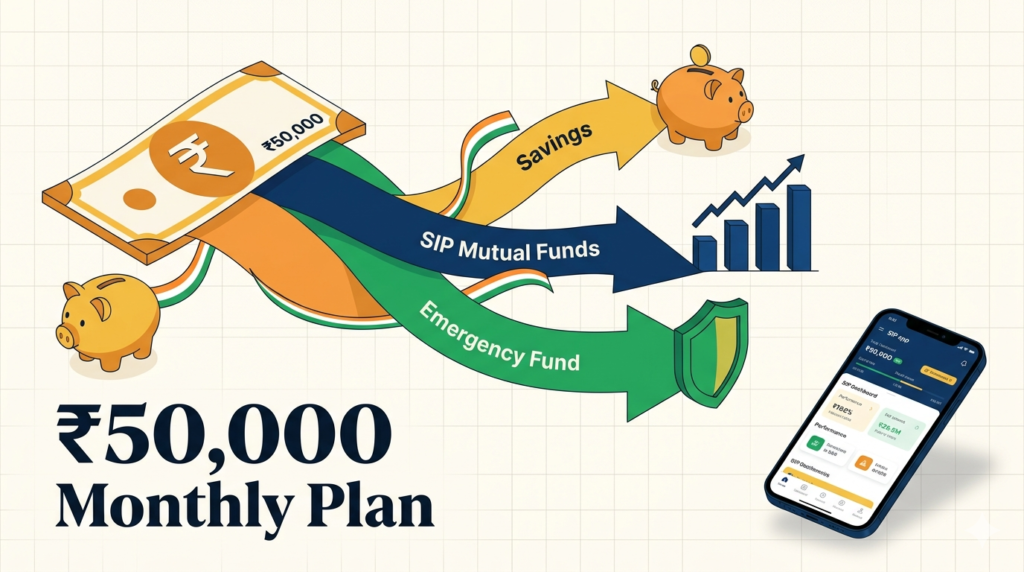

₹50,000 Monthly Income: The Complete Saving + SIP + Emergency Fund Plan
A practical, no-nonsense guide to budgeting, investing, and building financial security on a ₹50,000 salary in India.
You earn ₹50,000 a month. That’s a solid, respectable income for millions of Indians — whether you’re a government employee in Nagpur, a software tester in Pune, or a mid-level executive in Bangalore. But here’s the uncomfortable question most people never ask: Where does all that money actually go?
If you’re reaching the end of every month wondering how your ₹50,000 vanished — between rent, groceries, EMIs, and the occasional Swiggy binge — you’re not alone. According to financial planning surveys, most Indians in the ₹40,000–₹60,000 income bracket save less than 10% of their income, despite having the potential to save 25–30%.
This guide is built specifically for you. We’ll walk through an exact, step-by-step ₹50,000 monthly income plan that covers smart saving, SIP investment allocation, and building a robust emergency fund — so you can protect yourself today and grow wealth for tomorrow.
💡 Did you know? If you invest just ₹10,000/month via SIP starting at age 28, at a 12% annual return, you could have over ₹99 lakhs by age 48 — nearly 1 crore without touching a stock yourself.
- Why ₹50,000 Needs a Real Financial Plan
- The Smart Budget Breakdown for ₹50,000
- Building Your Emergency Fund First
- SIP Strategy: How Much, Where, and Which Funds
- Best Savings Tools for a ₹50,000 Income
- The Power of Step-Up SIP
- Expert Tips & Key Insights
- Real-Life Case Study: Rahul from Hyderabad
- Common Mistakes to Avoid
- FAQs
- Conclusion
Why ₹50,000 Needs a Real Financial Plan
₹50,000 per month might feel like “just enough” — especially in a city like Mumbai, Bangalore, or Delhi where rent alone can eat up ₹15,000–₹20,000. But the truth is, ₹50,000 is more than enough to build real financial security if managed with intention.
The three pillars of financial health on any income are:
- Saving: Systematically setting aside money before spending begins
- Investing via SIP: Letting your money grow through the power of compounding
- Emergency Fund: A financial cushion that protects you from life’s curveballs
Without all three working together, you’re either not growing (no SIP), not protected (no emergency fund), or running on empty (no savings discipline). Let’s fix that.
The Smart Budget Breakdown for ₹50,000/Month
The most effective budgeting framework for Indian households earning ₹40,000–₹70,000 is a modified version of the classic 50-30-20 rule, adapted for India’s cost of living, family obligations, and investment opportunities.
Here’s how we recommend splitting ₹50,000:
| Category | Allocation | Monthly Amount | Examples |
|---|---|---|---|
| 🏠 Needs (Fixed Expenses) | 45% | ₹22,500 | Rent, groceries, utilities, EMIs, insurance |
| 🎯 Financial Goals | 30% | ₹15,000 | SIP, PPF, RD, emergency fund top-up |
| 😄 Wants (Variable) | 20% | ₹10,000 | Dining, shopping, entertainment, travel |
| 🎓 Self-Development | 5% | ₹2,500 | Courses, books, skill upgrades |
| Total | 100% | ₹50,000 |
Always “pay yourself first.” On salary day, immediately transfer ₹15,000 to your investment and savings accounts before you spend a single rupee. Set up auto-debits for SIPs so the decision is automatic, not voluntary.
Breaking Down the ₹15,000 Financial Goals Bucket
This is the most important ₹15,000 you’ll ever spend each month. Here’s how to split it:
- ₹8,000 → SIP in Mutual Funds (equity, hybrid, or ELSS)
- ₹3,000 → Emergency Fund Building (until target is reached)
- ₹2,000 → PPF (Public Provident Fund) — long-term tax-free growth
- ₹2,000 → Recurring Deposit or Liquid Fund — for short-term goals
Once your emergency fund is fully funded (we’ll cover this next), redirect that ₹3,000 into additional SIPs or PPF contributions.
Building Your Emergency Fund First
Before you even think about investing in stocks or mutual funds, you need an emergency fund. This is not optional. Without it, a single medical emergency, job loss, or car breakdown can derail months of financial progress and force you to break your investments at the worst possible time.
How Much Should Your Emergency Fund Be?
The standard recommendation is 3 to 6 months of essential expenses. Let’s calculate yours:
- Essential monthly expenses (rent + groceries + utilities + EMIs): ~₹22,500
- Minimum Emergency Fund (3 months): ₹67,500
- Ideal Emergency Fund (6 months): ₹1,35,000
If you have dependents (spouse, children, elderly parents), or are in a volatile industry (freelancing, startups, sales), aim for a 6-month emergency fund. If you’re a government employee with job security, 3 months is sufficient.
Where to Keep Your Emergency Fund in India
Your emergency fund must be liquid, safe, and slightly growing. Here are the best options in 2026:
- Liquid Mutual Funds: Best choice — 6–7% returns, instant redemption (e.g., Nippon India Liquid Fund, SBI Liquid Fund). No exit load after 7 days.
- High-Yield Savings Account: IDFC FIRST Bank, YES Bank, or RBL Bank often offer 6–7% on savings accounts. Zero lock-in.
- Short-term FD (1–3 months): Suitable if you can forecast emergencies — but avoid long-term FDs for this money.
- Sweep FD Account: Offered by SBI, HDFC, and ICICI — auto-converts savings to FD for better rates.
Do NOT keep your emergency fund in equity mutual funds or stocks. Markets can fall exactly when you need cash the most. Emergency funds must be stable and accessible within 24–48 hours.
How Long to Build It on ₹50,000 Salary
By saving ₹3,000/month specifically for this purpose:
- ₹67,500 (3-month fund) → Ready in ~23 months
- ₹1,35,000 (6-month fund) → Ready in ~45 months
You can accelerate this by redirecting bonuses, tax refunds, or side income directly into the emergency fund until the target is hit.
SIP Strategy: How Much, Where, and Which Funds
A Systematic Investment Plan (SIP) is the most powerful wealth-building tool available to salaried Indians. It removes emotion from investing, leverages rupee cost averaging, and harnesses the miracle of compounding. On a ₹50,000 income, starting a SIP of ₹8,000–₹10,000/month is both feasible and transformative.
SIP Returns Projection at ₹8,000/Month
Assuming a conservative 12% CAGR (consistent with long-term large-cap mutual fund performance):
| Duration | Total Invested | Estimated Returns | Corpus |
|---|---|---|---|
| 5 Years | ₹4,80,000 | ₹1,65,000 | ₹6,45,000 |
| 10 Years | ₹9,60,000 | ₹9,00,000 | ₹18,60,000 |
| 15 Years | ₹14,40,000 | ₹25,60,000 | ₹40,00,000 |
| 20 Years | ₹19,20,000 | ₹60,80,000 | ₹80,00,000 |
*Projections are illustrative based on 12% CAGR. Actual mutual fund returns vary and are subject to market risk. Past performance is not indicative of future results.
Recommended SIP Portfolio for ₹8,000/Month
Don’t put all your SIP money into one fund. Diversify across categories:
- ₹3,000 → Large Cap Fund — Stability and consistent returns (e.g., Mirae Asset Large Cap, Canara Robeco Bluechip)
- ₹2,500 → Flexi Cap / Multi Cap Fund — Balanced growth across market caps (e.g., Parag Parikh Flexi Cap)
- ₹1,500 → ELSS Fund — Tax saving under Section 80C + equity returns (e.g., Axis Long Term Equity, Quant ELSS)
- ₹1,000 → Mid/Small Cap Fund — Higher growth, higher risk (e.g., Nippon India Small Cap, SBI Small Cap)
Use the AMFI India website or apps like Groww, Zerodha Coin, or MF Central to start and track your SIPs. Choose Direct Plans to save on distributor commissions — they can add 0.5–1% extra return annually over 20 years.
Best Savings Tools for a ₹50,000 Income
Beyond SIP, a well-structured savings plan uses multiple instruments for different goals and timelines:
Short-Term Savings (0–3 Years)
- Recurring Deposit (RD): Simple, disciplined, 6–7% returns at most banks. Good for goals like vacation funds or gadget upgrades.
- Liquid or Ultra Short-Term Mutual Funds: Better post-tax returns than FDs for someone in the 20–30% tax bracket.
- High-Interest Savings Account: For parking surplus before deploying to investments.
Medium-Term Savings (3–7 Years)
- Debt Mutual Funds: For goals like a car down payment, home renovation — lower risk, better than FD post-taxation.
- National Savings Certificate (NSC): Safe, government-backed, 5-year lock-in, ~7.7% interest (as of 2025).
- Fixed Deposits: Suitable for parking a lump sum if you get a bonus or windfall.
Long-Term Savings (7+ Years)
- Public Provident Fund (PPF): 15-year lock-in, ~7.1% interest, completely tax-free returns — one of India’s best long-term instruments.
- NPS (National Pension System): Additional tax deduction up to ₹50,000 under 80CCD(1B) over and above Section 80C.
- Equity Mutual Funds via SIP: Best long-term wealth creator if held for 10+ years.
The Power of Step-Up SIP — Your Secret Wealth Multiplier
One of the most underused strategies in India is the Step-Up SIP (also called Top-Up SIP). The concept is simple: increase your SIP amount by 10–15% every year, in line with salary hikes and inflation.
Let’s see what happens when you start with ₹8,000/month and increase by 10% annually for 20 years at 12% CAGR:
- Regular SIP (₹8,000 flat for 20 years): ~₹80 lakhs
- Step-Up SIP (10% annual increase for 20 years): ~₹1.5 crore+
That’s nearly double the corpus just by increasing your SIP by a modest 10% annually — roughly matching your expected salary increment.
Most mutual fund platforms including Groww, Zerodha Coin, and ET Money offer a built-in Step-Up SIP feature. Set it once and forget it — the increase happens automatically every year.
Expert Tips & Key Insights
- Automate everything: Set up auto-debit for SIPs, RDs, and emergency fund contributions on the 1st or 2nd of every month — the day after salary credit.
- Insurance before investment: Make sure you have a term life insurance plan (cover = 10–15x annual income) and health insurance (₹5 lakh+ cover) before aggressively investing. Don’t mix insurance with investment — avoid ULIPs and endowment plans.
- Use Section 80C wisely: Your ₹1.5 lakh 80C limit should be filled via ELSS SIP + PPF + EPF. Don’t buy unnecessary LIC policies just for tax saving.
- Review quarterly, not daily: SIPs are long-term instruments. Looking at NAV every day causes emotional decisions. Review your portfolio every 6 months or annually.
- Track your net worth: Use a simple Excel sheet or apps like Zerodha Kite or INDmoney to track total assets minus liabilities monthly.
- Don’t delay for the “right time”: The best time to start a SIP was 10 years ago. The second best time is today. A 1-year delay in starting a ₹8,000/month SIP at 12% CAGR costs you approximately ₹8–10 lakhs over 20 years.
Real-Life Case Study: Rahul from Hyderabad
📋 Meet Rahul — Software QA Engineer, Age 29
Monthly Take-Home: ₹50,000 | City: Hyderabad | Family: Married, no kids yet
Rahul used to spend his entire ₹50,000 every month and had zero savings at age 29. After following a structured plan in early 2024, here’s where he stands in April 2026:
- Rent + Utilities: ₹14,000
- Groceries + Food: ₹8,000
- EMI (bike loan): ₹3,500
- SIP: ₹8,000/month across 3 mutual funds
- PPF: ₹2,000/month
- Emergency Fund: ₹3,000/month (now at ₹72,000 — nearly 3 months covered)
- Wants + Misc: ₹11,500
🎯 After 24 months: Rahul has ₹72,000 in liquid mutual funds (emergency), ₹48,000 in PPF, and his SIP corpus has grown to ~₹2.1 lakhs. He’s now increasing his SIP by 10% using Step-Up feature and aims for ₹50 lakh by age 50.
Common Mistakes to Avoid
Investing Before Building an Emergency Fund
Many people jump into SIPs without any financial cushion. When an emergency hits, they redeem their SIP at a loss. Build 3 months of expenses first — then invest.
Lifestyle Inflation After Every Raise
Got a ₹5,000 raise? Don’t upgrade your lifestyle — upgrade your SIP. Lifestyle inflation is the #1 enemy of wealth building for salaried Indians.
Stopping SIPs During Market Downturns
Market falls are actually opportunities for SIP investors — you buy more units at lower NAV. Stopping SIPs during corrections is the single worst financial decision most retail investors make.
Over-diversifying with Too Many Funds
Having 8–10 mutual fund SIPs doesn’t reduce risk — it creates confusion and likely duplication. 3–4 well-chosen funds from different categories are sufficient.
Ignoring Term Insurance & Health Cover
A ₹1 crore term plan for a 30-year-old costs around ₹700–₹900/month. Without it, a single tragedy can wipe out a family’s financial future. This is non-negotiable.
Keeping Emergency Fund in a Regular Savings Account
A standard savings account at SBI or HDFC gives only 2.7–3% interest. Move your emergency fund to a liquid mutual fund or a high-yield savings account to earn 5–7% without any lock-in.
Frequently Asked Questions
Conclusion
Earning ₹50,000 a month is not a limitation — it’s an opportunity. With the right financial plan in place, you can protect yourself from financial emergencies, grow your wealth steadily through SIPs, and achieve goals you once thought were out of reach.
The three steps are simple, but they require consistency: Budget smartly using the 45-20-30 framework, build your emergency fund first in a liquid instrument, and start your SIP today — not next month, not after the next raise. Today.
Remember: the secret to building wealth in India isn’t earning more — it’s managing what you have with discipline and letting compounding do the heavy lifting. ₹8,000 invested today in a SIP is worth far more than ₹80,000 invested 10 years from now.
Start small. Stay consistent. Step up annually. And let time be your greatest ally.