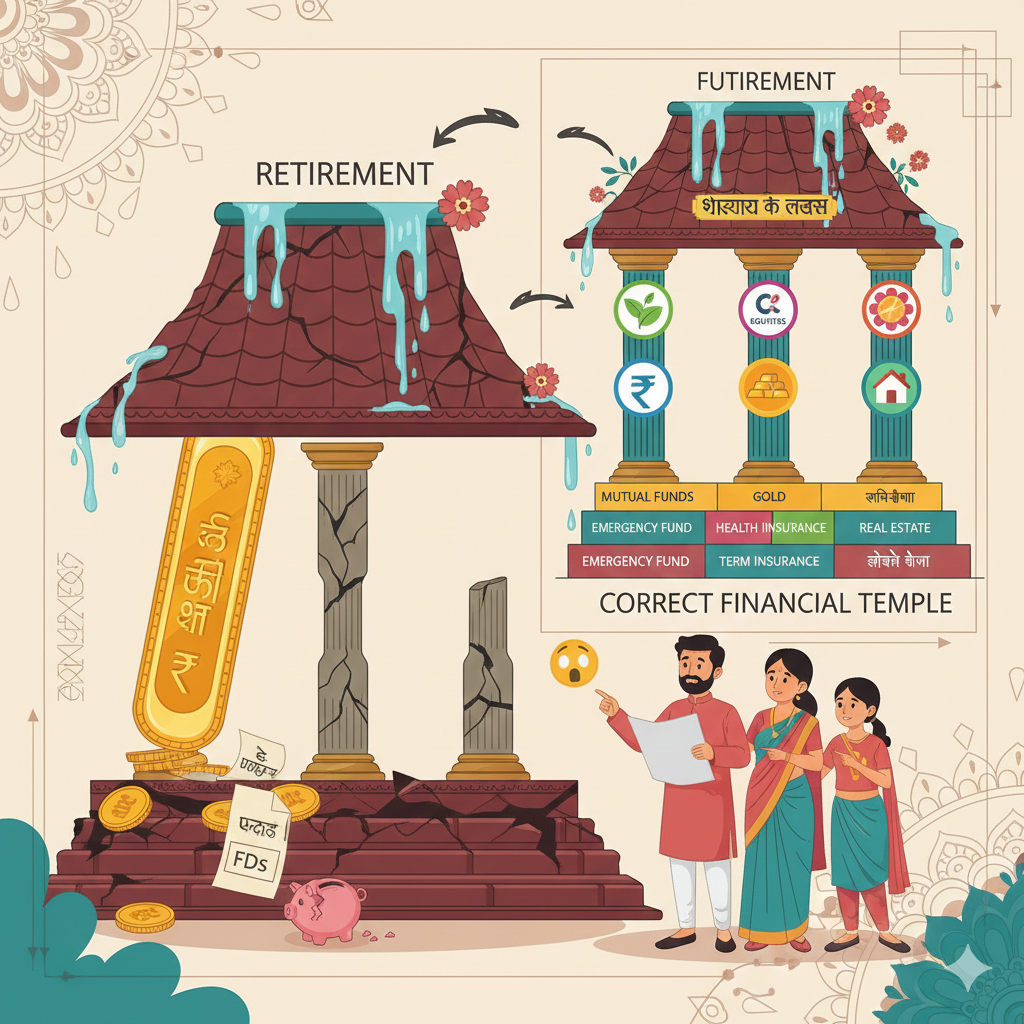

- “15 Common Money Mistakes Indian Families Make (And How to Fix Them)”
- “15 Common Money Mistakes Indian Families Make (And How to Fix Them)”
15 Common Money Mistakes Indian Families Make
Are You Guilty of These Financial Errors? Practical Solutions to Secure Your Family’s Future
In the pursuit of providing the best for our families, many Indian households unknowingly make financial decisions that jeopardize their long-term security. From cultural pressures to lack of financial literacy, these mistakes can cost families lakhs of rupees over their lifetime. This comprehensive guide identifies 15 common money mistakes and provides actionable solutions to correct them.
The Stark Reality: Indian Family Finance Statistics
Indian families have no emergency fund for 3+ months
Rely only on traditional savings (FD, Gold, Real Estate)
Underinsured for health and life coverage
Start retirement planning after age 45
The 15 Costly Financial Mistakes
Most Indian families keep all their savings locked in FDs or real estate, leaving no liquid cash for emergencies like medical crises or job loss.
Build an emergency fund covering 6-12 months of expenses in a savings account or liquid mutual funds. Start with ₹5000/month until you reach your target.
FDs offer negative returns after accounting for inflation (7-8%) and taxes. Yet, they remain the primary investment for 70% of Indian families.
Limit FDs to 20% of your portfolio. Shift to equity mutual funds for long-term goals (10+ years) to beat inflation.
Traditional/endowment plans offer 4-6% returns versus mutual funds’ 12-15%. Families sacrifice ₹15-20 lakhs over 20 years with this mistake.
Buy term insurance for protection and invest separately in mutual funds. This can increase your returns by 300% over 20 years.
Assuming ₹50,000/month will be enough in retirement when actually ₹1.5 lakhs/month might be needed due to inflation and healthcare.
Use the 25X rule: Save 25 times your annual expenses. At age 30, invest ₹10,000/month in equity funds to retire comfortably at 60.
Indian families typically allocate 20-30% of their wealth to gold, which generates no income and has storage/security costs.
Limit gold to 5-10% of your portfolio. Consider Sovereign Gold Bonds (SGBs) that pay 2.5% annual interest plus gold appreciation.
Most families have vague goals like “save for children’s future” without specific amounts, timelines, or investment plans.
Create a written financial plan: “Need ₹50 lakhs for daughter’s MBA in 15 years = Save ₹8,000/month in equity funds.”
Buying property because “everyone is buying” without calculating rental yield (2-3%) versus mutual fund returns (12-15%).
Only buy property to live in. For investment, REITs offer better liquidity and returns than physical real estate.
Assuming today’s costs will remain same. Education that costs ₹10 lakhs today will cost ₹48 lakhs in 20 years at 8% inflation.
Always use inflation-adjusted calculations. Use online calculators that factor in 6-8% education inflation and 5-6% general inflation.
Buying cars on EMI (9-12% interest) that lose 50% value in 3 years instead of investing that EMI amount.
Save first, then buy. If you pay ₹30,000/month car EMI, invest it for 3 years first, then buy in cash with the corpus.
Relying on employer insurance that’s insufficient (₹3-5 lakhs) when critical illnesses can cost ₹15-50 lakhs.
Buy a family floater health insurance of ₹15-25 lakhs. Top-up plans can increase coverage to ₹1 crore at minimal cost.
Investing in speculative stocks, cryptocurrencies, or schemes promising 20%+ returns based on tips from friends/relatives.
Stick to proven asset allocation: 60% equity, 30% debt, 10% gold. Use SIPs in index funds for steady, reliable growth.
85% of Indian families have no will, leading to disputes, legal hassles, and unnecessary taxes for heirs.
Create a will (can be simple holographic will). Nominate beneficiaries in all financial accounts. Consider creating trusts for minor children.
Spending ₹20-50 lakhs on weddings (often through loans) that could have been retirement corpus.
Set a reasonable budget (max 20% of net worth). Start saving separately for big events 5-10 years in advance.
Children grow up without financial literacy, repeating the same mistakes and remaining dependent longer.
Give pocket money with savings goals. Open a minor’s investment account. Discuss family finances appropriately with teenagers.
Waiting for “right time” or “more money” while missing the power of compounding. Starting at 40 versus 30 can mean 50% less corpus.
Start today with whatever you can. ₹5000/month at 12% for 30 years = ₹1.75 crores. Same for 20 years = ₹50 lakhs only.
Many financial mistakes stem from cultural pressures: keeping up with relatives’ lifestyles, extravagant weddings to maintain social status, buying property because “land never depreciates.” Recognize these pressures and make decisions based on your family’s actual financial situation, not societal expectations.
Your Family Finance Checklist
30-Day Action Plan to Fix These Mistakes
- Calculate total monthly expenses
- Open separate savings account for emergency fund
- Set up auto-transfer of ₹5000/month
- Review all insurance policies
- List all debts with interest rates
- Create debt repayment plan
- Review investment portfolio allocation
- Start SIP in index fund (even ₹1000/month)
- Write specific financial goals
- Create simple will (online templates available)
- Have money conversation with spouse/children
- Schedule quarterly finance review dates
Financial habits, whether good or bad, compound over time. Small corrections today can prevent major financial crises tomorrow.
Start Your Family’s Financial Transformation Today
You’ve identified the mistakes. Now it’s time to take action. Remember, the best time to start fixing your family’s finances was 10 years ago. The second-best time is today.
Your first step: Pick ONE mistake from this list that applies to your family. Commit to fixing it this month. Then move to the next one.
Thousands of Indian families have turned their finances around by addressing these common mistakes.
Frequently Asked Questions
Q1: We’ve already made these mistakes. Is it too late to fix them?
A: It’s never too late. Starting at 45 is better than 50. Starting at 50 is better than 55. Begin with your most critical gap (usually emergency fund or insurance), then work systematically through others.
Q2: How do we convince older family members to change financial habits?
A: Use concrete examples. Show how ₹10 lakhs in FD for 20 years becomes ₹32 lakhs, but in equity funds could be ₹1 crore. Focus on security aspects: “This health insurance will protect us from selling assets if someone gets sick.”
Q3: We have limited income. Where should we focus first?
A: Priority order: 1) Basic health insurance, 2) Small emergency fund (₹50,000), 3) Term insurance if you have dependents, 4) Start retirement SIP (even ₹500/month), 5) Pay off high-interest debt.
Q4: Should we hire a financial advisor?
A: If your portfolio is above ₹50 lakhs or you have complex needs (business, multiple properties, NRI status), yes. Otherwise, start with simple index fund SIPs and basic insurance. Fee-only advisors are better than commission-based.
Q5: How often should we review our family finances?
A: Monthly: Track expenses vs budget. Quarterly: Review investments and rebalance if needed. Annually: Review insurance adequacy, update will, reassess financial goals.