
Active Funds vs Index Funds: Real-World Indian Examples
A comprehensive guide to understanding the differences, performance, and suitability of active and index funds for Indian investors with practical examples and data.
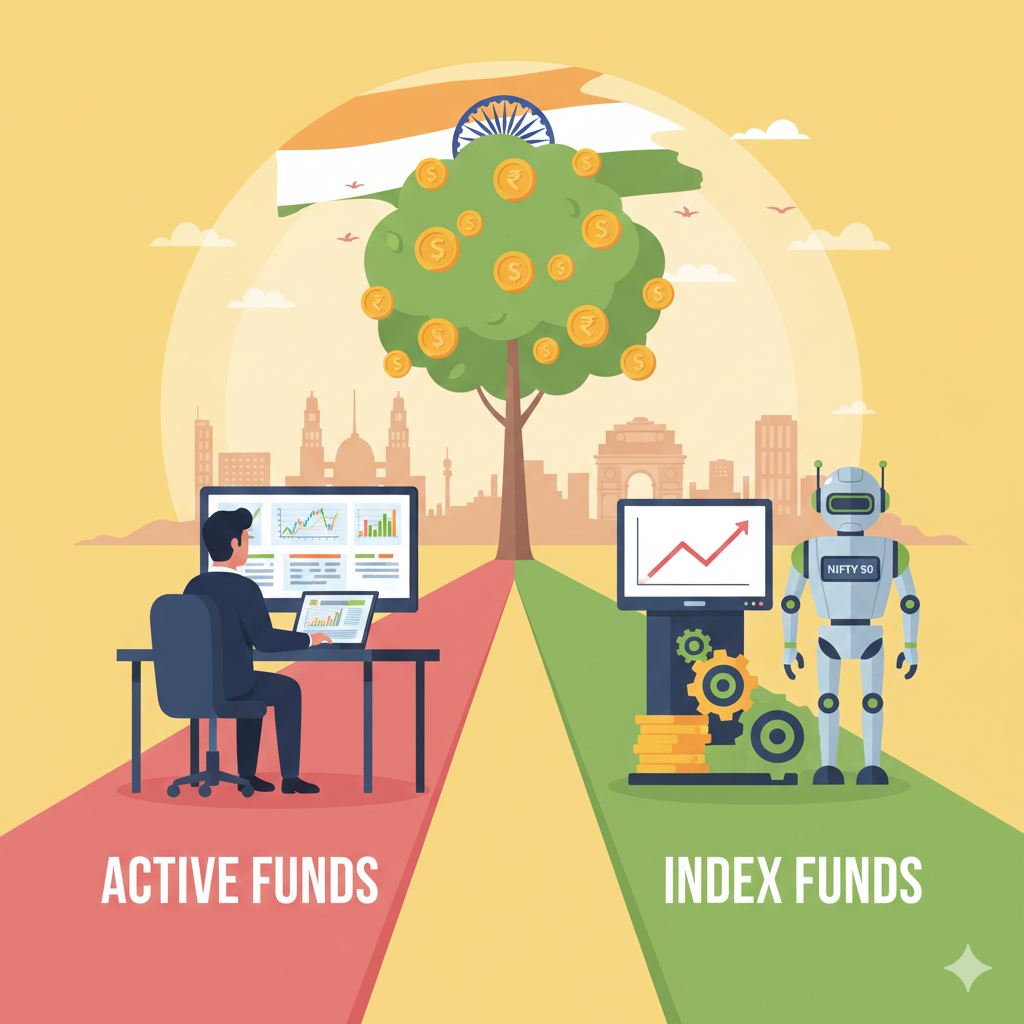
In the world of mutual fund investing, one of the most debated topics is the choice between active and index funds. While active funds promise the potential to outperform the market through expert stock selection, index funds offer a low-cost way to match market returns. For Indian investors, this decision can significantly impact long-term wealth creation.
This blog explores both approaches with real-world Indian examples, performance comparisons, and practical guidance to help you make an informed decision based on your financial goals and risk tolerance.
Understanding Active Funds
What are Active Funds?
Active funds are managed by professional fund managers who actively make investment decisions with the goal of outperforming a specific benchmark index. These managers conduct in-depth research, analyze market trends, and select individual stocks they believe will deliver superior returns.
In the Indian context, active fund managers try to beat popular benchmarks like the Nifty 50, Sensex, or sector-specific indices by identifying undervalued stocks or timing the market correctly.
Pros and Cons of Active Funds
Advantages: Potential for higher returns than the market, flexibility to adapt to market conditions, opportunity to avoid overvalued sectors, and professional management.
Disadvantages: Higher expense ratios (typically 1-2.5% in India), dependency on fund manager skill, potential for underperformance, and higher portfolio turnover leading to tax implications.
Understanding Index Funds
What are Index Funds?
Index funds are passive investment vehicles that aim to replicate the performance of a specific market index. Instead of trying to beat the market, these funds simply try to match it by holding all (or a representative sample) of the securities in the index they track.
In India, index funds typically track benchmarks like Nifty 50, Nifty Next 50, Sensex, or sectoral indices. They maintain a portfolio that mirrors the index composition, with adjustments only when the index itself changes.
Pros and Cons of Index Funds
Advantages: Lower expense ratios (typically 0.1-0.5% in India), consistent market-matching returns, transparency, lower portfolio turnover (better tax efficiency), and elimination of fund manager risk.
Disadvantages: No potential to outperform the market, must accept all index components (even overvalued stocks), and limited flexibility during market downturns.
Head-to-Head Comparison
| Parameter | Active Funds | Index Funds |
|---|---|---|
| Investment Approach | Active stock selection by fund manager | Passively mirrors a benchmark index |
| Primary Goal | Outperform the benchmark index | Match the benchmark index returns |
| Expense Ratio (India) | 1.0% – 2.5% annually | 0.1% – 0.5% annually |
| Portfolio Turnover | High (frequent buying/selling) | Low (only when index changes) |
| Tax Efficiency | Lower due to frequent transactions | Higher due to buy-and-hold strategy |
| Fund Manager Dependency | High (performance tied to manager skill) | None (automated replication) |
| Transparency | Limited (disclosures quarterly) | High (know exactly what you own) |
| Best For | Investors seeking alpha, comfortable with higher costs | Cost-conscious investors, long-term wealth builders |
Real-World Indian Examples (2020-2023 Performance)
| Fund Name | Type | Benchmark | 3-Year Return* | Expense Ratio | Outperformed Benchmark? |
|---|---|---|---|---|---|
| Axis Bluechip Fund (Direct-Growth) | Active Large Cap | Nifty 50 TRI | 14.2% | 0.63% | No (by 1.8%) |
| Mirae Asset Large Cap Fund (Direct-Growth) | Active Large Cap | Nifty 50 TRI | 18.7% | 0.55% | Yes (by 2.7%) |
| UTI Nifty 50 Index Fund (Direct-Growth) | Index Fund | Nifty 50 TRI | 16.0% | 0.20% | Matched (by -0.1%) |
| SBI Nifty 50 Index Fund (Direct-Growth) | Index Fund | Nifty 50 TRI | 16.1% | 0.30% | Matched (by 0.0%) |
| Parag Parikh Flexi Cap Fund (Direct-Growth) | Active Flexi Cap | Nifty 500 TRI | 22.3% | 0.77% | Yes (by 6.3%) |
| ICICI Pru Nifty Next 50 Index Fund | Index Fund | Nifty Next 50 TRI | 19.8% | 0.30% | Matched (by 0.2%) |
*Returns as of December 2023, Source: Value Research, AMFI
Key Insight for Indian Investors
Data from SPIVA India Scorecard shows that over a 10-year period, approximately 75% of Indian active large-cap funds failed to beat their benchmark index. However, in mid-cap and small-cap categories, active managers have shown better ability to outperform. This suggests that for large-cap exposure, index funds might be more efficient, while for mid/small-cap exposure, carefully selected active funds could add value.
Which Should You Choose? Decision Framework
Choosing between active and index funds depends on several factors:
- Market Efficiency: In highly efficient markets like large caps, index funds often win. In less efficient segments like small caps, active management can add value.
- Cost Sensitivity: If you want to minimize costs, index funds are clearly better with expense ratios 3-5 times lower.
- Investment Horizon: For very long-term investments (15+ years), the cost advantage of index funds compounds significantly.
- Risk Appetite: Active funds may take concentrated bets that can lead to higher volatility.
- Tax Considerations: Index funds typically generate fewer capital gains due to lower turnover.
Hybrid Approach: Many Indian investors adopt a core-satellite approach—using index funds for core large-cap exposure (70-80% of portfolio) and actively managed funds for satellite positions in mid/small caps or thematic opportunities (20-30% of portfolio).
Frequently Asked Questions (FAQs)
Historical data shows that over long periods, most active large-cap funds in India fail to consistently beat their benchmark indices after accounting for fees. However, in mid-cap and small-cap segments, skilled active managers have demonstrated better ability to outperform.
No, index funds carry market risk just like any equity investment. If the benchmark index falls, your investment will fall too. They eliminate fund manager risk and underperformance risk but not market risk.
Both are taxed similarly under Indian tax laws—equity funds have a 15% short-term capital gains tax (holding < 1 year) and 10% long-term capital gains tax (holding > 1 year) above ₹1 lakh. However, index funds typically have lower portfolio turnover, which can result in fewer taxable events.
Absolutely! Many savvy investors create a blended portfolio. A common strategy is to use index funds for large-cap exposure (where beating the market is hardest) and selective active funds for mid/small caps or specialized themes where skilled managers might add value.
You can start with as little as ₹100 through Systematic Investment Plans (SIPs) for most mutual funds in India, including both active and index funds. Some funds even allow SIPs of ₹500 per month.
Conclusion
The active vs index fund debate doesn’t have a one-size-fits-all answer for Indian investors. Index funds offer a low-cost, transparent way to capture market returns, particularly in efficient segments like large caps. Active funds, while costlier, provide the potential for outperformance, especially in less efficient market segments.
For most Indian investors, especially beginners, starting with a low-cost Nifty 50 index fund provides a solid foundation. As you build knowledge and portfolio size, you can consider adding selective active funds in areas where they’ve demonstrated consistent skill. Regardless of your choice, the most important decision is to start investing early and stay disciplined.
Remember, in the words of John Bogle, founder of Vanguard: “Don’t look for the needle in the haystack. Just buy the haystack!” This philosophy underpins the index fund approach that has helped millions worldwide build wealth steadily over time.
Start Your Investment Journey Today!
You don’t need large sums to begin building wealth. By investing just ₹100 per day (what you might spend on tea or coffee), you could accumulate over ₹25 lakhs in 20 years assuming a 12% annual return. The power of compounding works best when you start early.
Begin with as little as ₹500 per month in a low-cost index fund and gradually increase your investments as your income grows. The important thing is to start now!
Start Investing From ₹100/DayDisclaimer: Mutual fund investments are subject to market risks. Please read all scheme related documents carefully before investing. Past performance is not indicative of future returns.