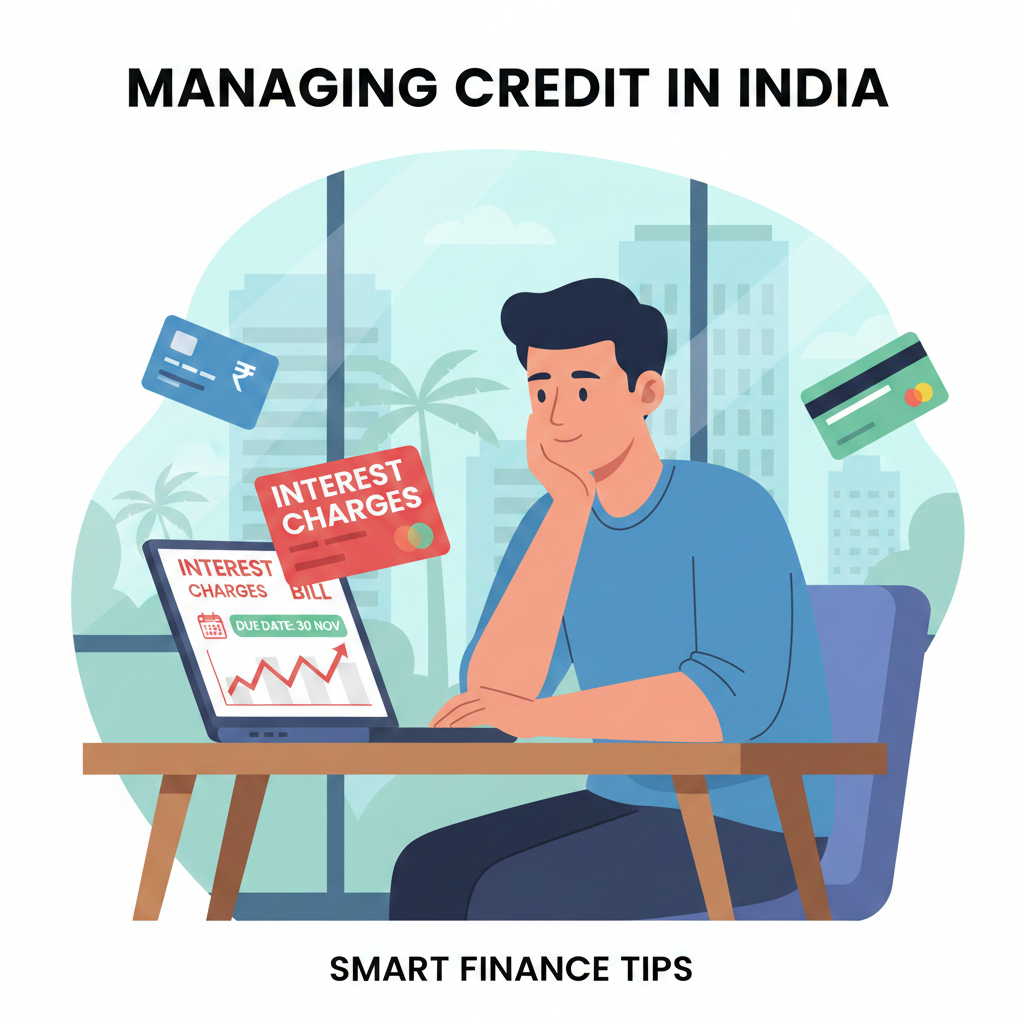

How Credit Card Interest Actually Works in India
A deep-dive guide with a real-life story to help you finally understand what your bank statement is really saying.
Credit cards in India are incredibly powerful tools: they offer rewards, cashback, convenience and short-term interest‑free credit. But the moment you miss a full payment, interest kicks in—and that is where most people start bleeding money without even realising it [web:6]. If you have ever looked at your statement and wondered, “How did my outstanding grow so fast?”, this guide is for you.
In this post, we will unpack how credit card interest is actually calculated in India, what RBI rules say, and how you can use this knowledge to stay out of the debt trap [web:1][web:3][web:4]. To make it easier to relate, we’ll follow the story of Raj, a young professional from Bengaluru, and see how a few small mistakes turned into a big interest burden.
Raj’s Story: From Swipes to Shock
Raj is a 30‑year‑old software engineer living in Bengaluru. Like many of us, he loves convenience, online shopping and reward points. He owns a popular cashback credit card from a leading private bank, with an advertised interest rate of “just 3.5% per month”. That number looks small enough to ignore—until you do the math and realise it is 42% per year [web:6].
One festive season, Raj decided to upgrade his life. He bought a new phone, a smart TV and some furniture on his credit card, totalling ₹70,000. His billing date was the 10th of every month. These purchases happened between 12th and 20th October, so they all appeared in the November 10th statement, with a due date of November 30th.
The statement clearly showed: Total amount due: ₹70,000, and Minimum amount due: ₹3,500. Raj had other expenses that month, so he decided to “play safe” and pay only the minimum. “Next month I’ll manage the rest,” he told himself.
The shock came with the December bill. Despite not swiping the card again, his outstanding had grown, thanks to interest and GST on that interest. And because he did not pay the full amount, the interest‑free period on new purchases had disappeared too [web:4][web:6]. Raj realised he had never really understood how the bank was calculating interest. That’s where most card users go wrong.
Grace Period: The Beautiful Free Ride (Until You Break It)
Every credit card in India offers an interest‑free period, also called the grace period. This is the number of days between the date of purchase and the due date of the statement during which no interest is charged, as long as you pay the full outstanding by the due date [web:4]. Typical grace periods range from 20 to 50 days, depending on when in the billing cycle you spent.
Example:
- Billing cycle: 11th of one month to 10th of next month.
- Statement date: 10th.
- Payment due date: 30th.
If Raj swipes on 12th October, that transaction appears in the 10th November statement, and he has until 30th November to pay. That is roughly 48 days of interest‑free credit. If he pays the entire due of ₹70,000 on or before 30th November, the bank will not charge any interest on those purchases [web:4].
Key point: The grace period applies only if you pay the full amount due. The moment you start revolving—by paying only the minimum or a part of the bill—the interest‑free period on new purchases is lost, and interest is charged from the date of each transaction [web:4].
RBI also mandates that banks must give at least a short grace window before levying late payment charges; many issuers now provide a three‑day grace period for late fees and reporting delays to credit bureaus, though interest on unpaid amounts continues to run until full repayment [web:4][web:7][web:10].
Interest Rates in India: Monthly vs Annual (APR)
Credit card interest in India is usually advertised as a monthly rate—something like “up to 3.5% per month”. It doesn’t sound scary, but converted to an annual percentage rate (APR), it can go as high as 40–50% per year [web:6]. That’s much higher than even personal loans.
| Issuer | Typical monthly rate | Approx. APR |
|---|---|---|
| SBI Card | Up to 3.75% per month | Around 45% per year [web:6] |
| HDFC Bank | 1.99% – 3.75% per month | 23.88% – 45% per year [web:6] |
| ICICI Bank | Around 3.75% per month | About 45% per year [web:6] |
| Axis Bank | 1% – 3.75% per month | 12.68% – 55.55% per year [web:6] |
So, Raj’s “3.5% per month” card is effectively a 42% APR product. Interest is generally calculated on a daily basis on the outstanding amount, then added to the bill at the end of the cycle [web:6].
How Banks Actually Calculate Interest
Most issuers use a variant of the average daily balance method. In simple terms, for each day of the billing cycle, the bank notes your outstanding balance. It then applies the daily interest rate and sums it over the month [web:4][web:6].
Daily interest rate roughly equals:
Monthly rate ÷ 30
So if the monthly rate is 3.5%, the daily rate is around 0.116% (3.5 ÷ 30). If Raj has an outstanding of ₹70,000 for the entire month, the interest for that month will be around:
₹70,000 × 3.5% ≈ ₹2,450
On top of this, GST of 18% is applied on the interest component, making the effective cost even higher [web:6].
The Minimum Payment Trap: How Raj Got Stuck
Credit card statements prominently display a tempting figure: the Minimum Amount Due. This is usually around 5% of the outstanding plus interest and fees, subject to a minimum fixed amount like ₹200–₹500 [web:1][web:3]. RBI’s new guidelines also push banks to structure the minimum in a way that actually reduces principal over time to avoid “negative amortisation”, where interest keeps compounding without the principal ever going down meaningfully [web:1][web:2][web:8].
In Raj’s case:
- Total due: ₹70,000
- Minimum due (say 5%): ₹3,500
He paid just the minimum in November. Now what happens?
- The remaining ₹66,500 continues as revolving credit.
- Interest for the next cycle is calculated on this outstanding from the date of each purchase, not from the statement date [web:4][web:6].
- No interest‑free period on any fresh purchases until the entire outstanding is cleared.
If the monthly interest rate is 3.5%, the interest for the next month could be roughly:
₹66,500 × 3.5% ≈ ₹2,327
With GST on interest, his new bill easily shows a total due of close to ₹69,000 again, even though he hasn’t spent anything new. If he keeps paying only the minimum, it can take several years to clear and he may end up paying almost the original principal again just in interest.
Moral from Raj’s story: The “minimum due” is designed to keep your account from becoming immediately delinquent, not to help you clear debt quickly. It keeps you inside the interest‑earning zone for the bank [web:1][web:3].
RBI Rules You Should Be Aware Of
The Reserve Bank of India has tightened norms to make card billing more transparent and fair. While banks are free to set their interest rates, they must follow certain rules on how they charge and disclose them [web:1][web:3][web:4]. Key points include:
1. Clear Disclosure of Charges
Banks must clearly disclose interest rates, late fees, over‑limit charges, and the method of calculating interest in the MITC (Most Important Terms and Conditions) and on the statement itself [web:3][web:4]. They must also specify whether interest is charged from the transaction date or from the statement date.
2. No Interest on Paid Portions
Interest can only be charged on amounts that remain unpaid after considering your payments, reversals or refunds, not on the portions you have already paid [web:4]. This means if your bill is ₹10,000 and you pay ₹6,000, interest should apply only to the remaining ₹4,000, though in practice the loss of grace period still makes it expensive [web:4][web:5].
3. Structure of Minimum Amount Due
Newer RBI directions discourage struct