
Gold Prices in India 2026: Should You Buy Gold Now or Wait?

Why Is the World Buying Gold in 2026? What Indian Families Must Know Before Buying
Central banks, investors and Indian households are all buying gold, but for very different reasons. Here is what the data shows, what it does not show, and how to decide sensibly.
Why is the world buying gold when prices are already near record levels? And more importantly, what should an Indian family do about it? Here is the twist that makes this story interesting: in April–June 2026, Indians spent about 50% more money on gold than a year earlier, yet they bought about 6% less gold by weight. Rising gold prices, rising investment demand and the actual quantity of gold bought by households are three different things, and mixing them up is how people make expensive decisions.
Central banks buy gold to diversify reserves and reduce dependence on any single currency. Investors buy it as protection against uncertainty. Indian families buy it for weddings, festivals and savings. None of these reasons guarantees that gold will keep rising. Whether you should buy depends on your goal, your time horizon and the form of gold you choose, not on headlines. When prices are high, staged buying of low-cost forms and a modest, goal-based allocation is usually more sensible than a rushed purchase.
Why Is the World Buying Gold? The Global Gold Trend
Why central banks hold gold
A central bank is the institution that manages a country’s money and its foreign-exchange reserves. Those reserves traditionally sit in foreign currencies (mainly the US dollar) and government bonds. Gold is different in three ways:
- It is no one’s liability. A bond is a promise by a government. Gold is an asset without a counterparty, so it cannot default.
- It does not depend on one country’s policies. Foreign-currency reserves can be affected by that country’s interest rates, inflation or sanctions.
- It pays no interest. That is the trade-off. Bonds earn interest, gold does not.
This is why central banks are buying gold as a form of diversification, not as a short-term bet. A family might compare it to keeping some savings in a bank deposit, some in property and some in gold, so that one bad outcome does not hurt everything.
What the numbers actually show
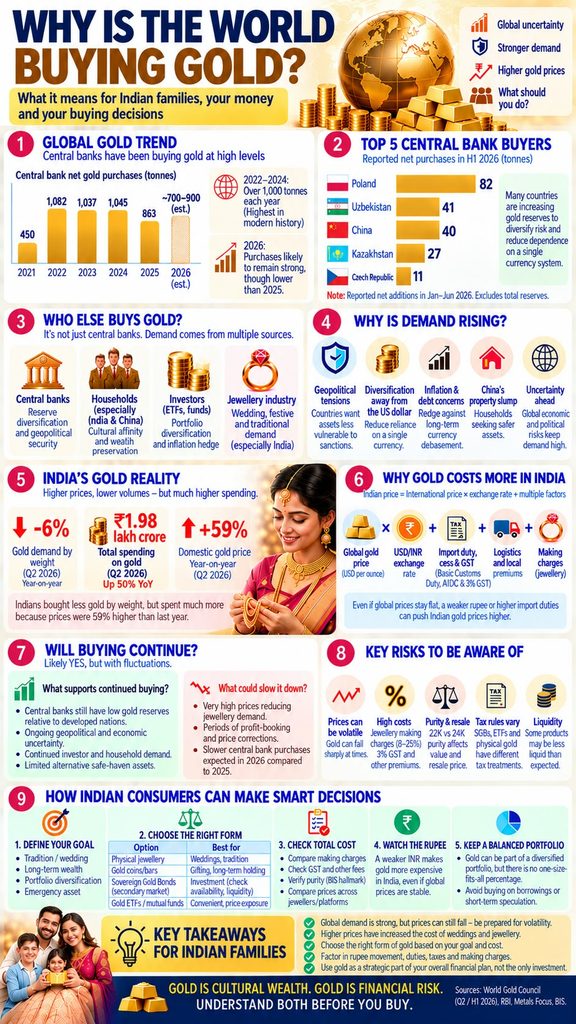
The infographic’s figures were checked against World Gold Council reports. Some hold up, some could not be confirmed, and one needs context.
| Claim | What reported data shows | Status |
|---|---|---|
| Central banks bought 863 tonnes in 2025 | WGC reports about 863 tonnes, roughly 21% lower than 2024 and the lowest since 2021, but well above the 2010–2021 yearly average of about 473 tonnes. | Verified |
| Over 1,000 tonnes a year in 2022–2024 | WGC describes the three years before 2025 as each exceeding 1,000 tonnes. Figures are revised over time, so the exact numbers for individual years may differ from those printed in the infographic. | Broadly verified; exact yearly figures not reproduced here |
| 450 tonnes in 2021; 700–900 tonnes estimated for 2026 | Could not be confirmed from the sources reviewed. WGC’s own commentary earlier in 2026 pointed to demand “close to” 2025 levels, which is not a tonnage forecast. | Unverified: treat as an estimate only |
| Top buyers Jan–Jun 2026: Poland 82, Uzbekistan 41, China 40, Kazakhstan 27, Czech Republic 11 tonnes | Matches WGC’s June 2026 central-bank statistics, which cover publicly reported changes only. WGC data also shows Turkey (about 83 tonnes) and Russia (about 44 tonnes) as net sellers in the same period. | Verified |
| India Q2 2026: demand down about 6%, spending about ₹1.98 lakh crore, up about 50% | WGC reports 131.4 tonnes (down 6% from 139.7 tonnes) and a record ₹1,98,100 crore in value (up 50%). | Verified |
| Domestic gold prices up about 59% year-on-year | Not a headline WGC number, but it is consistent with the data: if grams fell 6% while spending rose 50%, the average price paid rose roughly 59–60%. This is our arithmetic, not an official price series. | Derived estimate |
Also note that H1 2026 central-bank buying was about 345 tonnes, the weakest first half since 2022, although the second quarter rebounded strongly to roughly 289 tonnes. In other words, buying remains historically high, but it is uneven and not rising in a straight line.
Why a top-buyers list does not tell the whole story
The list of leading buyers shows who added the most gold in six months. It does not show who owns the most gold. A country with a small reserve can top the buying chart by adding a few dozen tonnes, while a country with very large holdings may add nothing. Reported figures also exclude purchases that are not disclosed immediately, which WGC says have been significant.
Past central-bank buying does not guarantee future gold-price growth. And a central bank buying gold does not automatically mean that a household should buy gold today. A central bank manages billions in reserves over decades. Your wedding fund, emergency money and retirement savings have very different needs.
Who Else Buys Gold? Four Buyers, Four Motives
Gold demand is not one single force. Four groups drive it, and they behave differently. That is why price, tonnes and rupees spent can all move in different directions.
| Buyer | Main motivation | What influences the buying decision | Important risk or limitation |
|---|---|---|---|
| Central banks | Diversify reserves; reduce reliance on one currency | Geopolitics, reserve strategy, concerns about currency or sanctions risk | Gold pays no interest; some banks also sell when they need cash |
| Indian households | Weddings, festivals, tradition, savings | Occasions such as Akshaya Tritiya, Dhanteras and wedding dates; family budgets; price levels | Jewellery carries making charges and resale deductions, so it is often poor as a pure investment |
| Investors | Portfolio diversification; protection during uncertainty | Interest rates, the US dollar, inflation expectations, market sentiment | Prices can fall sharply; investors may sell quickly and push prices down |
| Jewellers and the jewellery industry | Meeting customer demand; maintaining inventory | Customer affordability, wedding season, import costs and duty | High prices reduce volumes; margins depend on design, labour and stock costs |
Why Gold Prices Are Rising: What Drives Global Gold Demand
When people ask why gold prices are rising, the honest answer is that several forces work together:
- Geopolitical tension and economic uncertainty: when the world feels less predictable, demand for “safe-haven” assets tends to rise.
- Central-bank diversification: steady official buying adds a layer of demand that is less sensitive to short-term price moves.
- Concerns about inflation and currency value: people look for assets that may hold purchasing power over long periods.
- Investor demand: funds, ETFs, bars and coins add demand when sentiment turns cautious.
- Jewellery demand and cultural habit: in India and other large markets, gold is also seen as a store of value that families trust.
How interest rates, the dollar and inflation fit together
Gold pays no interest, so it competes with savings accounts and bonds. What matters most is the real interest rate: the interest rate minus inflation. When real rates fall, the “cost” of holding gold falls and gold becomes more attractive. When real rates rise, holding gold becomes less attractive relative to bonds. Gold is also priced in US dollars internationally, so a stronger dollar can weigh on prices while a weaker dollar can support them.
“Inflation always pushes gold up” and “war always pushes gold up” are not rules. Gold prices can fall during high inflation or geopolitical stress, for example if interest rates rise or the dollar strengthens at the same time. Gold can also fall simply because many investors decided to book profits.
India’s Gold Reality: Spending Up, Grams Down
According to WGC’s Q2 2026 data (April–June), India’s total gold demand was 131.4 tonnes, about 6% lower than a year earlier, while the value of that demand rose about 50% to a record ₹1.98 lakh crore. Within the total, jewellery demand fell about 15% to 75.1 tonnes, while bar and coin demand rose about 9% to 50.3 tonnes, and gold ETFs added around 4.2 tonnes. Retailers also reported more interest in lightweight and lower-carat jewellery.
Value-based demand versus volume-based demand
Volume-based demand counts how many tonnes or grams were bought. Value-based demand counts how many rupees were spent. When prices jump, families can spend more rupees and still receive fewer grams. Both numbers are true at the same time.
These are hypothetical numbers for explanation, not market data.
A family plans to spend ₹2,00,000 on gold. If gold costs ₹10,000 per gram, the budget buys 20 grams. If the price rises 50% to ₹15,000 per gram, the same ₹2,00,000 buys only about 13.3 grams. To still get 20 grams, the family would need ₹3,00,000. That extra ₹1,00,000 is the “price effect”. It does not mean the family suddenly wants more gold.
Why Indian families buy gold even at high prices
- Weddings: a large share of jewellery buying is tied to wedding dates, which cannot easily be postponed.
- Festivals: Akshaya Tritiya and Dhanteras are traditional occasions for buying gold.
- Cultural trust: many families see gold as security that can be passed down.
- Consumption, not only investment: jewellery is something you wear and gift. That is different from buying an asset to sell later.
When prices are very high, however, families often respond by buying lighter pieces, choosing lower-carat or studded designs, postponing discretionary purchases, or shifting to bars, coins or funds. That is consistent with the Q2 pattern of weaker jewellery volumes and stronger bar-and-coin demand.
Why Gold Price in India Differs from International Gold Prices
The gold price in India is not simply the international price. It is built from several layers:
- International gold price, quoted in US dollars.
- The USD/INR exchange rate: India imports almost all its gold, so a weaker rupee raises the rupee price even if the dollar price stays the same.
- Import duty: following reports of a government notification, the total duty on gold was raised from about 6% to about 15% from 13 May 2026 (basic customs duty of 10% plus an agriculture cess of 5%). Duty rules can change, so check the latest official notification.
- GST and other charges: these depend on the product and transaction. GST on gold jewellery is generally 3%, but how it applies to making charges is shown on the invoice.
- Local premiums, transport and distribution costs.
- Jewellery making charges, purity and design.
Not every component is a simple flat percentage added at the end. The final bill depends on the product, the applicable law and how the seller structures the transaction. Investment-grade gold (bars, coins, ETF units) is priced much closer to the underlying metal than jewellery, which includes labour and design costs on top.
Hypothetical numbers for explanation only. This is not a live quote and ignores duty, taxes and premiums.
Suppose gold is priced at $100 per gram internationally, and stays at $100 for the whole year. If the rupee is ₹85 per dollar, gold costs ₹8,500 per gram. If the rupee weakens to ₹90 per dollar, the same $100 gold costs ₹9,000 per gram, a rise of about 5.9%, even though the international price did not move at all. In reality, the global price and the rupee both move, which can either add to or cancel each other.
| Factor | How it can affect prices | Why the relationship is not guaranteed |
|---|---|---|
| International gold price | The base price on which Indian rates are built | Global prices can rise while Indian prices lag, or the reverse, depending on the rupee and local factors |
| USD/INR exchange rate | A weaker rupee raises the rupee price of imported gold | A falling dollar price can offset a weaker rupee |
| Interest rates | Lower real rates can support gold; higher real rates can weigh on it | Gold can still rise or fall for other reasons even when rates are unchanged |
| Geopolitical uncertainty | Can raise safe-haven demand | Prices may already reflect the risk, and gold can fall when tensions ease |
| Inflation expectations | Higher expected inflation can increase interest in gold | If rates rise faster than inflation, gold may not benefit |
| Import duties and taxes | Higher duty can raise domestic prices relative to global prices | The gap can narrow or widen with market conditions, and rules can change |
| Jewellery demand | Strong wedding and festival buying can support local premiums | High prices themselves reduce demand and can cool buying |
Will Gold Buying Continue? Bullish, Neutral and Bearish Views
Nobody can reliably predict the exact future gold price, and this article does not offer a price target. What can be done is to list what could support demand and what could weaken it.
Factors that could support demand
- Continued central-bank diversification.
- Ongoing geopolitical uncertainty.
- Steady investor demand through ETFs, bars and coins.
- Long-term household demand for weddings and savings.
- Concerns about currencies and long-term purchasing power.
Factors that could weaken demand or prices
- High prices reducing jewellery affordability.
- Profit-taking by investors.
- Rising real interest rates.
- A stronger US dollar.
- Easing geopolitical tensions.
- Reduced or reversed central-bank buying (some banks were net sellers in 2026).
- A shift in investor sentiment toward other assets.
Three scenarios, not predictions
- Bullish scenario: uncertainty persists, real rates stay low and official buying stays strong, so prices stay firm.
- Neutral scenario: prices move sideways as strong demand is balanced by weaker jewellery buying and profit-taking.
- Bearish scenario: higher real rates, a stronger dollar and calmer geopolitics lead to a significant price correction.
All three are possible. That is the point: plan for uncertainty instead of betting on one outcome.
Risks of Investing in Gold
Gold has a reputation for safety, but it is not risk-free. The main risks of investing in gold are:
- Price volatility: gold can fall sharply over months or even years.
- Buying after a rapid rise: entering at a peak can mean waiting a long time to break even.
- Making charges: these are paid upfront but may not be returned when you sell.
- Purity and resale deductions: jewellers often deduct for purity, wastage or melting when buying back.
- Liquidity differences: ETF units can be sold on the exchange, while selling jewellery depends on a buyer and their terms.
- Storage and theft: physical gold needs a locker or other safe storage.
- Product-specific taxation: ETFs, gold funds and physical gold are taxed differently.
- Costs and tracking differences: funds and ETFs charge expenses, and their returns can differ slightly from the gold price.
- Opportunity cost: money in gold is not in other assets that may do better, and gold pays no interest or dividends.
- Concentration risk: holding too much of your wealth in gold leaves you exposed to a single asset.
Gold should not replace an emergency fund, retirement planning or a diversified portfolio. If you need money at short notice, you do not want to be forced to sell gold in a falling market.
How Indian Families Can Make Smart Gold-Buying Decisions
If you are wondering should I buy gold now in India, work through these five steps rather than reacting to the headline price. This also works as a simple guide to gold investment for beginners.
Step 1: Define your goal
- Jewellery for weddings or festivals: a consumption decision, driven by date, design and affordability.
- Long-term wealth diversification: an investment decision, driven by cost, liquidity and tax.
- Short-term speculation: high risk; prices can move against you quickly.
- Emergency financial needs: gold may be sold or pledged, but it should not be your only safety net.
- Gifting and cultural purposes: emotional and traditional value matters, and that is a valid reason to buy.
A jewellery purchase and an investment purchase should not be judged by the same yardstick. A necklace you will wear for twenty years should be judged on design and meaning, while a gold ETF should be judged on cost and tracking.
Step 2: Choose the right form of gold
| Gold product | Best suited for | Major advantages | Major disadvantages | Costs or risks to examine |
|---|---|---|---|---|
| Jewellery | Weddings, festivals, gifting, personal use | Can be worn and enjoyed; strong cultural value | Often inefficient as an investment; storage and theft concerns | Making and wastage charges, GST, purity, resale and exchange deductions |
| Coins and bars | Long-term holders who want physical gold without design costs | Lower making cost than jewellery; easy to measure | Storage needed; resale terms vary | Premium over metal value, purity and hallmarking, buyback terms, GST |
| Gold ETFs | Investors comfortable with a demat and trading account | No storage; traded on exchanges; price tracks gold | Needs a demat account; market price can differ slightly from the gold value | Expense ratio, brokerage, tracking difference, taxation |
| Gold mutual funds | Beginners who want an easier route and may prefer SIP-style investing | No separate trading account is usually needed; can invest in small amounts | Layered costs because they typically invest in gold ETFs | Fund expense ratio, exit load if any, tax holding period |
| Existing Sovereign Gold Bonds | Investors who already hold them, or buy them on the exchange | Government-backed; pay fixed interest; track gold | Fresh government issuance is not currently open; exchange prices may be at a discount and liquidity can be thin | Maturity date, exchange price versus gold value, interest, tax rules that changed from 1 April 2026 |
About Sovereign Gold Bonds: no new tranche has been issued since February 2024, and no issuance calendar is currently announced. Existing bonds continue under their original terms, and some series trade on the exchange. Tax and redemption rules differ by bond and date, so check the specific series and RBI announcements before buying or selling. None of these products is risk-free.
Gold ETFs generally need a demat and trading account. Gold mutual funds can be a simpler entry route for people without one. Compare the expense ratio and check the tax holding period (as reported, long-term treatment applies after more than 12 months for listed gold ETFs and more than 24 months for gold mutual funds and physical gold, but confirm current rules).
Step 3: Calculate the total cost
Two shops can quote the same gold rate and still charge very different totals. Compare these items:
- Gold purity: 24-carat, 22-carat or lower; ask what you are actually getting.
- Hallmarking and HUID: jewellery should carry a BIS hallmark with a unique HUID. Verify using official BIS guidance rather than relying on the seller’s word alone.
- Net gold weight: excluding stones, beads and other materials.
- Making charges: check whether they are per gram or a percentage.
- Wastage charges, where applicable.
- GST and other applicable charges.
- Buyback and exchange terms, and what deductions apply when you sell later.
Hypothetical numbers only. Real making charges, GST treatment and buyback terms vary by seller and product.
Assume gold costs ₹10,000 per gram and you buy a 10-gram ornament.
- Gold value: 10 × ₹10,000 = ₹1,00,000
- Making charge at 12%: ₹12,000, so subtotal ₹1,12,000
- GST at 3% on that subtotal (simplified): ₹3,360, so you pay about ₹1,15,360
Later, you sell it back when the gold price is still ₹10,000 per gram. The jeweller pays on gold value only and deducts 5% for purity and melting: ₹1,00,000 − ₹5,000 = ₹95,000. Your loss is about ₹20,360, or roughly 17.6%, even though the gold price did not fall. For you to break even, the price would need to rise to about ₹12,143 per gram, an increase of roughly 21%. That does not make jewellery a bad purchase, because you got to wear it, but it shows why jewellery should not be treated as a pure investment.
Step 4: Consider currency movements
Because India imports gold, how rupee depreciation affects gold prices is important. Revisit Example 2: a weaker rupee can raise your price even when global gold is flat. Rupee weakness reportedly reached record lows in May 2026, which is one reason the government increased import duty to protect foreign-exchange reserves. If both a weaker rupee and higher duty hit at once, domestic prices can rise faster than international prices.
Step 5: Keep a balanced portfolio
Gold may act as a diversifier because it does not always move with shares or bonds. But there is no single correct percentage. Your sensible gold allocation in a portfolio depends on:
- Your goals (a wedding in two years versus retirement in twenty).
- Your time horizon.
- Your risk tolerance.
- What you already own, including jewellery at home.
- Stability of your income.
- How quickly you may need cash.
Diversification does not guarantee profits or prevent losses. A qualified, registered advisor can help set an allocation that suits your situation.
Frequently Asked Questions About Gold Buying in India
1. Why is the world buying gold in 2026?
Several groups have different reasons. Central banks diversify reserves, investors seek protection from uncertainty, and households buy for weddings, festivals and savings. High prices have also lifted the rupee value of purchases even where the quantity bought has fallen.
2. Why are central banks buying gold?
Gold is not another country’s liability, does not depend on one currency, and can diversify reserves held in foreign currencies and bonds. Not every central bank is buying, though; some, such as Turkey and Russia, were net sellers in the first half of 2026.
3. Should I buy gold now in India?
It depends on your goal and time horizon. If you need jewellery for an upcoming wedding, buy based on the date and budget. If it is for investment, consider staged purchases rather than one large purchase at a high price. This is general information, not personal advice.
4. Is gold a good investment when prices are high?
High prices mean you receive fewer grams per rupee, and they raise the risk of a correction. Gold can still play a diversifying role, but it should be a measured part of your savings, not a bet on the price rising further.
5. Why are gold prices rising in India?
Higher international prices, a weaker rupee, higher import duty (about 15% since 13 May 2026, as reported) and strong investment demand all contribute. Which factor matters most changes over time.
6. Can gold prices fall after reaching record highs?
Yes. Gold has fallen after earlier peaks. Rising real interest rates, a stronger dollar, calmer geopolitics or investor profit-taking can all reduce prices.
7. Does a weaker rupee make gold more expensive?
Generally yes, because gold is priced in dollars internationally and India imports it. If the dollar price falls at the same time, the effect can be offset.
8. Is jewellery a good investment?
Usually not as a pure investment, because making charges and resale deductions reduce what you recover. It can still be worthwhile for wearing, gifting and tradition.
9. Are gold ETFs better than physical gold?
ETFs avoid storage and making charges and are easy to trade, but need a demat account and carry expenses and tracking differences. Physical gold offers tangibility but has storage, purity and resale considerations. “Better” depends on your purpose.
10. Are gold mutual funds suitable for beginners?
They can be, because they offer a simple way to start with small amounts without a separate trading account. Check the expense ratio and the tax holding period first.
11. How much gold should an Indian investor hold?
There is no single right percentage. It depends on your goals, time horizon, risk tolerance, existing holdings (including family jewellery) and liquidity needs. A registered advisor can help.
12. Can gold protect savings against inflation?
Over long periods gold has often helped preserve purchasing power, but it does not do so every year. As an inflation hedge it is imperfect, so treat it as one tool, not a guarantee.
13. What should I check before buying gold jewellery?
Check the BIS hallmark and HUID, purity, net weight, making and wastage charges, GST on the invoice, and the shop’s buyback and exchange policy. Compare the final price, not just the daily gold rate.
14. Should I buy gold in one lump sum or in stages?
Staged buying (for example, monthly) spreads your purchase price over time and reduces the risk of buying everything at a peak. It does not guarantee a better outcome, but it can make decisions calmer.
Tax rates, import duty and regulations can change. Check current guidance from the Income Tax Department, CBIC, RBI and BIS before acting.
Conclusion: Why Is the World Buying Gold, and What Should You Do?
So, why is the world buying gold? Central banks want diversification, investors want protection from uncertainty, and Indian families have always valued gold for weddings, festivals and security. But the headline numbers can mislead: Indians spent far more rupees in Q2 2026 while buying fewer grams, and that is mostly a price story.
- Separate your goal: jewellery, investment, gifting or emergency.
- Do not follow central banks blindly; their goals and time horizons differ from yours.
- Compare the total cost of jewellery, including making charges, GST and resale deductions.
- Remember that rupee weakness and import duty can raise Indian prices even when global gold is flat.
- Consider staged buying instead of one large purchase at a high price.
- Keep gold as one part of a diversified plan, and keep your emergency fund separate.
Sources and Further Reading
- World Gold Council: Gold Demand Trends Q2 2026, Central Banks
- World Gold Council: Central bank gold statistics, June 2026
- World Gold Council: Gold Demand Trends, India Focus Q2 2026
- World Gold Council: Gold Demand Trends Full Year 2025, Central Banks
- World Gold Council: India gold market update, import tightening (May 2026)
- PTI report: Gold imports drop after customs duty hike (June 2026)
- Reserve Bank of India (Sovereign Gold Bond announcements)
- Bureau of Indian Standards (hallmarking guidance)
- CBIC (customs and GST information)
- Income Tax Department (capital gains rules)
Disclaimer: This article is for general education only. It is not personalised investment, tax or legal advice, and it does not predict future gold prices. Illustrative examples use hypothetical numbers. Gold and all other investments carry risk, and past performance does not guarantee future results. Consider consulting a SEBI-registered investment advisor or a qualified tax professional.

Disclaimer: InvestmentSutras is an educational initiative. All articles and assessments are for educational and learning purposes only. This should not be treated as investment advice or recommendation. Please consult a registered investment advisor before acting on any suggestions.