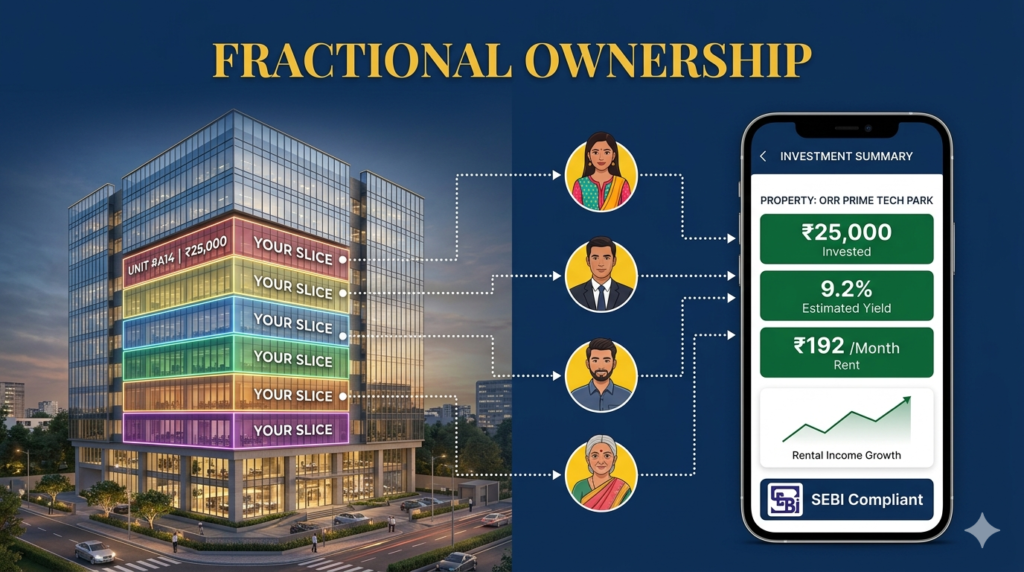

Imagine earning rent from a swanky Grade-A office building in Bangalore’s Outer Ring Road — the kind of property where MNCs pay ₹80–120 per sq.ft. every month. For decades, this was a privilege reserved for high-net-worth individuals with crores to spare. A salaried software engineer in Pune or a small business owner in Coimbatore simply couldn’t afford the ticket price.
That era is over. Fractional ownership of commercial real estate has democratized one of India’s most powerful wealth-building asset classes. Today, you can co-own a premium commercial property with as little as ₹25,000 and start earning passive rental income — just like a landlord, without the landlord headaches.
In this comprehensive guide, you’ll learn exactly what fractional ownership is, how it works in the Indian context, the best platforms available in 2026, realistic return expectations, tax implications, risks to watch, and how to take your first step — even if you’re a complete beginner.
📋 Table of Contents
- What Is Fractional Ownership in Real Estate?
- How Does It Work in India?
- Types of Properties You Can Invest In
- Top Fractional Ownership Platforms in India (2026)
- What Returns Can You Realistically Expect?
- Fractional Ownership vs REITs vs Direct Real Estate
- Tax Implications You Must Know
- Expert Tips for First-Time Investors
- Real-Life Case Study: Ramesh’s ₹25,000 Journey
- Common Mistakes to Avoid
- FAQs
- Conclusion
1. What Is Fractional Ownership in Real Estate?
Fractional ownership means that multiple investors collectively own a high-value asset — in this case, commercial real estate — by pooling their money. Each investor holds a proportional share of the property and earns proportional income (rent) and appreciation.
Think of it like this: A premium office building worth ₹50 crore is divided into 2,000 fractions. Each fraction costs ₹25,000. You buy one fraction, and you own 1/2000th of that building. When the building earns ₹3 crore in annual rent, your share is ₹1,500 per year — deposited directly into your account.
Fractional ownership = Owning a % of a premium property that you couldn’t afford alone, while earning proportional rental income and capital appreciation — managed by a professional platform.
The concept isn’t new globally — timeshares, real estate syndicates, and REITs have existed for decades. But technology-enabled fractional ownership platforms are the new evolution. They use SPVs (Special Purpose Vehicles), digital contracts, and SEBI-registered frameworks to make it accessible, transparent, and legally sound for retail investors.
Why Is This Suddenly Possible in India?
Several converging factors have enabled this:
- SEBI’s SM REIT Regulations (2024): The Securities and Exchange Board of India introduced the Small and Medium Real Estate Investment Trust (SM REIT) framework, providing a regulated path for fractional ownership platforms.
- Digital Infrastructure: UPI, e-KYC, and digital wallets make onboarding and transactions seamless.
- Rise of PropTech Platforms: Companies like Strata, hBits, PropertyShare, and Grip Invest have built robust technology layers.
- Growing Middle-Class Demand: Indian investors are increasingly seeking inflation-beating, passive income assets beyond FDs and mutual funds.
2. How Does It Work in India? Step-by-Step
Here’s the exact process of how fractional ownership operates in the Indian market:
Step 1: Platform Lists a Property
A fractional ownership platform identifies and acquires (or partners to list) a premium commercial asset — a Grade-A office building, a warehouse, a retail space, or a co-working hub. The property is thoroughly vetted: location, tenant quality, lease duration, title clarity, and valuation.
Step 2: Property Is Structured via an SPV
A Special Purpose Vehicle (SPV) — typically a Private Limited Company or LLP — is created specifically for this property. Investors buy shares or units in this SPV, which legally holds the property. This structure protects your investment and provides clear ownership rights.
Step 3: You Invest Your Share
You sign up on the platform, complete KYC, and choose how much to invest (starting from ₹25,000 on some platforms). Funds are pooled from all investors. The SPV uses these funds to acquire the property.
Step 4: Rent Gets Distributed
The commercial tenant (usually a corporate client on a long-term lease of 3–9 years) pays rent monthly. After deducting platform fees and maintenance costs, your proportional rent share is transferred to your registered bank account — often monthly or quarterly.
Step 5: Exit When You Want
Most platforms offer exit options: either via a secondary market (selling your units to another investor) or a planned exit when the SPV sells the property (typically after 3–5 years), distributing capital gains proportionally.
Fractional ownership is not as liquid as mutual funds or stocks. Secondary markets are still developing in India. Plan for a minimum holding horizon of 3–5 years before you invest.
3. Types of Properties You Can Invest In
Not all commercial real estate is created equal. Here’s what’s commonly available on Indian fractional ownership platforms:
| Property Type | Example Locations | Typical Yield | Tenant Profile |
|---|---|---|---|
| Grade-A Office Spaces | Bangalore ORR, Mumbai BKC, Hyderabad HITEC City | 7%–10% per annum | MNCs, IT companies, banking firms |
| Industrial/Warehouses | Pune, Chennai, NCR logistics hubs | 8%–12% per annum | E-commerce, FMCG, manufacturing |
| Retail/Mall Spaces | Tier-1 cities, mall anchor stores | 6%–9% per annum | Retail chains, QSR brands |
| Co-working Hubs | Bangalore, Mumbai, Delhi | 8%–11% per annum | Startups, freelancers, enterprises |
| Data Centers | Mumbai, Hyderabad, Chennai | 9%–13% per annum | Cloud companies, telecom |
For a first-time fractional investor, Grade-A office spaces with MNC tenants on long-term leases are generally the safest entry point — stable rent, lower vacancy risk, and strong capital appreciation potential.
4. Top Fractional Ownership Platforms in India (2026)
Several platforms have emerged in India’s fractional ownership space. Here’s an overview of the key players. Always verify their current SEBI registration and SM REIT compliance before investing.
1. Strata
One of India’s pioneers in fractional CRE investment. Strata offers curated office and warehouse properties. Minimum investment varies by deal, and the platform provides detailed financial due diligence reports for every listed property.
2. hBits
hBits focuses on Grade-A commercial properties in Tier-1 cities. Known for transparent reporting and regular investor communications. They list properties with existing tenants and established lease agreements, reducing uncertainty.
3. PropertyShare
PropertyShare targets high-yield commercial properties including offices and warehouses. They have also started listing opportunities with international institutional-grade tenants, offering potentially stronger lease covenants.
4. Grip Invest
While broader in scope (also covers bonds and leasing), Grip Invest includes real estate-linked instruments. Good for beginners looking for diversified alternative investments starting at lower ticket sizes.
5. WiseX (by Nikhil Kamath’s group)
A newer entrant that’s gained significant traction. WiseX aggregates alternative investment products including fractional real estate, targeting India’s growing base of young, digitally-savvy investors.
- Is the platform SEBI-registered or compliant with SM REIT norms?
- Are properties held via a clearly structured SPV?
- Is there a third-party trustee or custodian?
- What are the total fees (platform fee, management fee, exit fee)?
- Is there a secondary market for early exit?
- How are rental distributions handled (monthly/quarterly)?
5. What Returns Can You Realistically Expect?
Return expectations from fractional commercial real estate ownership in India have two components:
A. Rental Yield (Regular Income)
Most platforms target a rental yield of 7%–11% per annum on invested capital. This is significantly higher than bank FDs (currently 6.5%–7.5%) and comparable to or better than dividend yields from equity funds.
Example: If you invest ₹5 lakh at an 8% annual rental yield, you earn ₹40,000 per year — about ₹3,333 per month.
B. Capital Appreciation
When the property is sold (typically after 3–7 years), any increase in property value is distributed to investors. Premium commercial real estate in India’s top cities has historically appreciated at 5%–15% over a 5-year hold period, depending on location and demand. However, this is not guaranteed and depends on market conditions.
C. Total Return (IRR)
When you combine rental income + capital appreciation, many platforms project an Internal Rate of Return (IRR) of 12%–18% per annum. Actual results vary significantly based on property quality, market cycles, and exit timing.
Projected returns on marketing materials often represent best-case scenarios. Always stress-test with conservative assumptions: What if the tenant vacates? What if there’s a 6-month vacancy? What if the property sells at a discount? A good investment should still make sense under pessimistic scenarios.
6. Fractional Ownership vs REITs vs Direct Real Estate
| Feature | Fractional Ownership | REITs | Direct Real Estate |
|---|---|---|---|
| Min. Investment | ₹25,000 – ₹10 lakh | ₹300 – ₹500 (1 unit) | ₹50 lakh+ |
| Liquidity | Low (secondary market) | High (stock exchange) | Very Low |
| Diversification | Single property | Portfolio of properties | Single property |
| Control | No direct control | No control | Full control |
| Rental Yield | 7%–11% | 5%–8% | 2%–4% (net) |
| Management Hassle | None (platform managed) | None (REIT managed) | High |
| SEBI Regulation | SM REIT (evolving) | Fully regulated | No securities regulation |
| Transparency | Platform-dependent | Very high (listed) | Varies |
Key Insight: REITs are better for liquidity and diversification. Fractional ownership may offer higher yields and more targeted property exposure. Direct real estate offers maximum control but requires crores and significant effort. The ideal portfolio might include all three in proportion to your goals.
📌 Also Read on Investment Sutras
7. Tax Implications You Must Know
Taxation on fractional ownership returns can be complex. Here’s a simplified breakdown for Indian investors:
Rental Income
Your share of rental income is treated as “Income from House Property” under the Income Tax Act. It will be added to your total income and taxed at your applicable slab rate (5%, 20%, or 30%). A standard deduction of 30% on the net annual value is typically available.
Capital Gains on Property Sale
- Short-Term Capital Gains (STCG): If the property is sold within 24 months of acquisition, gains are taxed at your income slab rate.
- Long-Term Capital Gains (LTCG): If held for more than 24 months, gains are taxed at 20% with indexation benefit (or 12.5% without indexation under the updated regime — verify current rules).
SM REIT-Structured Returns
If the platform operates under SEBI’s SM REIT framework, the tax treatment may differ and could be more favorable. Consult a CA familiar with real estate investment taxation before investing.
If you invest through an SPV (company structure), dividend distribution tax rules may apply. Always ask the platform for a clear tax breakdown document before committing capital. Hire a CA to file your returns the first time you receive rental income from fractional ownership.
8. Expert Tips for First-Time Fractional Investors
- Start Small, Learn First: Invest ₹25,000–₹1 lakh in your first deal. Understand how the platform works, how distributions arrive, and how reporting is done before scaling up.
- Prioritize Tenant Quality: A property leased to an MNC or listed company on a 5-year lock-in is infinitely safer than one with a small startup on a 1-year lease. Tenant quality = income stability.
- Check Occupancy Rate: Is the property already leased and generating income? Avoid “future income” projections from vacant properties.
- Read the SPV Documents: The Shareholders’ Agreement and SPV documentation define your rights. Don’t skip this. If you can’t understand it, get a lawyer to review it.
- Diversify Across Properties: Don’t put all ₹5 lakh into one property. Spread across 3–4 deals on the same or different platforms to reduce concentration risk.
- Understand Exit Mechanisms: Before you invest, know your exit options. Is there a secondary market? What happens if you need money in 2 years?
- Don’t Chase Yield Alone: A 15% projected yield from a dodgy property in a bad location is more dangerous than a 9% yield from a Grade-A building with a blue-chip tenant.
9. Real-Life Case Study: Ramesh’s ₹25,000 Journey
Background: Ramesh, 34, works as a software developer in Pune. He earns ₹14 lakh per year and already has SIPs running in mutual funds. He wanted passive rental income but couldn’t afford to buy a commercial property. He discovered a fractional ownership platform through a financial blog.
First Investment (2022): He invested ₹25,000 in a fractional deal for a co-working hub in Koregaon Park, Pune. The property was already fully leased to an established co-working operator at ₹85/sq.ft.
What He Earned: His annual rental yield was approximately 9.2% — translating to ₹2,300 per year, or roughly ₹192 per month. Small, but real passive income.
Scale-Up (2023–2025): Encouraged by the experience, Ramesh gradually increased his total fractional real estate portfolio to ₹4.5 lakh across 3 properties: a warehouse in Chakan, an office space in Hinjawadi IT Park, and the original co-working hub.
Current Monthly Income: His fractional real estate portfolio now generates approximately ₹3,100–₹3,500 per month in rental income — enough to cover his EMI for a two-wheeler, automatically. One property was sold after 3 years, delivering a 14% IRR including capital appreciation.
Ramesh’s Advice: “Start with money you won’t need for 4–5 years. Read everything about the property before investing. The income is genuinely passive — I spend maybe 20 minutes a month reviewing statements.”
*This is an illustrative case study based on typical investor experiences. Individual results will vary. This is not investment advice.
10. Common Mistakes to Avoid
- Investing in Unlisted/Unregulated Platforms: Verify SEBI registration. Several unregulated schemes promise “guaranteed returns” on real estate — these can be fraudulent.
- Ignoring the Fine Print on Fees: Some platforms charge 2–3% upfront fee + 1–2% annual management fee + exit fee. These can significantly dent your actual yield.
- Treating Projected Returns as Guaranteed: Projections are not promises. If the tenant vacates, income stops. If the property market dips, capital gains may not materialize.
- Not Maintaining Liquidity Elsewhere: This is an illiquid investment. Never put emergency funds or money needed within 2 years into fractional real estate.
- Over-concentrating in One Property: Even experienced investors sometimes put too much into a single deal. Diversify.
- Skipping Tax Planning: Failing to account for rental income in your ITR can lead to scrutiny and penalties. Declare all income.
- FOMO-driven Investing: Just because a deal has “only 48 hours left” doesn’t mean you must invest. Artificial urgency is a red flag.
- SEBI Official Website — Check registration status of platforms
- Income Tax India — For tax guidance on rental income and capital gains
- Reserve Bank of India — For updates on real estate financing regulations
11. Frequently Asked Questions (FAQs)
12. Conclusion: Start Small, Think Big
Fractional ownership of commercial real estate is one of the most exciting developments in Indian personal finance in the last decade. It tears down the crore-worth barriers that kept premium commercial property exclusive to the ultra-wealthy — and brings Grade-A office parks, logistics hubs, and retail spaces within reach of the salaried class.
Here’s your action plan to get started:
- ✅ Research 2–3 SEBI-compliant fractional ownership platforms
- ✅ Start with a small amount (₹25,000–₹1 lakh) to understand the process
- ✅ Choose a property with an existing blue-chip tenant and a long lease lock-in
- ✅ Read the SPV documents and fee structure carefully
- ✅ Consult a CA for tax planning before your first investment
- ✅ Never invest money you might need in the next 3 years
- ✅ Diversify across properties once you’re comfortable
The Indian commercial real estate sector continues to grow driven by IT expansion, e-commerce logistics, and institutional demand. With the right due diligence, fractional ownership can become a meaningful pillar of your passive income strategy — one ₹25,000 slice at a time.
📚 Explore More on Investment Sutras