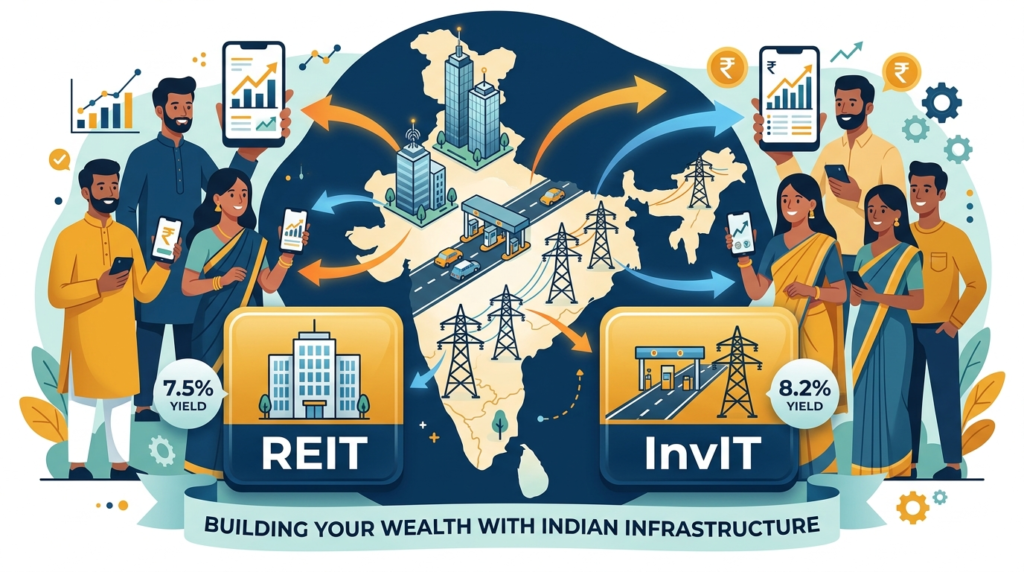

How to Invest in REIT and InvIT in India: The Complete Beginner’s Guide (2026)
Imagine owning a slice of a premium Grade-A office building in Bangalore’s Whitefield, or a stake in a pan-India highway network — all without spending crores of rupees. Sounds like a dream? Thanks to REITs (Real Estate Investment Trusts) and InvITs (Infrastructure Investment Trusts), this is now possible for every Indian investor with as little as ₹10,000–₹15,000.
In this complete guide, you’ll learn exactly what REITs and InvITs are, how they work, how to buy them step-by-step, the tax implications, risks to watch out for, and whether they’re right for your portfolio in 2026.
📋 Table of Contents
- What is a REIT? Simple Explanation
- What is an InvIT? Simple Explanation
- REIT vs InvIT: Key Differences
- How Do REITs and InvITs Work in India?
- Listed REITs and InvITs in India (2026)
- How to Invest in REIT and InvIT Step-by-Step
- Tax on REIT and InvIT Income in India
- Expert Tips & Key Insights
- Real-Life Case Study
- Common Mistakes to Avoid
- FAQs
- Conclusion
1. What is a REIT? A Simple Explanation for Indian Investors
A Real Estate Investment Trust (REIT) is a company that owns, operates, or finances income-generating real estate properties. Think of it as a mutual fund — but instead of stocks or bonds, the underlying assets are real estate properties like commercial offices, malls, hotels, or warehouses.
In India, REITs were introduced by SEBI (Securities and Exchange Board of India) and are regulated under the SEBI (Real Estate Investment Trusts) Regulations, 2014. They allow retail investors to participate in the commercial real estate market, which was previously accessible only to ultra-HNIs and institutional players.
How Does a REIT Generate Returns?
- Rental Income: The REIT collects rent from tenants (usually large corporations) and distributes a significant portion as dividends to unit holders.
- Capital Appreciation: As the value of underlying properties rises, the unit price of the REIT also increases.
- Mandatory Distribution: SEBI mandates that REITs distribute at least 90% of their net distributable cash flows to investors every 6 months.
2. What is an InvIT? Infrastructure for Your Portfolio
An Infrastructure Investment Trust (InvIT) works exactly like a REIT — but instead of real estate, the underlying assets are infrastructure projects such as:
- 🛣️ Highways and toll roads
- ⚡ Power transmission lines
- 🔌 Gas pipelines
- 📡 Telecom towers
- 🏭 Renewable energy assets
InvITs are governed by SEBI (Infrastructure Investment Trusts) Regulations, 2014. Like REITs, they pool money from multiple investors to buy and manage infrastructure projects, and regularly distribute the income generated.
Infrastructure assets typically generate stable, long-term cash flows due to government-backed contracts, toll agreements, and long-duration PPAs (Power Purchase Agreements). This makes InvITs attractive for income-seeking investors.
3. REIT vs InvIT: Understanding the Key Differences
| Parameter | REIT | InvIT |
|---|---|---|
| Underlying Asset | Commercial Real Estate | Infrastructure Projects |
| Asset Examples | Office parks, malls, warehouses | Highways, power lines, pipelines |
| Regulator | SEBI | SEBI |
| Distribution Mandate | Min. 90% of NDCF every 6 months | Min. 90% of NDCF every quarter |
| Minimum Investment | ~₹300–₹400 per unit (1 unit) | ~₹100–₹200 per unit (1 unit) |
| Risk Profile | Moderate | Moderate to High |
| Income Stability | High (long-term office leases) | Moderate (project risk exists) |
| Listed on Exchange? | Yes (NSE, BSE) | Yes (NSE, BSE) — some are private |
4. How Do REITs and InvITs Work in India?
Understanding the structure helps you invest more confidently. Here’s a simplified breakdown of the REIT/InvIT structure in India:
The REIT/InvIT Structure
- Sponsor: A real estate or infrastructure company creates the trust and initially contributes assets.
- Trustee: An independent trustee (registered with SEBI) holds the assets and ensures compliance.
- Manager: A management company handles day-to-day operations, acquisitions, and distributions.
- Unit Holders (Investors): That’s you! You buy units and receive proportional income.
The Money Flow
Tenants or project users → pay rent/tolls/tariffs → to the REIT/InvIT → which distributes 90%+ as dividends → to unit holders (you).
5. Listed REITs and InvITs in India (2026)
🏢 Listed REITs in India
| REIT Name | Sponsor | Key Assets | Exchange |
|---|---|---|---|
| Embassy Office Parks REIT | Embassy Group + Blackstone | Office parks across Bangalore, Mumbai, Pune, NCR | NSE, BSE |
| Mindspace Business Parks REIT | K Raheja Corp + Blackstone | Office parks in Hyderabad, Mumbai, Pune, Chennai | NSE, BSE |
| Brookfield India Real Estate Trust | Brookfield Asset Management | Grade-A offices in NCR, Mumbai, Kolkata, Pune | NSE, BSE |
| Nexus Select Trust | Blackstone | Premium retail malls across India | NSE, BSE |
🛣️ Listed Public InvITs in India
| InvIT Name | Sponsor | Key Assets | Exchange |
|---|---|---|---|
| IRB InvIT Fund | IRB Infrastructure | Toll road projects across India | NSE, BSE |
| IndInfravit Trust | L&T Infrastructure | Highway projects | NSE, BSE |
| PowerGrid InvIT | Power Grid Corporation of India | Power transmission assets | NSE, BSE |
| India Grid Trust (IndiGrid) | Sterlite Power | Power transmission network | NSE, BSE |
| Highways Infrastructure Trust | National Highways Infra Trust (NHAI) | Highway projects | NSE, BSE |
6. How to Invest in REIT and InvIT in India: Step-by-Step
Investing in REITs and InvITs is very similar to buying stocks. Here is your complete, step-by-step guide:
Open a Demat and Trading Account
You need a Demat account with a registered stockbroker. Popular options for Indian investors include Zerodha, Groww, Upstox, HDFC Securities, ICICI Direct, or Angel One. Complete your KYC (PAN card + Aadhaar + bank account details). This typically takes 24–48 hours for digital KYC.
Add Funds to Your Trading Account
Transfer funds via UPI, NEFT, or IMPS from your bank account to your trading account. You’ll need a minimum of around ₹300–₹500 for REITs (price of one unit) and about ₹100–₹200 for most InvITs. However, it’s advisable to invest a meaningful amount for better returns.
Search for the REIT or InvIT on Your Broker’s Platform
Log in to your broker’s app or website. In the search bar, type the name of the REIT or InvIT (e.g., “Embassy REIT”, “PowerGrid InvIT”). You can also search by their NSE/BSE ticker symbols.
Analyse Before You Buy
Before placing an order, review the following:
- Distribution Yield: Annual distributions as a % of unit price. Aim for 6–8%+ for REITs.
- Occupancy Rate: For REITs, higher is better. 90%+ is healthy.
- Net Asset Value (NAV): Compare market price to NAV to check if it’s trading at a discount or premium.
- Debt Levels: REITs and InvITs often carry debt. Check the Loan-to-Value (LTV) ratio.
- Sponsor Quality: A reputable, financially strong sponsor reduces risk significantly.
Place Your Buy Order
Select the REIT or InvIT, choose the number of units, and place a Market Order (buy at current price) or a Limit Order (buy only at a specific price you set). Units are settled in your Demat account within T+1 day (next trading day).
Track Your Investment and Receive Distributions
Once you hold units, you’ll start receiving quarterly or semi-annual distributions directly in your bank account. You can track your holdings in your Demat account. Reinvest the distributions for compounding, or use them as regular income.
7. Tax on REIT and InvIT Income in India (2026)
Taxation on REIT and InvIT income can be complex because the distributions can be of different types. Here’s a clear breakdown:
Components of REIT/InvIT Distributions
- Interest Income: Taxable in the hands of the investor at their applicable income tax slab rate.
- Dividend Income: Taxable at slab rate in the hands of the investor (post-2020 rules).
- Return of Capital (Amortization): Not taxable immediately, but reduces the cost of acquisition (impacts capital gains when you sell).
- Capital Gains Component: Taxable as per capital gains rules.
Capital Gains Tax on Sale of Units
| Holding Period | Type | Tax Rate |
|---|---|---|
| Less than 12 months | Short-Term Capital Gain (STCG) | 20% (post-July 2024 Budget) |
| More than 12 months | Long-Term Capital Gain (LTCG) | 12.5% (above ₹1.25 lakh gain) — post-July 2024 Budget |
8. Expert Tips and Key Insights
- 🎯 Think of REITs as bond + equity hybrids: They offer regular income like bonds but also have equity-like capital appreciation potential. Ideal for investors in the 40–55 age bracket seeking stable income.
- 📊 Compare Distribution Yield, not just unit price: A cheaper unit isn’t necessarily better. A REIT at ₹350/unit with 8% yield is more attractive than one at ₹200/unit with 4% yield.
- 🏗️ Check the WALE (Weighted Average Lease Expiry): A high WALE (e.g., 6–7 years) means lease renewals are far away, ensuring income stability.
- 💰 Reinvesting distributions multiplies wealth: If you reinvest the quarterly distributions back into buying more units, compounding kicks in and significantly boosts long-term returns.
- 🔍 Diversify across REITs and InvITs: Don’t put all your money in one REIT. Diversify across office REITs, retail REITs, and InvITs (highways, power) to spread sector risk.
- 📅 Track the Record Date: To receive a distribution, you must hold the units before the record date declared by the REIT/InvIT. Plan your purchases accordingly.
- 🌍 Follow institutional flows: FII (Foreign Institutional Investor) buying in REITs is a positive signal for long-term price stability.
📖 Also Read on Investment Sutras
- 7 Best Mutual Funds for SIP in 2025: Expert-Picked Picks Every Indian Investor Must See
- What is XIRR in Mutual Fund? Meaning, Full Form, Formula & How to Calculate It
- I Invested ₹1007 Every Month for 23 Years — Here’s How It Saved Me When I Lost My Job
- Teaching Kids About Money in India: Age-by-Age Guide 2026
9. Real-Life Case Study: Ramesh’s Journey with Embassy REIT
📘 Case Study: A Bengaluru IT Professional Discovers Passive Real Estate Income
Background: Ramesh, a 38-year-old software engineer from Bengaluru, always wanted to invest in real estate but couldn’t afford to buy a commercial property. He had ₹3 lakhs in savings and wanted passive income.
What He Did: In early 2022, Ramesh opened a Zerodha account and invested ₹2.5 lakhs in Embassy Office Parks REIT by purchasing approximately 700 units at around ₹357/unit. He also invested ₹50,000 in PowerGrid InvIT for sector diversification.
Results Over 2+ Years:
- He received regular semi-annual distributions from Embassy REIT (roughly ₹21–₹23 per unit per year), adding up to ~₹15,000–₹16,000 annually in his bank account.
- The InvIT provided quarterly distributions, adding another ₹3,000–₹4,000 per year.
- Over the period, he benefitted from both income distributions and some capital appreciation on his units.
Key Lesson: Ramesh effectively became a co-owner of some of Bengaluru’s most premium commercial properties — without any property management headaches. His total annual passive income from these investments crossed ₹18,000–₹20,000 per year — nearly a 7% yield on his invested capital.
Note: This is an illustrative example for educational purposes. Past performance does not guarantee future returns. Please do your own research before investing.
10. Common Mistakes to Avoid When Investing in REITs and InvITs
- ❌ Chasing high yield blindly: An unusually high distribution yield (above 10–12%) can be a red flag. It may indicate the unit price has fallen sharply due to underlying problems. Always investigate why the yield is high.
- ❌ Ignoring occupancy rates (for REITs): A REIT with falling occupancy (say, below 80%) will face rental income pressure soon. Don’t ignore this metric.
- ❌ Not accounting for all taxes: Many investors only think about capital gains but forget that interest and dividend components of distributions are taxed at slab rates. Factor in your total tax outgo.
- ❌ Overconcentrating in one REIT: Putting your entire investment in a single REIT or InvIT concentrates your risk in one sector and geography. Diversify.
- ❌ Investing in private InvITs as a retail investor: Some InvITs have minimum investment requirements of ₹1 crore+ and are meant only for institutional investors. Retail investors should only invest in publicly listed InvITs.
- ❌ Selling during short-term market dips: REIT/InvIT unit prices can be volatile in the short term due to interest rate changes. Selling in panic can destroy your yield potential. These are long-term instruments.
- ❌ Ignoring the Loan-to-Value (LTV) ratio: REITs and InvITs with very high debt levels are riskier. SEBI mandates LTV should not exceed 49% for REITs. Check this before investing.
11. Frequently Asked Questions (FAQs)
Q1. What is the minimum investment required for REITs and InvITs in India?
After SEBI’s 2021 reforms, the minimum investment in listed REITs and InvITs has been reduced to just one unit. Depending on the REIT or InvIT, one unit can cost anywhere from ₹100 to ₹500, making them highly accessible to retail investors. For example, if Embassy REIT is trading at ₹380, you need just ₹380 to buy one unit.
Q2. Are REITs safe investments in India?
REITs are relatively safer than direct stock investing because they generate income from long-term lease agreements with reputable tenants. However, they are not risk-free. Key risks include vacancy risk (tenants leaving), interest rate risk (rising rates make REIT yields less attractive), and market price volatility. They are generally considered moderate-risk instruments, suitable for investors seeking income with some growth potential.
Q3. Can I invest in REIT through mutual funds or SIP?
Yes! A few mutual fund schemes invest in REITs and InvITs. For example, Kotak International REIT FOF and Mirae Asset Global X Artificial Intelligence & Technology ETF FOF (some have REIT exposure). Some newer fund-of-fund (FOF) schemes specifically invest in domestic REITs. This allows you to invest via SIP with as little as ₹500/month, adding convenience and rupee cost averaging benefits.
Q4. How often do REITs pay dividends or distributions in India?
SEBI mandates that REITs must distribute at least 90% of their Net Distributable Cash Flow (NDCF) to unit holders at least twice a year (semi-annually). InvITs are required to distribute at least quarterly. However, many REITs and InvITs pay quarterly distributions as well, as a best practice.
Q5. What is the difference between a REIT and a Real Estate Mutual Fund?
A REIT directly owns physical real estate assets and distributes rental income. Investors own units of the actual trust. A Real Estate Mutual Fund typically invests in stocks of real estate companies (developers), not in properties directly. REITs provide more direct real estate exposure with mandatory income distribution, while real estate MFs are more equity-oriented. REITs also offer higher dividend yields compared to most real estate equity funds.
Q6. How is InvIT different from a bond or fixed deposit?
While both InvITs and bonds/FDs provide periodic income, InvITs are not guaranteed instruments. Their distributions depend on project cash flows and can vary. However, InvITs typically offer higher yields (7–9%) compared to bank FDs (6–7%), along with the potential for capital appreciation. FDs offer guaranteed returns and capital protection, while InvITs carry some capital risk but offer better return potential over the long term.
Q7. Are REIT distributions taxable in India?
Yes. REIT distributions are taxable in India, but the tax treatment varies by component. Interest income and dividend components are taxed at your applicable income tax slab rate. The return of capital (amortization) component is not immediately taxable but reduces your cost basis. Capital gains on selling units are taxed at 20% (STCG, held less than 12 months) or 12.5% (LTCG, held more than 12 months, above ₹1.25 lakh). Consult a chartered accountant for precise calculation.
🔗 Useful External Resources
12. Conclusion: Should You Invest in REITs and InvITs in India?
REITs and InvITs have genuinely democratised access to two asset classes that were once out of reach for the average Indian investor — prime commercial real estate and large-scale infrastructure projects.
If you are:
- Looking for regular passive income beyond FDs and bonds
- Wanting to diversify your portfolio beyond equities and gold
- Interested in real estate or infrastructure without the hassle of property ownership
- Comfortable with moderate risk over a 3–5 year horizon
…then REITs and InvITs are worth seriously considering as part of your investment portfolio.
Start small — even 10–20 units of a reputed REIT. Learn how the distributions work. Track the quarterly reports. As your confidence grows, increase your allocation. Think of REITs and InvITs not as a replacement for mutual funds or equities, but as a complementary layer in your investment portfolio that provides stable income and real-asset exposure.