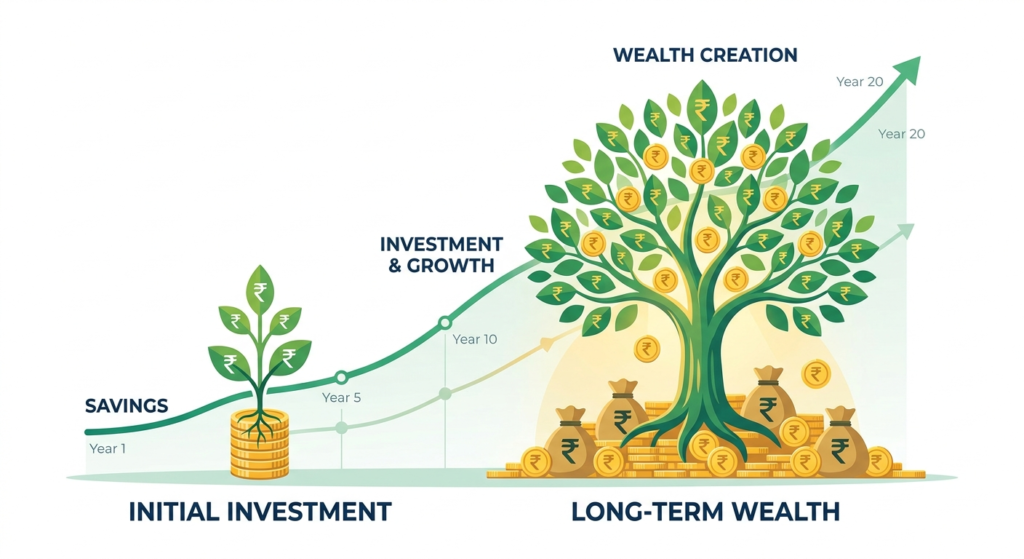

₹10,000/Month SIP →
How Much in 10, 20, 30 Years?
Real calculations, real numbers, and the compounding truth that most investors never see until it’s too late.
What If ₹10,000 a Month Could Make You a Crorepati?
Here’s a question most people never ask: What would happen if you invested ₹10,000 every single month — the cost of a decent dinner out for four, or a couple of OTT subscriptions — into a mutual fund SIP, and simply refused to touch it?
The answer might genuinely surprise you. In 30 years at 12% annualised returns, that ₹10,000/month becomes over ₹3.5 crore. In 20 years, it’s around ₹99 lakh — just a hair away from ₹1 crore. Even in 10 years, you’re sitting on ₹23 lakh from a total investment of just ₹12 lakh.
This article breaks it all down with real numbers — no vague estimates, no hopeful guessing. We use three realistic return scenarios (10%, 12%, and 15%), show you the power of compounding in plain language, factor in inflation, and share the mistakes that keep most Indians from reaching their financial potential.
Whether you’re a first-time investor or someone reconsidering their SIP strategy, by the end of this piece you’ll have everything you need to make a confident, informed decision.
What Is a SIP? (And Why India Is Obsessed With It)
A Systematic Investment Plan (SIP) is a method of investing a fixed amount into a mutual fund at regular intervals — typically monthly. Think of it like an EMI for your future self. Instead of paying a bank, you’re paying your wealth account.
According to data from AMFI India (Association of Mutual Funds in India), monthly SIP contributions crossed ₹20,000 crore in 2024, reflecting the extraordinary trust Indians are placing in this disciplined investment approach.
Why SIP Works: Three Unbeatable Advantages
- Rupee Cost Averaging: When markets fall, your ₹10,000 buys more units. When they rise, you gain on all units. Over time, your average cost per unit smooths out — reducing the risk of bad timing.
- The Magic of Compounding: Your returns earn returns. Every year, a larger base generates interest, creating a snowball that grows faster as it rolls.
- Investor Discipline: SIP removes the temptation to “wait for the right time.” The right time, as data consistently shows, is always: as early as possible.
SIP is not just an investment tool — it’s a behavioural framework. It keeps you invested when headlines are scary and markets are red. That discipline alone separates successful long-term investors from the rest.
Assumptions Used in This Article
Before we dive into the numbers, let’s be transparent about what we’re calculating with:
- Monthly SIP Amount: ₹10,000
- Investment Horizons: 10 years, 20 years, 30 years
- Expected Annual Returns: 10% (conservative), 12% (moderate), 15% (optimistic)
- Compounding Frequency: Monthly (as is standard in mutual fund SIPs)
- No step-up in SIP amount — the base calculation assumes a flat ₹10,000. We’ll show you what step-ups can do separately.
These return figures are based on historical performance of Indian equity mutual funds over 10–30 year periods. Past returns do not guarantee future results. Market-linked investments are subject to risk. Please read all scheme-related documents before investing.
The 10% figure represents a conservative estimate slightly above Nifty 50’s long-run average after accounting for fund expenses. The 12% figure aligns closely with large-cap and diversified equity fund historical averages. The 15% figure reflects top-performing flexi-cap or mid/small-cap funds over long periods.
₹10,000 SIP Returns: The Real Data
Let’s cut straight to what you came for — actual numbers. The formula used is the standard SIP Future Value formula:
FV = P × [((1 + r)ⁿ − 1) / r] × (1 + r)
Where P = monthly SIP, r = monthly rate (annual rate ÷ 12), n = total months
Scenario 1: At 10% Annual Returns (Conservative)
| Horizon | Total Invested | Final Corpus | Wealth Gained | Wealth Multiple |
|---|---|---|---|---|
| 10 Years | ₹12,00,000 | ₹20,48,450 | ₹8,48,450 | 1.7× |
| 20 Years | ₹24,00,000 | ₹75,93,700 | ₹51,93,700 | 3.2× |
| 30 Years | ₹36,00,000 | ₹2,27,93,200 | ₹1,91,93,200 | 6.3× |
Table 1: ₹10,000/month SIP at 10% annual returns
Scenario 2: At 12% Annual Returns (Moderate — Most Likely)
| Horizon | Total Invested | Final Corpus | Wealth Gained | Wealth Multiple |
|---|---|---|---|---|
| 10 Years | ₹12,00,000 | ₹23,23,400 | ₹11,23,400 | 1.9× |
| 20 Years | ₹24,00,000 | ₹99,91,500 | ₹75,91,500 | 4.2× |
| 30 Years | ₹36,00,000 | ₹3,52,99,100 | ₹3,16,99,100 | 9.8× |
Table 2: ₹10,000/month SIP at 12% annual returns
Scenario 3: At 15% Annual Returns (Optimistic — Top-Performing Funds)
| Horizon | Total Invested | Final Corpus | Wealth Gained | Wealth Multiple |
|---|---|---|---|---|
| 10 Years | ₹12,00,000 | ₹27,86,600 | ₹15,86,600 | 2.3× |
| 20 Years | ₹24,00,000 | ₹1,51,59,700 | ₹1,27,59,700 | 6.3× |
| 30 Years | ₹36,00,000 | ₹7,01,01,500 | ₹6,65,01,500 | 19.5× |
Table 3: ₹10,000/month SIP at 15% annual returns
Notice something remarkable: at 12%, your money grows to nearly ₹1 crore in 20 years — from only ₹24 lakh invested. And in 30 years? You’re looking at a corpus of over ₹3.5 crore from a ₹36 lakh investment. That’s the compounding effect working exactly as intended.
The Power of Compounding: Why Time Is Your Greatest Asset
Albert Einstein reportedly called compound interest the “eighth wonder of the world.” Whether or not he actually said it, the sentiment is mathematically accurate — and the SIP data above proves it.
Let’s look at what happens with ₹10,000/month SIP at 12% returns, year by year:
| Year | Total Invested | Corpus Value | Gain So Far |
|---|---|---|---|
| 5 | ₹6,00,000 | ₹8,24,600 | ₹2,24,600 |
| 10 | ₹12,00,000 | ₹23,23,400 | ₹11,23,400 |
| 15 | ₹18,00,000 | ₹50,45,800 | ₹32,45,800 |
| 20 | ₹24,00,000 | ₹99,91,500 | ₹75,91,500 |
| 25 | ₹30,00,000 | ₹1,89,76,000 | ₹1,59,76,000 |
| 30 | ₹36,00,000 | ₹3,52,99,100 | ₹3,16,99,100 |
The “First ₹10 Lakh vs Last ₹10 Lakh” Insight
Here’s a mind-bending way to understand compounding acceleration. In the first few years of your SIP, generating your first ₹10 lakh in returns takes a long time. But as your corpus grows, each ₹10 lakh of additional return comes faster and faster — because a larger base generates more interest every month.
Notice that from Year 0 to Year 15, the corpus grows to ₹50.4 lakh. But from Year 15 to Year 30, the same SIP amount grows by an additional ₹3.02 crore. The last 15 years generate 6 times more wealth than the first 15. This is why stopping a SIP early is so devastating to long-term wealth creation.
The Inflation Factor: What Will Your Corpus Actually Buy?
India’s average retail inflation (CPI) has historically hovered around 5–6% per year over long periods, according to data from the Reserve Bank of India (RBI). This means a rupee today won’t buy the same amount in 20 or 30 years.
Let’s calculate the inflation-adjusted (real) value of your SIP corpus, assuming 6% average inflation:
| Horizon | Nominal Corpus (12%) | Real Value (after 6% inflation) |
|---|---|---|
| 10 Years | ₹23,23,400 | ≈ ₹12,97,000 |
| 20 Years | ₹99,91,500 | ≈ ₹31,18,000 |
| 30 Years | ₹3,52,99,100 | ≈ ₹61,50,000 |
The real value is significantly lower — but notice that even in inflation-adjusted terms, ₹10,000/month invested over 30 years still creates substantial purchasing power. And critically, your alternative — keeping money in a savings account or FD at 6–7% — barely keeps pace with inflation after taxes.
To beat inflation meaningfully, equity SIPs targeting 12–15% are among the best tools available to Indian retail investors. This is why SEBI has continuously worked to expand mutual fund access and investor awareness.
Real Mutual Fund Examples That Have Delivered Strong Returns
Note: The following examples are for educational reference only and do not constitute investment advice. Always consult a SEBI-registered financial advisor before investing. Past performance does not guarantee future results.
Several Indian equity mutual funds have delivered impressive long-term returns over 15–20 year periods. These include funds in categories like:
- Large-Cap Funds: Historically delivering 11–13% CAGR over 15+ years. Examples include well-established funds from AMCs like HDFC, SBI, and Mirae Asset.
- Flexi-Cap / Multi-Cap Funds: Often delivering 13–16% over long periods due to their ability to shift allocation between large, mid, and small caps dynamically.
- Mid-Cap Funds: Higher risk but have delivered 15–18% over 20-year periods for top performers. Suitable for investors with longer horizons and higher risk tolerance.
- Index Funds (Nifty 50/Sensex): Tracking market indices, delivering approximately 12–13% historically at lower expense ratios.
You can explore fund-wise performance data on the official AMFI India performance portal.
The 12% return assumption used in this article is conservative for equity mutual funds over 20–30 year periods. Many diversified equity funds have historically exceeded this figure, though with year-to-year volatility. For best SIP strategies tailored to your risk profile, explore curated resources on InvestmentSutras.
SIP vs Lump Sum: Which Strategy Wins?
This is one of the most common questions new investors ask. The honest answer is: it depends. But here’s a clear framework:
When SIP Is Better
- You’re investing from regular income (salary, business profits)
- Markets are volatile or at high valuations
- You don’t have a large corpus available upfront
- You want to remove emotional decision-making from investing
When Lump Sum Works
- You receive a windfall (bonus, inheritance, property sale proceeds)
- Markets have corrected significantly (30–50% drawdowns)
- You have a long enough horizon to ride out volatility
Many experienced investors use a hybrid approach: maintain a monthly SIP for disciplined accumulation, and deploy lump sums during significant market corrections. This maximises both consistency and opportunistic investing.
Common Mistakes That Kill Long-Term SIP Returns
Getting the math right is only half the battle. The other half is investor behaviour — and this is where most people trip up.
1. Stopping the SIP During Market Crashes
This is the single most wealth-destroying mistake. When markets fall 20–30%, many investors panic and stop their SIPs. But this is precisely when your ₹10,000 is buying the most units at bargain prices. Stopping a SIP during a crash is like walking out of a sale.
2. Expecting Consistent 12% Every Year
In reality, equity markets deliver returns in a lumpy, non-linear fashion. Some years give 35%. Others give -15%. The 12% is a long-term average — your patience determines whether you experience it.
3. Never Increasing the SIP Amount
If your salary grew from ₹50,000 to ₹1,50,000 over 10 years but your SIP stayed at ₹10,000, you’re actually investing a smaller portion of your income in real terms. A flat SIP is a shrinking SIP in real purchasing power terms.
4. Withdrawing Before the Horizon
As the compounding table above shows, the real wealth creation happens in years 15–30. Withdrawing at year 8 or 12 for a car or vacation means exiting right before the exponential phase kicks in. Keep your SIP goal separate from short-term needs.
For a complete mutual fund investment guide, including how to structure different SIPs for different goals, InvestmentSutras has detailed resources available.
Pro Tips to Maximise Your SIP Returns
1. The Step-Up SIP Strategy
Instead of keeping your SIP flat at ₹10,000, increase it by 10% every year. This is called a step-up or top-up SIP, and the results are extraordinary:
| Horizon | Flat ₹10K SIP @12% | 10% Step-Up SIP @12% | Extra Corpus |
|---|---|---|---|
| 10 Years | ₹23,23,400 | ₹31,60,000 | +₹8,36,600 |
| 20 Years | ₹99,91,500 | ₹1,76,00,000 | +₹76,08,500 |
| 30 Years | ₹3,52,99,100 | ₹8,10,00,000 | +₹4,57,00,900 |
Step-up amounts are approximate; actual results vary. Consult a financial advisor.
A 10% annual step-up in your SIP can more than double your final corpus over 30 years. Most AMCs offer this as a built-in feature — you can set it up once and forget it.
2. Stay Invested During Market Crashes
The Sensex fell 38% during COVID-19 in early 2020. Investors who kept their SIPs running — or increased them — saw massive gains in the following 18 months. Those who paused their SIPs missed the recovery. Market crashes are not danger zones for SIP investors — they are acceleration zones.
3. Review, Not React
Review your portfolio once a year. Rebalance if one asset class has grown disproportionately. But don’t check it monthly and don’t switch funds based on one bad quarter. Consistency, not cleverness, drives SIP outcomes.
4. Diversify Across Fund Categories
Don’t put all ₹10,000 into a single fund. Consider splitting across a large-cap fund, a flexi-cap fund, and optionally a mid/small-cap fund or index fund. This diversification smooths out category-specific volatility. Read more about long term wealth creation strategies on InvestmentSutras.
5. Use Direct Plans Over Regular Plans
Direct mutual fund plans have no distributor commission, making their expense ratios 0.5–1% lower than regular plans. Over 30 years, that 1% difference can compound to lakhs of rupees in your pocket. Always choose direct plans when possible.
The Best Time to Start Was Yesterday. The Next Best Time Is Today.
₹10,000 a month is not a small amount — but it’s also not an impossible one for a growing number of Indian households. And as the numbers above show clearly, what seems like a modest commitment today has the potential to become life-changing wealth over 20–30 years.
The math doesn’t care about market sentiment, economic cycles, or government elections. It only cares about two things: how much you invest, and for how long.
Start today. Increase your SIP every year. And let compounding — the eighth wonder of the world — do the rest.
Frequently Asked Questions (FAQ)
Verified External Resources