

Last updated: March 2026 | Reading time: ~10 minutes
Most people who start investing in mutual funds face the same confusion: there are hundreds of funds out there, and no one tells you why they are different or which one you actually need. You scroll through an app, see names like “Large Cap Growth Fund,” “Dynamic Bond Fund,” “ELSS,” or “Nifty 50 Index Fund” — and you pick one mostly by gut feeling or because a friend mentioned it.
That is the wrong way to invest. Every mutual fund belongs to a category, and each category has a defined purpose, a risk profile, and a type of investor it suits best. Once you understand the categories, choosing the right fund becomes far less intimidating.
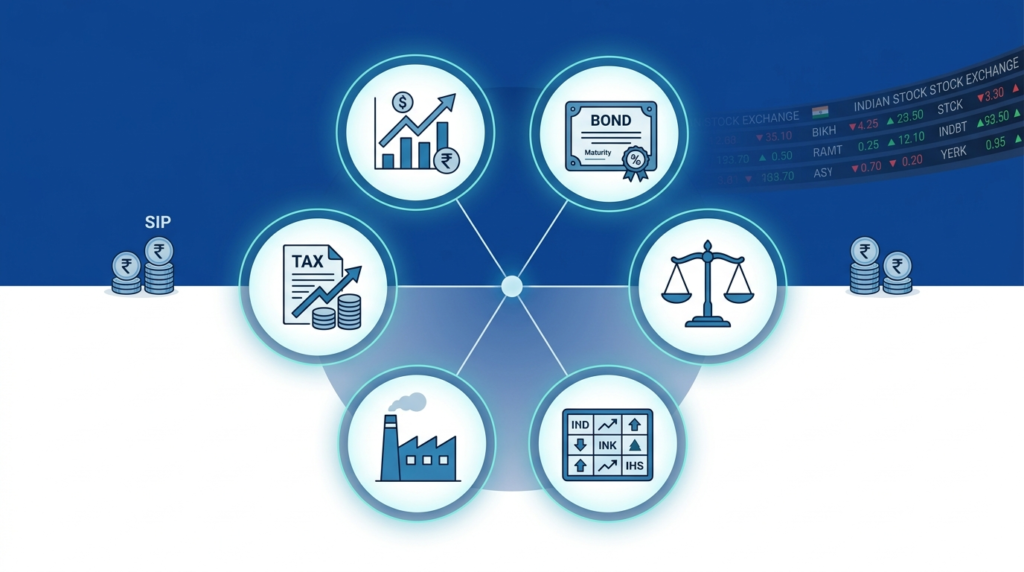
This guide breaks down all six major mutual fund categories in India — equity, debt, hybrid, index, sectoral, and ELSS — in plain language. By the time you finish reading this, you will know exactly what each category does and where it fits in your portfolio.
What Is a Mutual Fund Category?
A mutual fund category is a classification defined by SEBI (Securities and Exchange Board of India) that groups funds based on where they invest — stocks, bonds, a mix of both, or a specific sector. Every fund house in India must classify its schemes under SEBI-mandated categories so investors can compare like with like. There are over 36 sub-categories in India, but they all fall under six broad groups.
1. Equity Mutual Funds — Built for Long-Term Wealth Creation
Equity funds invest primarily in the stocks of companies listed on Indian stock exchanges like the NSE and BSE. SEBI mandates that an equity fund must invest at least 65% of its corpus in equities at all times. The remaining portion may be held in cash or debt instruments to manage liquidity.
These funds are designed for investors who want their money to grow significantly over 5 to 10 years or longer. The trade-off is volatility — your investment will fall in value during market downturns, sometimes sharply. But history shows that equity funds in India have delivered strong real returns over long periods when held patiently.
Types of Equity Funds in India
Equity funds are further divided by market capitalisation and investment style:
- Large Cap Funds — invest in the top 100 companies by market cap. Lower risk within equity, but also lower upside.
- Mid Cap Funds — invest in companies ranked 101 to 250 by market cap. Higher growth potential, higher volatility.
- Small Cap Funds — invest in companies ranked below 250. Highest potential, highest risk, and least liquidity.
- Flexi Cap / Multi Cap Funds — fund manager can move across large, mid, and small cap freely. Good for diversified equity exposure.
- Large and Mid Cap Funds — blend of large and mid cap stocks for balanced growth.
Who should invest in equity funds:
Investors with a time horizon of at least 5 years, a moderate to high risk appetite, and a long-term goal such as retirement, children’s education, or building wealth over decades.
Risk level: Moderate to High | Ideal horizon: 5 years and above
If you are weighing equity funds against a more passive approach, read our detailed comparison: Index Fund vs Active Fund in India 2026: Which Is Better for Long-Term SIP?
2. Debt Mutual Funds — Stability, Income, and Capital Preservation
Debt funds invest in fixed-income instruments — government bonds, corporate bonds, treasury bills, commercial papers, and other money market instruments. They lend money to governments or companies and earn interest in return. Your capital is relatively protected, and returns are more predictable than equity funds.
Think of debt funds as the calm, steady part of your portfolio. They are not going to double your money in five years, but they will not cut your savings in half either during a stock market crash.
Key Debt Fund Sub-Categories
- Liquid Funds — invest in instruments maturing within 91 days. Suitable for parking surplus cash. Better post-tax returns than savings accounts for amounts over ₹5–10 lakh.
- Short Duration Funds — invest in bonds with 1–3 year maturity. Good for short-term goals.
- Corporate Bond Funds — invest at least 80% in highest-rated corporate bonds (AA+ and above). Moderate risk, decent returns.
- Gilt Funds — invest exclusively in government securities. No credit risk, but significant interest rate risk.
- Dynamic Bond Funds — fund manager adjusts portfolio duration based on interest rate outlook. Returns can vary widely depending on manager calls.
Who should invest in debt funds:
Conservative investors, retirees, or anyone with a short to medium-term goal (1–3 years) who cannot afford significant capital erosion. Also ideal for building an emergency fund that earns better returns than a savings account.
A note on taxation: After the 2023 budget changes, debt fund gains are now taxed as per your income tax slab regardless of holding period. This reduced the appeal of debt funds for high-income earners compared to bank FDs in some cases. Always factor in your tax bracket when choosing between debt funds and FDs. Read more: Mutual Fund Tax Rules in India 2024–25: STCG, LTCG and New Rates Explained
Risk level: Low to Moderate | Ideal horizon: 3 months to 3 years
3. Hybrid Mutual Funds — The Middle Path Between Growth and Safety
Hybrid funds invest in both equity and debt instruments in varying proportions. They are built for investors who want some growth from equities but are not comfortable with full equity volatility. Think of them as a blended portfolio in a single fund.
Types of Hybrid Funds
| Fund Type | Equity Allocation | Debt Allocation | Best For |
|---|---|---|---|
| Conservative Hybrid | 10%–25% | 75%–90% | Near-retirees, capital preservation |
| Balanced Hybrid | 40%–60% | 40%–60% | Moderate investors, 3–5 year goals |
| Aggressive Hybrid | 65%–80% | 20%–35% | Long-term, equity-leaning investors |
| Balanced Advantage (BAF) | Dynamic (0%–100%) | Dynamic | Investors wanting auto risk management |
| Multi Asset Allocation | At least 10% | At least 10% | Diversification across asset classes incl. gold |
Balanced Advantage Funds (BAF) deserve special mention. They dynamically adjust equity and debt allocation based on market valuations using a model-driven approach. When markets are expensive, the fund reduces equity; when markets fall, it adds equity. For investors who find it hard to time the market themselves, a BAF can do that work automatically.
>For a deeper dive on this, see: Balanced Advantage Fund vs Hybrid Fund: Which One Is Right for You in 2026?
Risk level: Low to High (depends on sub-category) | Ideal horizon: 3–7 years
4. Index Funds — Low Cost, No Manager, Just the Market
An index fund simply mirrors a market index — the Nifty 50, Sensex, Nifty Next 50, or Nifty Midcap 150, for example. The fund buys all stocks in the index in the same proportion and holds them passively. There is no active stock picking, no fund manager making calls, and as a result, no fund manager fees beyond a minimal cost.
This makes index funds the lowest-cost way to invest in equities. A typical actively managed large cap fund charges an expense ratio of 1%–2.5% per year. A Nifty 50 index fund can cost as little as 0.05%–0.20% per year. Over 20 years, that cost difference compounds into a significant gap in your final corpus.
Why Index Funds Have Grown So Popular in India
Multiple studies globally, and now increasingly in India too, show that most actively managed funds fail to beat their benchmark index consistently over a 10-year period. When a fund manager’s skill cannot reliably overcome the higher costs, the simple, low-cost index fund often wins by default.
This philosophy — known as passive investing — has been championed by legendary investor Warren Buffett and popularised in India over the last 5 years as data on long-term fund performance became more transparent.
Who should invest in index funds:
Cost-conscious investors, beginners who want market returns without complexity, and anyone building a long-term SIP portfolio where minimising fees over decades matters significantly.
Risk level: Moderate to High (mirrors equity market risk) | Ideal horizon: 7 years and above
For an authoritative global perspective on passive investing, the SPIVA India Scorecard by S&P Dow Jones Indices publishes annual data on how Indian active funds perform against their benchmarks — worth a read before you decide.
5. Sectoral and Thematic Funds — Concentrated Bets on Specific Industries
Sectoral funds invest at least 80% of their portfolio in stocks of one specific sector — banking, technology, healthcare, infrastructure, FMCG, energy, and so on. Thematic funds are slightly broader: they invest in a theme that can span multiple sectors, such as “Digital India,” “manufacturing,” “ESG,” or “consumption.”
When you get the sector right, the returns can be exceptional. The pharma sector delivered extraordinary gains during COVID-19. IT funds outperformed every other category when global digital spending boomed in 2020–21. But when a sector goes out of favour — and every sector does at some point — these funds can severely underperform for years.
The Real Risk of Sectoral Funds
Most retail investors who buy sectoral funds do so after reading that a particular sector has already done well. By the time mainstream media reports a sector’s outperformance and retail investors pile in, the best returns are often already behind them. This is the classic “buying high” mistake in a concentrated form.
Additionally, sectoral funds carry concentration risk — if the entire sector goes through regulatory changes, global headwinds, or a commodity supercycle reversal, your entire fund is exposed. Unlike a diversified equity fund where one bad sector is cushioned by other sectors, here there is no such buffer.
Who should invest in sectoral or thematic funds:
Only investors who have a strong understanding of the sector, a high risk tolerance, and are treating the allocation as a tactical satellite position — not as the core of their portfolio. This category is not recommended for beginners.
Risk level: Very High | Ideal horizon: 5+ years (sector cycles are long)
6. ELSS — Tax Saving Mutual Funds with the Shortest Lock-in
Equity Linked Savings Schemes (ELSS) are a special category of equity mutual funds that qualify for tax deduction under Section 80C of the Income Tax Act. You can invest up to ₹1.5 lakh per financial year in ELSS and claim a deduction from your taxable income — saving up to ₹46,800 in taxes annually if you are in the 30% bracket.
ELSS funds invest at least 80% of their corpus in equities, similar to a regular equity fund. What makes them distinct is the mandatory 3-year lock-in period per investment. This is the shortest lock-in among all Section 80C instruments — PPF locks in for 15 years, NSC for 5 years, and tax-saving FDs for 5 years.
How ELSS Compares to Other 80C Options
| Instrument | Lock-in | Expected Returns | Tax on Returns |
|---|---|---|---|
| ELSS | 3 years | 10%–14% (market-linked) | LTCG at 12.5% above ₹1.25 lakh |
| PPF | 15 years | 7.1% (fixed) | Fully exempt (EEE) |
| NSC | 5 years | 7.7% (fixed) | Taxable as income |
| Tax Saving FD | 5 years | 6.5%–7.5% | Taxable as income |
| NPS (80CCD1B) | Till retirement | 8%–12% (market-linked) | Partial tax on withdrawal |
For investors who want both tax savings and long-term wealth creation, ELSS is often the most efficient 80C option — provided you are comfortable with equity market risk and do not need the money before 3 years.
See our full comparison: ELSS vs PPF 2026: Which Is Better to Save Tax Under Section 80C?
Risk level: Moderate to High | Ideal horizon: 3 years minimum, ideally 5+ years
All Six Categories at a Glance
| Category | What It Invests In | Risk | Goal | Horizon |
|---|---|---|---|---|
| Equity | Stocks (65%+ in equities) | Mod–High | Long-term wealth creation | 5+ years |
| Debt | Bonds, G-secs, money market | Low–Mod | Capital safety, income | 3 months–3 years |
| Hybrid | Mix of equity + debt | Low–High | Balanced growth | 3–7 years |
| Index | Replicates a market index | Mod–High | Market returns, low cost | 7+ years |
| Sectoral | One sector only | Very High | Tactical sector exposure | 5+ years |
| ELSS | Equities (80%+), 3yr lock-in | Mod–High | Tax saving + wealth growth | 3+ years |
How to Use These Categories to Build a Sensible Portfolio
Understanding categories is one thing — putting them together into a coherent portfolio is another. Here is a simple framework based on investor stage:
For a beginner investor (age 22–30)
You have time on your side. A portfolio tilted heavily toward equity — a Nifty 50 or Nifty Next 50 index fund combined with a flexi cap or large cap fund for the core, and an ELSS for tax savings — is a strong starting point. Keep a liquid fund for your emergency corpus.
For a mid-career investor (age 35–45)
A 70:30 equity-to-debt allocation works well here. Use hybrid funds or a balanced advantage fund for the equity portion if you find market volatility stressful. Add a short duration debt fund for medium-term goals.
For a near-retiree or retiree (age 55+)
Capital protection becomes more important than growth. Conservative hybrid funds, corporate bond funds, and gilt funds should form the majority of the portfolio, with a small equity allocation to beat inflation over the long term.
When You Should Not Rely on Google and Need to Speak to an Expert
The internet — including articles like this one — is excellent for building conceptual knowledge about mutual fund categories. But there are situations where reading more articles is not enough and where getting the call wrong will have real financial consequences for you.
Speak to a SEBI-registered investment advisor (RIA) or a qualified financial planner in these situations:
- You have inherited a large lump sum — say ₹20 lakh or more — and are not sure how to deploy it across categories.
- You are within 5 years of retirement and are not sure how much equity exposure is too much or too little.
- You are making investment decisions while also managing a home loan, business cash flows, or a child’s education corpus simultaneously.
- Your financial situation is complex — multiple income sources, NRI status, HUF structures, or business ownership — which affects taxation and the right fund choices for you.
- You are considering putting a large portion of your savings into a single sectoral or thematic fund based on a “hot tip” or market buzz.
- You are unsure whether the old or new tax regime is better for you, which directly affects whether ELSS still makes sense in your case.
Google can tell you what an aggressive hybrid fund is. It cannot tell you whether an aggressive hybrid fund is right for your specific situation, your tax bracket, your existing commitments, and your actual risk tolerance when markets fall 40%. That is what a good financial advisor does.
To find a fee-only, SEBI-registered investment advisor in India, the SEBI registered adviser list is the most reliable starting point. Avoid advisors who earn commissions from funds they recommend.
Benefits of Understanding Fund Categories Before You Invest
Knowing these categories helps you in four specific ways. First, it prevents accidental duplication — many investors own five equity funds when they think they are diversified, but all five are large cap funds doing essentially the same thing. Second, it aligns your investment to your time horizon — a retiree putting everything in equity funds and a 25-year-old putting everything in debt funds are both making category mismatches. Third, understanding categories makes you resistant to sales pitches — when a distributor recommends a sectoral NFO, you will know to ask why you need concentrated sector risk. Fourth, it helps you rebalance intelligently as your life changes — moving from equity-heavy in your 30s to a more balanced allocation in your 50s is a category-level decision.
Risks to Be Aware of Across Categories
Every category carries specific risks that investors often underestimate at entry but regret during downturns. Equity funds carry market risk and can fall 40–50% in a severe crash. Debt funds carry credit risk (the bond issuer may default) and interest rate risk (rising rates reduce bond prices). Hybrid funds carry both in varying degrees. Index funds will always deliver the market’s full downside, not just part of it. Sectoral funds can stay underperforming for 5–7 years if a sector cycle turns. ELSS locks your money for 3 years with no exit even if the market crashes — though historically, patient investors have been rewarded.
Key Takeaways
- Equity funds are for long-term wealth creation (5+ years), not short-term goals.
- Debt funds are for capital safety and short-to-medium-term needs, not for beating equity returns.
- Hybrid funds balance risk and reward — the right sub-category depends on your specific risk tolerance and horizon.
- Index funds remove fund manager risk and fees — a powerful advantage over long investment periods.
- Sectoral funds are concentrated bets. They are not for beginners or core portfolio allocations.
- ELSS is the most efficient 80C tax saver if you are comfortable with 3-year equity market risk.
- Building a portfolio means using the right categories for the right goals — not picking winners.
- Google and articles are good for learning concepts; a SEBI-registered advisor is essential for complex, high-stakes financial decisions.
Frequently Asked Questions
What is the difference between equity and hybrid mutual funds?
Equity funds invest at least 65% in stocks and carry higher market risk, making them suitable for long-term goals. Hybrid funds split their portfolio between equity and debt in varying proportions to balance growth and stability, making them suitable for investors with moderate risk tolerance and medium-term horizons.
Which mutual fund category is best for beginners?
For most beginners in India, a Nifty 50 index fund or a large cap equity fund via monthly SIP is the most sensible starting point. These offer broad market exposure at low cost with professional management, and are far less complex than sectoral or thematic funds.
Is ELSS better than PPF for tax saving?
ELSS offers higher potential returns (market-linked), a shorter lock-in of just 3 years, and greater liquidity. PPF offers guaranteed, tax-free returns but locks your money for 15 years. ELSS suits investors with higher risk tolerance and longer financial planning horizons; PPF suits conservative investors seeking guaranteed safety.
What is an index fund and how is it different from an active fund?
An index fund passively replicates a market index like Nifty 50 without any stock selection decisions. An active fund employs a fund manager who picks stocks to try to beat the benchmark. Index funds charge significantly lower fees and have shown competitive long-term returns compared to most active large cap funds in India.
Should I invest in sectoral funds?
Sectoral funds should only form a small, tactical part of a portfolio — typically under 10–15% — and only for investors who have a strong understanding of the sector’s fundamentals and cycle. They are not recommended for beginners or as a core holding, due to their concentrated risk and tendency to underperform for extended periods.
How many mutual fund categories are there in India?
SEBI has defined over 36 mutual fund sub-categories in India, all falling under five broad asset class groups: equity, debt, hybrid, solution-oriented (children’s funds, retirement funds), and other (index funds, ETFs, FOFs). For practical investing purposes, understanding the six categories covered in this article covers the vast majority of what retail investors need.
Conclusion: Categories Are the Foundation, Not the Final Answer
Most investing mistakes in India are not caused by bad stock picks or poor market timing — they happen because investors buy the wrong category for their goal. Someone puts their daughter’s 2-year tuition money in a small cap fund. Someone else puts their entire retirement savings in a debt fund and watches inflation silently erode its real value. Getting the category right solves both problems before they start.
Think of fund categories as the building blocks of your financial plan. Equity for growth. Debt for stability. Hybrid for balance. Index for cost efficiency. Sectoral for calculated concentration. ELSS for tax efficiency. Each has its place, and none of them works in isolation.
The best portfolio is not the one with the highest-rated fund in each category. It is the one structured correctly for your age, income, goals, and risk tolerance — and then held patiently through the inevitable market cycles that will test your resolve.

Pingback: How to Invest in Mutual Funds in India: A Complete Step-by-Step Guide for Beginners (2026) - investmentsutras.com
Pingback: Best Mutual Funds for SIP in 2026: Top Picks for Every Indian - investopedia.org.in