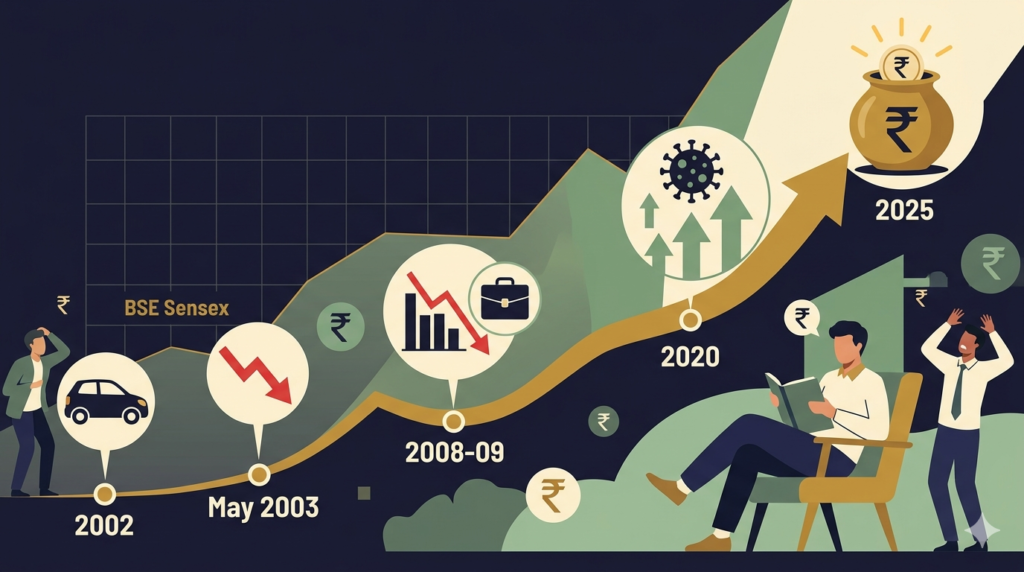

My 22-Year Stock Market Journey: From the Maruti IPO in 2002 to Building a Crorepati Corpus Through SIPs
How patience, discipline, and courage during market crashes turned a modest monthly SIP into life-changing wealth
It was the summer of 2002. I was a young professional in my late twenties, earning a decent salary but with absolutely no clue about the stock market. A colleague casually mentioned that a company called Maruti Udyog was coming out with an IPO — India’s most famous car brand was finally going public. I remember thinking: “Even if I don’t understand stocks, everyone knows Maruti cars. How can this go wrong?”
That single decision — driven more by common sense than financial expertise — became the starting pistol for a 22-year wealth-building journey that would survive election shocks, corporate frauds, global financial meltdowns, and a once-in-a-century pandemic. Today, I want to share that story in its entirety — not to brag, but because I genuinely believe the lessons I learned the hard way can save you years of confusion and help you build real, lasting wealth.
If you’ve been wondering whether regular SIPs actually work, whether you should invest during market crashes, or whether a salaried person can actually build a crore-plus corpus — this story is your answer. Grab a cup of chai and settle in.
1. The Maruti IPO — My First Stock Market Win (2002)
Maruti Udyog Limited launched its IPO in June 2003 (the issue opened for subscription; I’m referring to the preparation and application process that began in 2002 during the announcement phase). The issue price was set at ₹125 per share. I applied for the maximum retail allotment I could — and to my surprise and delight, I received full allotment. This was unusual even then, since most popular IPOs were oversubscribed.
What happened next was nothing short of magical for a first-time investor. Maruti shares listed and began climbing. I watched the price hit ₹200, then ₹220, then ₹250. When it crossed ₹250 — double my cost price — I did what most new investors do: I sold everything. I locked in a 100% return in what felt like no time at all.
I sold Maruti at 2x my entry price and felt like a genius. What I didn’t realize was that Maruti would eventually become a multi-bagger many times over. But I don’t regret it. That profit seeded my investing future and gave me the confidence to continue. Sometimes the “wrong” decision teaches you the most.
The money I made from the Maruti IPO wasn’t life-changing in absolute terms, but it was life-changing in mindset. For the first time, I understood that the stock market wasn’t a casino — it rewarded patience, research, and conviction. I was hooked, but I also knew I needed a more systematic approach.
Why the Maruti IPO Was a Perfect Entry Point
- Maruti had massive brand recognition — nearly every Indian family knew the name
- The Indian automobile sector was entering a high-growth phase
- Government disinvestment gave it institutional credibility
- The IPO was priced fairly, not aggressively — leaving room for listing gains
- It taught me the power of investing in businesses you understand
2. Early Lessons: From Stocks to Mutual Funds (2003–2005)
After the Maruti success, I made the classic mistake of trying to replicate it by picking individual stocks. I bought a handful of mid-cap companies based on tips from colleagues, newspaper headlines, and sheer gut feel. Some worked out. Many didn’t. I watched one stock fall 40% and held it in denial for months, hoping it would “come back.” (It never did, at least not in the time I held it.)
This experience was humbling. I realized something important: I didn’t have the time, skill, or information advantage to be a stock picker. I had a full-time job, a family, and limited bandwidth to research companies. I needed a smarter vehicle.
In 2004, I met a financial advisor who introduced me to Systematic Investment Plans (SIPs) in mutual funds. He explained a concept that would become the cornerstone of my wealth-building strategy: the power of compounding over time, combined with rupee cost averaging. I was skeptical at first. “Won’t I do better just picking stocks?” I asked. His answer has stayed with me to this day:
“Most retail investors underperform even a basic index fund. A mutual fund gives you professional management, diversification, and discipline — the three things most individual investors lack. Stop trying to be smarter than the market. Be more consistent than other investors instead.”
That advice landed. By early 2005, I had started my first SIPs across a mix of large-cap and diversified equity mutual funds. I chose schemes from reputed AMCs (Asset Management Companies) that had strong track records, reasonable expense ratios, and experienced fund managers. And I committed to something radical: I would not miss a single SIP installment, no matter what.
3. The Election Crash of May 17, 2003 — My First Bulk Buy
Before I get into the SIP journey, I need to tell you about one of the most important single days in my investing life: May 17, 2003.
The 2003 Indian general elections had just concluded. The ruling BJP-led NDA, expected to win comfortably, was defeated by the Congress-led UPA alliance. The result shocked markets and investors. On that single day, the BSE Sensex crashed by a jaw-dropping 842 points — one of its biggest single-day falls at that time. Circuit breakers were triggered. Trading was halted. Panic was everywhere.
I remember sitting in my office that morning, watching the news with colleagues. Everyone was terrified. “The market is finished.” “India is going to go socialist.” “Sell everything.” The noise was deafening.
But I had been reading. I had studied how markets react to political events. And I remembered something Warren Buffett had said: “Be greedy when others are fearful.” The Indian economy’s fundamentals hadn’t changed overnight. Companies still had the same assets, the same customers, the same products. The stock prices had simply been repriced by emotion, not by business reality.
I called my broker and placed a significant lump-sum purchase order across several blue-chip stocks and a couple of diversified mutual funds. My hands were trembling slightly — not from fear, but from the weight of the decision. I was buying when the entire country was selling.
Within 12 months, the Sensex had not only recovered but climbed to new highs. The stocks I bought on that “Black Friday” of Indian markets gave me returns of 60–120% over the next 18 months. That lump-sum decision on May 17, 2003 became one of the highest-returning investments of my life. It permanently changed how I view market crashes.
The Lesson From the Election Crash
- Market crashes driven by sentiment (not fundamentals) are buying opportunities
- Political uncertainty is temporary; business fundamentals are durable
- You need cash reserves specifically set aside for opportunistic buying
- Fear at market bottoms is the loudest just before the recovery
- Conviction matters more than timing — you’ll never catch the exact bottom
4. Building the SIP Machine: 2005 to 2025
From 2005 onward, I became a SIP fanatic — and I mean that in the most disciplined, un-glamorous way possible. There was nothing exciting about what I was doing. Every month, on a fixed date, money left my bank account and went into mutual funds. Through market booms, crashes, elections, family emergencies, job changes, and a pandemic — the SIP ran.
The key principle underlying all of this was simple: SIP is not a product; it’s a discipline. It removes the need to time the market. When markets fall, your fixed amount buys more units. When markets rise, your existing units gain value. Over 20 years, this averaging effect works powerfully in your favour.
5. The 7% Annual SIP Increase Strategy — The Secret Multiplier
Here’s something most personal finance articles don’t talk about enough: the step-up SIP strategy. It’s not enough to start a SIP and forget it. Your income grows over time. Inflation erodes the real value of a fixed contribution. The solution is to increase your SIP amount by a fixed percentage every year.
I chose 7% per year — roughly in line with my expected salary increments and Indian CPI inflation. Here’s what that looked like in practice:
The magic of the step-up SIP is that it massively increases your total corpus compared to a flat SIP, while each individual increment feels manageable because your income has grown alongside it. You’re not making a dramatic sacrifice — you’re simply directing your salary growth towards wealth creation rather than lifestyle inflation.
Even a 5% annual step-up on a ₹10,000/month SIP over 20 years, assuming a 12% annual return, can build a corpus of approximately ₹1.5 crore more than a flat SIP. The step-up is arguably the most underrated wealth-building tool available to salaried Indians. Learn more at Investment Sutras.
6. The Satyam Scam and the 2008 Crash — Buying When Everyone Was Selling
January 7, 2009. Ramalinga Raju, the founder of Satyam Computer Services, sent a letter to his board confessing to one of India’s biggest corporate frauds in history. ₹7,000 crore in fake cash, inflated earnings, and fabricated invoices — all revealed in one stunning admission. The market fell sharply. Satyam’s stock crashed over 77% in a single session.
But the Satyam scandal didn’t hit India in isolation. It came on the heels of the 2008 global financial crisis — the collapse of Lehman Brothers, the subprime mortgage disaster in the US, and a synchronized global recession. The Sensex, which had peaked at over 21,000 in January 2008, had crashed to below 8,000 by March 2009 — a fall of nearly 62%.
The mood in India was apocalyptic. Friends were asking me to stop my SIPs. “What’s the point? The market won’t recover for years.” My own portfolio had lost significant paper value. It looked ugly on paper.
But here’s what I kept reminding myself: these are paper losses, not real ones — unless I sell. I hadn’t sold a single unit. And more importantly, every SIP installment I made during those low market levels was buying me units at bargain prices. I was, without realizing the sophistication of the strategy, accumulating units at multi-year lows.
I went further. I had been maintaining a separate emergency corpus and a small “opportunity fund” — cash I kept aside precisely for moments like these. In early 2009, when fear was at its peak, I deployed a significant lump-sum amount into diversified equity funds. Not all at once — I spread it over three months to avoid trying to time the exact bottom.
By 2010, the Sensex had recovered to pre-crisis levels. By 2014, it had doubled from the 2009 bottom. The units I bought during the crash — both through SIPs and the lump-sum — gave me extraordinary returns over the next five years. The 2008–2009 crisis, in hindsight, was one of the greatest gifts the market ever gave me.
Why Most Investors Failed in 2008 (And How You Can Avoid Their Mistake)
- They watched their portfolio value daily and panicked at paper losses
- They stopped SIPs exactly when SIPs were most valuable
- They had no “opportunity fund” to deploy during the crash
- They confused short-term market price with long-term business value
- They listened to news headlines instead of fundamental analysis
The most dangerous thing an investor can do in a bear market is sell and wait for clarity. Clarity always comes after the recovery. By the time the situation “looks better,” prices are 30–50% higher than where you sold.
7. COVID-19 Market Dip of 2020 — History Repeats Itself
March 2020 was surreal for the entire world. A pandemic that had started in a city in China had spread globally. Countries were going into lockdown. Hospitals were overwhelmed. The human cost was devastating. And markets? They crashed with breathtaking speed.
The BSE Sensex fell from approximately 41,000 in January 2020 to under 26,000 by March 23, 2020 — a fall of about 38% in less than 45 days. It was one of the sharpest crashes in global market history. Even experienced investors I knew were in a daze.
By 2020, I had 15 years of market experience. I had seen the 2003 election crash. I had survived 2008. And I recognized the pattern immediately: panic selling driven by fear, not fundamentals. Yes, the short-term economic damage would be severe. But companies — the good ones with strong balance sheets — would survive. India would not stop consuming, building, and growing permanently.
My SIPs continued without interruption. Not a single installment was paused. And over March and April 2020, I again deployed my opportunity fund into equity mutual funds in a staggered manner. I chose large-cap and flexi-cap funds primarily, since they gave broad diversification and were managed by fund managers who could navigate the uncertainty.
I did NOT try to pick individual stocks during COVID. The uncertainty was too high — some sectors (airlines, hospitality, retail) would be devastated for years, while others (pharma, IT, FMCG) would thrive. Mutual funds, managed by professionals with research teams, were better equipped to navigate that complexity than I was.
The Sensex recovered to its pre-COVID levels by November 2020 — just 8 months after the crash. By the end of 2021, it had crossed 60,000. The funds I had invested in during March–April 2020 had delivered 60–90% returns in under 18 months.
And through all of this, the SIPs had never stopped. The disciplined investors who stayed the course were rewarded. Those who paused SIPs “until things stabilize” missed the sharpest recovery in modern Indian market history.
Market crashes feel different every time. In 2003 it was political. In 2008 it was financial. In 2020 it was biological. But the investor’s playbook remains the same: don’t sell quality, don’t pause your SIP, and if you have the courage, buy more. The recovery always comes. The only question is whether you’ll still be invested when it does.
8. Key Insights and Expert Tips from 22 Years of Investing
Twenty-two years of investing teaches you things no textbook can. Here are the most important principles that shaped my journey:
🏆 Principle 1: Start Before You’re Ready
I started with the Maruti IPO knowing almost nothing. Waiting for the “right time” or until you “understand markets fully” is a trap. The best teacher is actual money in the market, even a small amount. Start with ₹500 or ₹1,000 SIPs if that’s what you can afford. Just start.
📅 Principle 2: Never Miss a SIP — Treat It Like an EMI
I never missed a single SIP in 20 years. Not during a salary cut. Not during a family medical emergency. Not during the COVID lockdown. I treated it exactly like an EMI — a non-negotiable commitment. This is the single most important habit in my wealth journey. Read more about SIP discipline on Investment Sutras.
💰 Principle 3: Maintain an “Opportunity Fund”
Alongside my SIPs, I always maintained a separate liquid fund specifically earmarked for market crashes. This is not your emergency fund — that’s separate. This is money that sits in a liquid or ultra-short-term fund, waiting for the market to give you a gift. When markets fell 30%+, I deployed this. After deployment, I rebuilt it slowly over 12–18 months.
📊 Principle 4: Increase SIPs Every Year Without Fail
The 7% annual step-up was the single biggest driver of my corpus growth. Your savings rate should grow faster than inflation. Every January, I increased my SIPs. This one habit, compounded over 20 years, made an enormous difference.
🧘 Principle 5: Emotional Detachment Is a Superpower
The investors who lose money aren’t always the ones who make bad decisions. They’re often the ones who make good decisions and then panic-sell when markets fall. Developing emotional detachment — the ability to see a 30% portfolio drop as an opportunity rather than a disaster — is the most valuable skill in investing.
🔎 Principle 6: Review Annually, Not Daily
I reviewed my portfolio once a year, in January. I checked whether my fund managers were still consistent, whether my asset allocation needed rebalancing, and whether my financial goals had changed. Daily or even monthly monitoring leads to emotion-driven decisions. Set it and mostly forget it.
9. Common Mistakes I Made (And You Should Avoid)
I sold at 2x. Maruti became a much larger multi-bagger over the next decade. I don’t regret it entirely — it taught me invaluable lessons — but holding quality businesses longer is almost always the right decision.
After the Maruti success, I thought I had a “gift” for picking stocks. I didn’t. Tip-based investing cost me money and time. I should have moved to mutual funds earlier.
In the early years, I owned too many mutual fund schemes — sometimes 8–10 at once. This created false diversification. The underlying stocks were largely the same across funds. Five well-chosen funds are better than fifteen mediocre ones.
I didn’t plan my withdrawals and fund switches tax-efficiently in the early years. Capital gains tax can significantly erode returns. Plan your exits with a CA or tax advisor. ELSS funds for tax saving under Section 80C were something I should have started earlier.
My portfolio was 100% Indian equity for the first 10 years. Adding international funds (US equities) and debt funds for stability would have improved my risk-adjusted returns and provided portfolio balance during Indian market downturns.
10. Frequently Asked Questions
Q1: Is it too late to start investing if I’m already in my 30s or 40s?
Absolutely not. The best time to plant a tree was 20 years ago; the second best time is today. Even 15–20 years of disciplined SIP investing can build a substantial corpus. A ₹20,000/month SIP started at 40, with a 12% CAGR and 7% annual step-up, can still create a significant retirement fund by 60. Start now — the compounding will still work in your favour.
Q2: Should I stop my SIP when the market is falling?
No — and in fact, a falling market is when your SIP is working hardest for you. When NAVs (Net Asset Values) are low, your fixed monthly amount buys more units. This is rupee cost averaging in action. Stopping your SIP during a crash locks in your losses and causes you to miss the recovery. The worst decision I ever almost made was pausing my SIP in 2008. Fortunately, I didn’t.
Q3: How much should I invest in lump sum during a market crash?
Only invest what you can truly afford to leave untouched for 3–5 years minimum. I recommend keeping a dedicated “opportunity fund” of 10–20% of your investable surplus in liquid funds at all times. When the market falls 30% or more from recent highs, consider staggered deployment of this fund over 3–6 months — not all at once, as nobody can predict the exact bottom.
Q4: How do I choose the right mutual funds for long-term SIP?
Look for funds with: consistent performance over 10+ years (not just recent 1–3 year returns), experienced and stable fund management, reasonable expense ratios (below 1.5% for direct plans), AUM that is large enough to be stable but not so large that it limits flexibility, and alignment with your risk tolerance. Use platforms like Value Research or MorningStar India for objective ratings.
Q5: What is the ideal number of SIP funds to have?
In my experience, 4–6 well-chosen funds are optimal for most retail investors. A suggested allocation might be: 1–2 large-cap or index funds, 1 flexi-cap or multi-cap fund, 1 mid-cap fund (for those with higher risk tolerance), 1 ELSS fund for tax efficiency, and optionally 1 international equity fund for geographic diversification. Beyond 6 funds, you create administrative complexity without meaningful additional diversification.
Q6: Is a step-up SIP better than a regular flat SIP?
Significantly better, especially over long periods. A step-up SIP aligns your contributions with your income growth, fights inflation’s erosion of your savings rate, and dramatically increases your final corpus. Even a modest 5–7% annual increase in SIP amount, sustained over 15–20 years, can potentially double or triple your final corpus compared to a flat SIP. The calculation is almost always surprising when you run the numbers.
11. Conclusion: The Unglamorous Truth About Wealth Building
My 22-year journey from the Maruti IPO to a multi-crore portfolio wasn’t a story of genius stock picking or perfect market timing. It was a story of:
- ✅ Starting early — even without full knowledge
- ✅ Being consistent — never missing a SIP for 20 years
- ✅ Increasing contributions — 7% step-up every year
- ✅ Being greedy when others were fearful — 2003, 2008–09, 2020
- ✅ Staying the course — through noise, crashes, and uncertainty
- ✅ Keeping it simple — mutual funds, SIPs, and patience
The Indian stock market has an extraordinary long-term track record. The Sensex has grown from under 1,000 in the early 1990s to over 70,000 today. Every major crash has been followed by an even bigger recovery. History has consistently rewarded patient, disciplined investors.
If you take one thing from this story, let it be this: wealth is built not by those who are the smartest in the room, but by those who are the most consistent. Start your SIP today. Set up the step-up. Build your opportunity fund. And the next time the market crashes and everyone around you is panicking — remember May 17, 2003. Remember 2009. Remember March 2020. And smile, because you know what comes next.