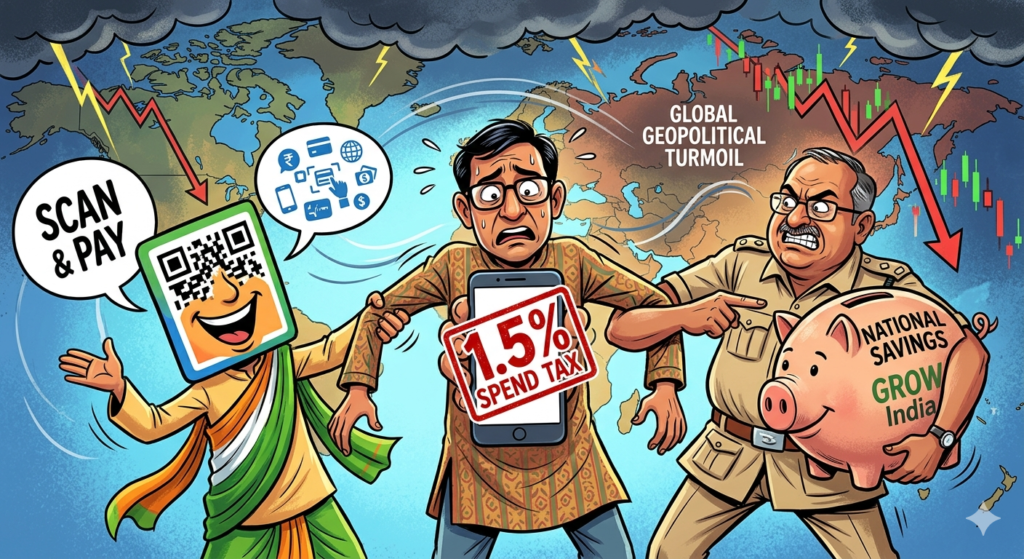

📢 New Tax Rules From This Financial Year: 1.5% ‘Spend Tax’ Levied on Every UPI Transaction to Boost Savings
As the new financial year dawns upon us — bringing with it the familiar dread of ITR filings, revised mutual fund statements, and resolutions to “finally track expenses” — the government has ushered in a fiscal reform that nobody saw coming. Effective from today, the start of FY 2026-27, a 1.5% ‘Spend Tax’ will be applied on all Unified Payments Interface (UPI) transactions across the country. The notification, quietly uploaded to the income tax department’s website in the wee hours of April 1st, states that the levy is designed to “cultivate a culture of mindful consumption and accelerate household savings in an uncertain global landscape.”
I discovered this new reality while attempting to pay ₹40 for a plate of steaming idlis at my neighborhood joint. As the familiar UPI interface lit up, a pop-up I had never seen before appeared: “Spend Tax (1.5%): ₹0.60. Total payable: ₹40.60. Note: Saving is not just prudent — it is now incentivized via taxation.” The idli vendor, a pragmatic man named Subramaniam who has seen demonetization, GST, and now this, simply shrugged. “Saar, last year they wanted everyone to go digital. This year they say digital is too expensive. Next year maybe they will tax breathing also. I will just add 1.5% to idli price.” And just like that, the great Indian savings revolution began — one irritated breakfast transaction at a time.
While domestic Twitter erupted into a meme-storm that would make even the most stoic bureaucrat crack a smile, economic analysts were quick to point out that the Spend Tax is not merely a domestic fiscal instrument — it is a direct response to the crumbling architecture of global economic stability. Consider the backdrop against which this new financial year begins: the Red Sea trade routes remain a geopolitical chessboard where container ships navigate like reluctant knights; Western sanctions have fragmented global payment systems into rival blocs; and the US dollar’s unshakeable dominance is being questioned by a coalition of emerging economies meeting in conference rooms that smell of ambition and fresh paint. In such a climate, a nation’s greatest asset isn’t its foreign exchange reserves alone — it is the collective savings of 1.4 billion citizens who can weather a storm without running to the IMF with a begging bowl.
The Finance Minister, in a press briefing that felt equal parts economic seminar and gentle scolding from a favorite aunt, elaborated on the geopolitical rationale. “When Argentina faced its debt crisis, what saved them? Savings. When Türkiye battled runaway inflation, who survived? Those with cushion. When Japan stagnated for three decades, who remained comfortable? The diligent savers. We are learning from history so our citizens don’t have to relive it. This tax is a reminder — a gentle, recurring, unavoidable reminder — that the world is unpredictable and your rainy day fund should be thicker than your swiggy order history.” She then unveiled a chart showing the correlation between national savings rates and geopolitical resilience, which looked suspiciously like an inverted version of her son’s crypto portfolio.
The irony is not lost on anyone. For the better part of a decade, we were told that UPI was the path to prosperity. We digitized our roadside tea stalls, our vegetable vendors, our temple donation boxes, and even the local bhajan mandali started accepting QR code payments. We celebrated “Digital India” with the enthusiasm of a toddler given a new tablet. And now, just as we have fully embraced frictionless transactions — tapping, scanning, and paying with the casual indifference of billionaires — the government has installed a speed bump on the information superhighway. It’s like being encouraged to run a marathon, only to be told at the 40-kilometer mark that every additional step will cost you. The sense of betrayal among India’s 400 million active UPI users is palpable, though it mostly manifests as clever WhatsApp forwards and unusually heated discussions at family dinners.
Global reaction has been a mixture of fascination and horror. The IMF released a statement commending India’s “innovative approach to fiscal behavioral modification,” which economists translated as “we have no idea if this will work but it’s entertaining to watch.” The World Bank reportedly requested a detailed implementation framework, presumably to consider exporting the model to other developing nations. European newspapers ran headlines like “India Taxes Digital Payments to Cure Spending Addiction” with a tone that suggested both admiration and the quiet relief that they aren’t the ones experimenting. A Bloomberg columnist quipped: “If India’s Spend Tax succeeds in boosting savings without triggering a cash economy resurgence, half the world’s finance ministries will be on a plane to New Delhi by June. The other half will be too busy dealing with their own debt crises to travel.”
Closer to home, the ground reality is a fascinating study in human adaptability. Entrepreneurs have already launched “Spend-Tax-Optimizer” apps that route payments through a labyrinth of wallets and prepaid instruments, promising to reduce the effective tax rate to 0.4%. The RBI, in a circular that seemed to anticipate such shenanigans, clarified that any attempt to artificially structure transactions to evade the Spend Tax would attract a 5% “Circumvention Penalty,” plus a sternly worded email. Meanwhile, a new genre of influencer has emerged: the “Save-Fluencer,” who creates content around zero-spend challenges, DIY budgeting journals, and the spiritual benefits of not buying things you don’t need. Their most viral video features a young man paying his electricity bill by reciting a poem about the transience of material wealth. The electricity board accepted the poem, though they did add a late payment fee.
Small businesses are navigating the new landscape with their characteristic resilience. Kirana store owners now offer “pre-tax discounts” for cash payments, inadvertently giving the informal economy a new lease on life. Restaurant bills come with a handwritten note: “Pay via cash and receive one free papad. Pay via UPI and receive one free existential crisis.” Auto-rickshaw drivers, ever the philosophers of the road, have started quoting fares as “Seventy rupees plus tax, madam. Government wants you to save, so I am helping by taking more.”
The geopolitical subtext grows more intriguing by the day. With the US-China trade war showing no signs of resolution, and Europe grappling with its own energy transition headaches, emerging economies are being forced to build internal buffers. India’s Spend Tax, viewed through this lens, is less about the immediate revenue (estimated at a modest ₹8,000 crore annually) and more about sending a signal: we are serious about domestic financial resilience. As one former economic advisor put it over a dinner that was suspiciously free of digital payments: “When the global financial system sneezes, you don’t want to be the country without a handkerchief. The Spend Tax is our handkerchief. It’s a bit scratchy, and nobody asked for it, but it’s better than catching a cold.”
There is, however, a deeper philosophical question buried under the memes and the merchant grumbling. If the goal is to encourage saving, why tax spending rather than simply reward saving? The government’s answer, embedded in the 203-page finance bill that nobody outside of a few sleep-deprived bureaucrats has fully read, is that the revenue from the Spend Tax will be channeled into a “National Savings Incentive Fund” that will eventually provide matching contributions to citizens who maintain a minimum savings balance. In theory, your own taxation today could become your retirement bonus tomorrow. In practice, it feels a bit like the government taking a slice of your pizza and promising to return it as a full pie if you don’t eat for five years.
As the first day of the new financial year draws to a close, what can we say about the Spend Tax experiment? It has certainly achieved one thing: it has made everyone think about every single digital payment they make. That ₹5 payment to a colleague for splitting a coffee? Taxed. The ₹2 you send to your sibling to annoy them? Taxed. The charitable donation of ₹500 to a temple? Taxed, though religious institutions have reportedly asked for an exemption on the grounds that divine blessings should not be subject to TDS (Tax Deducted at Source for Salvation).
The memes, as expected, have been magnificent. The internet is flooded with jokes about “UPI — UPI (Universal Payment Interface) now stands for ‘Unwanted Payment Imposition’.” Others have calculated that if they make 50 UPI transactions a day (which, let’s be honest, many of us do), the annual Spend Tax would be enough to fund a modest vacation — which they would then be too broke to take because they spent all their money on the tax itself. The circular logic is not lost on the masses.
Just kidding. There is no 1.5% ‘Spend Tax’ on UPI transactions. This entire article, the finance ministry quotes, the global geopolitical analysis, and the idli vendor’s resigned wisdom — all of it is a satirical construction designed to remind you what day it is. No new tax rules have been introduced this financial year that levy a surcharge on digital payments. Your UPI transactions remain as free (monetarily speaking) as they were yesterday. However, given the state of global economic uncertainty and the government’s demonstrated love for creative fiscal interventions, would anyone really be shocked if this showed up in next year’s budget? Probably not. Which is why we wrote this — to make you smile, to make you think, and to remind you that in the game of financial pranks, April 1st always wins.
✨ This article was produced by the Bureau of Imaginative Fiscal Policy, in collaboration with the Department of Mildly Uncomfortable Laughter. ✨
*No actual UPI transactions were taxed in the making of this article. The author’s savings account, however, remains in critical condition due to an unfortunate combination of book purchases and online course enrollments. Please save responsibly.*