
SIP Calculator for Mutual Fund Investments: How to Calculate Your SIP Returns Accurately (2026 Guide)
Last Updated: March 2026 | Reading Time: ~10 minutes | Category: Mutual Funds, SIP Investing
>Imagine investing just ₹5,000 a month and walking away with over ₹95 lakhs in 20 years. Sounds dramatic? It is — and it is entirely possible through the power of SIP investing in mutual funds. But here is the thing: most Indian investors start a SIP without ever calculating what that money will actually grow into. They pick a fund, set up an auto-debit, and hope for the best.
That is precisely why a SIP calculator for mutual fund investments is one of the most valuable financial tools you can use before putting a single rupee to work. It gives you clarity, sets realistic expectations, and — perhaps most importantly — keeps you invested during market downturns when the temptation to stop your SIP is the strongest.
In this guide, we break down how SIP calculators work, what the numbers actually mean, how to use them intelligently, and what most people get dangerously wrong when reading the output.
What Is a SIP Calculator?
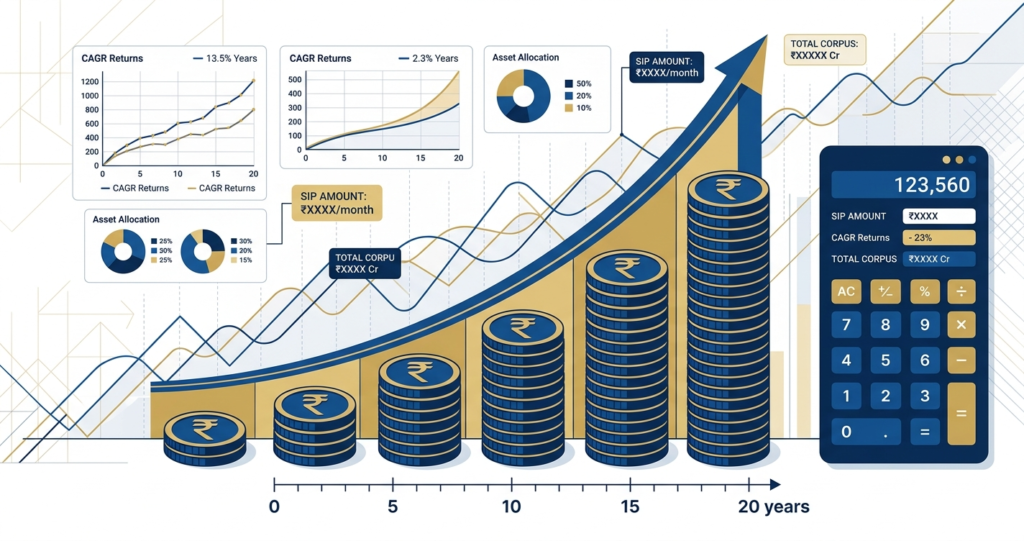
A SIP calculator is an online tool that estimates the future value of your monthly mutual fund investments based on three key inputs: the amount you invest every month, the expected annual rate of return, and the duration of the investment. It applies the concept of compound interest to show you how your wealth can grow over time when you invest consistently.
In simple terms: A SIP calculator tells you — if I invest ₹X every month at Y% annual return for Z years, how much will I have at the end? It does not guarantee those returns. It gives you a projection to plan around.
The formula behind a SIP calculator is based on the future value of a recurring investment, also called an annuity formula:
Where: P = Monthly SIP amount | r = Monthly rate of return (annual rate ÷ 12) | n = Total number of months
You do not need to calculate this manually. Every good SIP calculator handles this instantly. But understanding what drives the formula helps you make smarter decisions about your investment horizon and contribution amount.
How Does a SIP Calculator Work?
When you enter your monthly investment amount, expected return rate, and time period into a SIP calculator, it runs the annuity formula in the background and produces two numbers: the total amount you invested (your principal), and the estimated maturity value (what your investment could be worth). The difference between these two is your estimated wealth gain — the money created purely by compounding and market growth.
Let us walk through a real example. Say you invest ₹10,000 per month for 15 years, expecting an annual return of 12%:
| Input | Value |
|---|---|
| Monthly SIP Amount | ₹10,000 |
| Investment Duration | 15 Years |
| Expected Annual Return | 12% |
| Total Amount Invested | ₹18,00,000 |
| Estimated Maturity Value | ₹50,45,760 |
| Total Wealth Gained | ₹32,45,760 |
You invested ₹18 lakhs over 15 years and potentially walked away with over ₹50 lakhs. That is the compounding engine at work — your money earns returns, and then those returns earn their own returns. Over a long enough timeline, this effect becomes extraordinary.
Why Time Is the Single Most Important Variable in Your SIP
Most investors obsess over which fund to pick. That matters, of course. But the far bigger lever in your SIP outcome is how long you stay invested. An investor who starts early with a modest SIP will almost always end up wealthier than someone who starts late with a large one.
Here is a comparison that makes this uncomfortably clear:
| Investor | Monthly SIP | Duration | Total Invested | Estimated Value @ 12% |
|---|---|---|---|---|
| Starts at 25 | ₹5,000 | 35 Years | ₹21,00,000 | ₹3.24 Cr |
| Starts at 35 | ₹10,000 | 25 Years | ₹30,00,000 | ₹1.89 Cr |
| Starts at 40 | ₹20,000 | 20 Years | ₹48,00,000 | ₹1.99 Cr |
The investor who started at 25 invested less money in absolute terms but ended up with the most — simply because compounding had more years to work. This is the most powerful lesson a SIP calculator can teach you, and it is why financial advisors consistently say: the best time to start a SIP was yesterday; the second best time is today.
For a deeper dive into choosing the right funds for long-term investing, read our article on Best SIP to Start in 2026: Top Mutual Fund Plans for Every Indian Investor.
What Return Rate Should You Use in a SIP Calculator?
This is where most people make a critical error. They plug in 20% returns because their friend’s fund returned 22% last year, or because they read an optimistic article online. A SIP calculator is only as useful as the assumptions you put into it.
Here are realistic annual return benchmarks to use as planning assumptions in India:
| Fund Category | Conservative Estimate | Moderate Estimate | Optimistic Estimate |
|---|---|---|---|
| Large Cap Equity | 10% | 12% | 14% |
| Mid Cap / Small Cap | 12% | 15% | 18% |
| Flexi Cap / Multi Cap | 10% | 13% | 16% |
| Hybrid / Balanced Fund | 8% | 10% | 12% |
| Index Fund (Nifty 50) | 10% | 12% | 13% |
Always run your SIP projections at a conservative rate first, then at a moderate rate. This builds a range of outcomes rather than a single number you get emotionally attached to. Plan for the conservative scenario. Anything above that is a bonus.
SEBI mandates that mutual fund advertisements display the disclaimer: “Mutual fund investments are subject to market risks.” This is not just legal boilerplate. Actual returns will vary year to year. Use the calculator for direction, not precision.
Benefits of Using a SIP Calculator Before Investing
A SIP calculator is not just a number-crunching tool. Used correctly, it is a goal-setting and behavioural finance instrument. Here is what it genuinely does for you as an investor:
1. Goal clarity: When you type in that you want to accumulate ₹1 crore in 15 years, the calculator tells you exactly how much you need to invest per month. That number becomes your SIP target. It turns abstract goals into concrete monthly commitments.
2. Behavioural anchor: Markets will fall. There will be months when your SIP portfolio shows negative returns. Having pre-calculated your expected long-term outcome helps you stay invested rather than panic-selling. You know the math works in your favour over time.
3. Comparison of scenarios: What happens if you increase your SIP by ₹2,000 a month? What if you extend the tenure by 5 years? A calculator lets you explore these trade-offs instantly without any guesswork.
4. Inflation awareness: Many calculators now include inflation-adjusted returns. If your target corpus is ₹1 crore today but you are investing for 20 years, that ₹1 crore will have the purchasing power of roughly ₹37 lakhs in today’s money (assuming 5% inflation). A good SIP calculator helps you account for this reality.
5. Reduces over-reliance on “hot tips”: When you see the numbers work on paper through regular disciplined investing, you are far less likely to chase sectoral funds or thematic NFOs that promise extraordinary returns.
Risks and Limitations of SIP Calculators You Must Know
Here is what most SIP calculator articles conveniently leave out: the calculator has no idea what the market will actually do. It is running a formula, not a prediction. The number it shows you is a projection based on a fixed assumed return — and real market returns are anything but fixed.
1. Assumes a constant rate of return: Real equity markets deliver lumpy, inconsistent returns. A fund might return 35% in one year and -15% the next. The calculator smooths this into a steady 12%, which is useful for planning but not a guarantee of outcome.
2. Does not account for exit load and expense ratio: Every mutual fund charges an expense ratio — typically between 0.10% for direct index funds and 1.5–2% for actively managed funds. Over 20 years, a 1% difference in expense ratio can cost you lakhs. Factor this into your expected return assumption.
3. Tax on redemption is not included: When you redeem your equity mutual fund units after a year, long-term capital gains (LTCG) above ₹1.25 lakh are taxed at 12.5% (as per current rules). The calculator typically shows pre-tax values. Your actual in-hand amount will be lower.
4. Inflation erosion is often ignored: ₹50 lakhs in 2045 will not buy what ₹50 lakhs buys today. Always look at inflation-adjusted projections, especially for long-term retirement planning.
For a deeper understanding of cost-efficient investing, read our comparison of Index Fund vs Active Fund in India 2026 — which one should you really choose?
Who Should Use a SIP Calculator?
Almost every investor benefits from running a SIP projection — but there are specific situations where it becomes especially valuable.
First-time investors who are deciding how much to invest benefit enormously from seeing projections in black and white. The abstract idea of “investing ₹5,000 a month” becomes tangible when you see that it compounds to ₹49 lakhs in 20 years.
Goal-based investors saving for a specific milestone — a home down payment in 7 years, a child’s education in 12 years, or retirement in 25 years — can reverse-engineer their required monthly SIP amount by inputting the target corpus and working backwards.
Existing SIP investors who want to review whether they are on track for their targets should run a calculation annually. Life circumstances change. Income grows. Goals shift. Your SIP amount should evolve too.
Investors considering a Step-Up SIP will find advanced calculators particularly useful. A step-up SIP increases your contribution by a fixed percentage every year — typically aligned with your salary increment. The difference in outcome compared to a flat SIP is striking. Read more about this in our guide on the SIP Step-Up Strategy and how it builds significantly more wealth.
When You Should Not Rely on Google (and Need a Real Expert Instead)
SIP calculators and online articles — including this one — are educational resources. They help you understand concepts, run projections, and make more informed decisions. But there are situations where this is genuinely not enough, and where reading more articles is actually a form of procrastination that costs you real money.
You have a large inherited lump sum to invest. Deploying ₹25 lakhs or ₹50 lakhs efficiently requires a proper financial plan — not a SIP calculator. Tax implications, asset allocation, staggered investment strategy, and fund selection all intersect in ways that a generic online tool cannot handle for your specific situation.
You are within 5 years of retirement. At this stage, your investment strategy shifts from accumulation to capital preservation. Asset allocation decisions during this window can make or break your retirement corpus. A qualified SEBI-registered investment advisor (RIA) will evaluate your full financial picture.
You are making investment decisions with borrowed money or by stopping an emergency fund. No SIP projection justifies investing money you cannot afford to lock away. A financial planner can help you sequence your financial priorities.
Your tax situation is complex. Business owners, NRIs, or individuals with multiple income streams face layered capital gains tax scenarios that online calculators do not address. A chartered accountant or tax advisor should be part of your investment planning process.
The internet is an excellent starting point. A SEBI-registered financial advisor is where you finish. You can find registered advisors at SEBI’s official website or through the AMFI portal.
Key Takeaways
1. A SIP calculator is a projection tool, not a guarantee. Use it to set direction, not carve promises in stone.
2. Time in the market beats monthly SIP amount. Starting early — even with a small amount — is almost always the better choice.
3. Use conservative return assumptions (10–12% for equity) to avoid over-estimating your future corpus.
4. Always account for expense ratio, exit load, and capital gains tax — these are real costs that reduce your actual returns.
5. Step-Up SIPs, where you increase your contribution annually, can dramatically accelerate wealth creation.
6. For complex financial goals, inherited wealth, or retirement planning, consult a SEBI-registered investment advisor — online tools have clear limits.
Frequently Asked Questions (FAQ)
What is a SIP calculator and how does it work?
A SIP calculator is an online tool that estimates the future value of your systematic investment plan contributions. You enter your monthly investment amount, expected annual return, and investment tenure. The tool applies a compound interest formula to project your estimated maturity value and wealth gain over the period.
Is the return shown in a SIP calculator guaranteed?
No. A SIP calculator projects returns based on a fixed assumed rate, such as 12% per year. Actual mutual fund returns fluctuate with market conditions. The calculator gives you a useful planning estimate, not a contractual guarantee of any specific return.
How much SIP is needed to get ₹1 crore in 15 years?
At an assumed annual return of 12%, you would need to invest approximately ₹19,800 per month for 15 years to accumulate ₹1 crore. At a 15% return assumption, the required monthly SIP drops to around ₹14,400. Use a calculator to adjust these numbers for your specific scenario.
Can I use a SIP calculator for ELSS mutual funds?
Yes. ELSS funds have a 3-year lock-in period, but the SIP calculator works the same way. Enter your monthly investment, expected return, and the number of years you plan to invest. Keep in mind that each SIP instalment in an ELSS fund is locked individually for 3 years from its investment date.
What return rate should I use in a SIP calculator for India?
For Indian equity mutual funds, using 10–12% per year is a reasonable, historically grounded assumption for long-term projections. For debt funds, 6–7% is more appropriate. Always run calculations at both conservative and moderate rates to build a range of possible outcomes.
Does a SIP calculator account for taxes?
Most standard SIP calculators display pre-tax projections. When you redeem equity mutual fund units held for over a year, long-term capital gains exceeding ₹1.25 lakh are taxed at 12.5%. Your actual take-home amount after tax will be lower than the calculator’s output.
Conclusion: The Calculator Is a Tool — Your Discipline Is the Strategy
A SIP calculator is one of the most democratising tools in personal finance. In two minutes, any investor in India — with no finance degree and no expensive advisor — can understand the trajectory of their wealth. That is genuinely powerful.
But the calculator only works in your favour when you actually start a SIP, maintain it through market cycles, increase it as your income grows, and stay invested long enough for compounding to do its job. The tool projects the destination. You have to show up for the journey — every month, for years.
Use the SIP calculator above, input honest numbers, and start with whatever amount you can afford today. The worst SIP is always the one you planned to start next month.
Disclaimer: This article is for educational purposes only and does not constitute investment advice. Mutual fund investments are subject to market risks. Please read all scheme-related documents carefully before investing. Consider consulting a SEBI-registered investment advisor for personalised financial guidance.