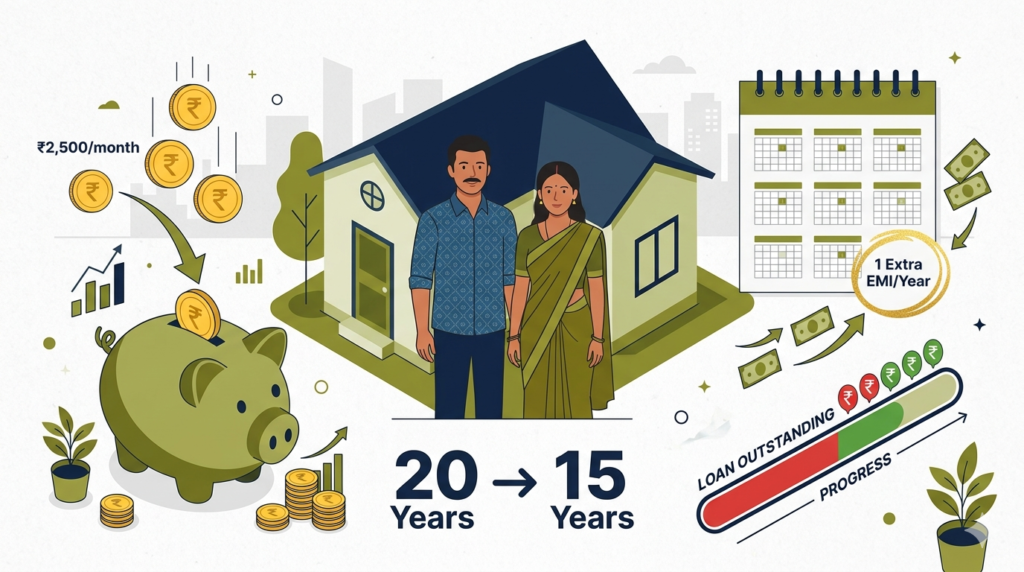

How I Reduced My Home Loan Tenure from 20 Years to 15 Years — One Small Prepayment at a Time
A real-life playbook on using monthly micro-savings, annual bonus payments, and one extra EMI per year to save lakhs of interest and own your home sooner.
It was a humid Tuesday evening in Bengaluru when I first opened the amortisation schedule on my home loan. I had taken a loan of ₹50 lakhs at 8.5% interest for 20 years. What I saw shook me: by the time I paid the last EMI, I would have paid the bank nearly ₹1.06 crore in interest alone — more than double what I borrowed. My house would technically cost me ₹1.56 crore for a ₹50 lakh loan.
That evening, I decided something had to change. And change it did — not through some windfall or lottery win, but through a dead-simple system: small monthly savings parked into my EMI-linked account, annual bonus prepayments, and one extra EMI paid every single year.
Today, my 20-year loan will be cleared in approximately 15 years — saving me five full years of EMIs and potentially ₹12–18 lakhs in interest (depending on how rates move). In this article, I’ll walk you through exactly how I did it, the math behind it, the mistakes I almost made, and how you can replicate this strategy regardless of your loan size.
📋 Table of Contents
- Why Home Loan Prepayment is the Best Low-Risk Investment
- My Exact Strategy: The Three-Pillar System
- Pillar 1 — Monthly Micro-Savings (₹2,000–₹3,000/month)
- Pillar 2 — One Extra EMI Every Year
- Pillar 3 — Using Annual Bonus for Lump-Sum Prepayments
- The Math: How Much Does Each Prepayment Actually Save?
- Real-Life Case Study: My Loan Journey Year by Year
- Expert Tips: Making Prepayment Work Harder
- Common Mistakes to Avoid
- Frequently Asked Questions
- Conclusion
Why Home Loan Prepayment Is the Best Low-Risk “Investment” You Can Make
Before we get into the how, let’s talk about the why — because many people ask me: “Shouldn’t I invest that extra money in mutual funds or stocks instead of prepaying my loan?”
Here’s the answer: your home loan is charging you 8.5% to 9.5% per annum (floating rate, as of 2024–25 averages). That return is guaranteed, risk-free, and tax-adjusted. To beat it consistently through equity investing, you’d need returns above 10–12% post-tax — which is possible but never guaranteed.
💡 The Guaranteed Return Principle
Every rupee you prepay on your home loan gives you a guaranteed, immediate return equal to your interest rate. If your rate is 8.75%, prepayment gives you 8.75% risk-free return. No mutual fund, fixed deposit, or bond can match this for a risk-free return profile.
Additionally, there’s a powerful psychological benefit: owning your home debt-free earlier dramatically reduces financial stress, especially during job uncertainty or health emergencies. A lower or shorter loan gives you room to breathe.
What Happens Inside Your EMI (The Hidden Trap)
Most people don’t realise this: in the early years of your home loan, the vast majority of your EMI goes towards interest, not principal. Here’s a simplified example for a ₹50 lakh loan at 8.5% for 20 years:
| Year | EMI (₹) | Interest Component | Principal Component | Principal Outstanding |
|---|---|---|---|---|
| Year 1 | 43,391 | ~₹35,000 | ~₹8,391 | ~₹49.1 lakhs |
| Year 5 | 43,391 | ~₹31,200 | ~₹12,191 | ~₹44.3 lakhs |
| Year 10 | 43,391 | ~₹24,500 | ~₹18,891 | ~₹34.5 lakhs |
| Year 15 | 43,391 | ~₹14,000 | ~₹29,391 | ~₹19.2 lakhs |
*Approximate figures. Actual EMI and split depends on exact rate and bank calculations.
See the problem? In Year 1, over 80% of your EMI is going to interest. You’re paying ₹35,000 to the bank and only ₹8,391 reduces your actual debt. This is why prepayment in the early years of the loan is exponentially more powerful than prepayment in the later years.
My Exact Strategy: The Three-Pillar Prepayment System
I didn’t have a massive surplus. I wasn’t earning a crore-per-year salary. I was a salaried professional in Bengaluru with a middle-class income and the usual expenses: school fees, car loan, rent (before possession of the flat), groceries, and occasional holidays. My approach was built on three simple pillars that anyone can follow.
🏛️ The Three Pillars
- Pillar 1: Park ₹2,000–₹3,000 every month into the EMI-linked bank account as micro-savings, and prepay when the accumulated amount exceeds one EMI
- Pillar 2: Pay one full extra EMI every year (around festival season or year-end)
- Pillar 3: Direct 100% of annual bonus/increment arrears towards lump-sum prepayment
Pillar 1 — Monthly Micro-Savings: The ₹2,000–₹3,000 Trick
This was the most creative part of my strategy and something I’ve never seen anyone write about explicitly. Here’s the key insight that my bank relationship manager shared with me:
Most banks allow prepayments only when the amount equals or exceeds one EMI. So if my EMI was ₹43,391, I couldn’t just walk in and prepay ₹5,000 randomly. I needed to accumulate at least ₹43,391 before I could make a part-payment.
The Micro-Saving Method
Instead of waiting to “save up” a large lump sum, I started transferring small amounts into the same bank account linked to my home loan EMI every month:
- Month 1: Transfer ₹3,000 extra into the account
- Month 2: Transfer ₹2,500 extra
- Month 3: Transfer ₹3,000 extra
- … and so on
I treated this as a non-negotiable monthly “investment,” just like my SIP. It went out on the 5th of every month automatically via a standing instruction. I didn’t think of this money as “available.” It was already gone.
⚠️ Important: Why Park in the EMI Account?
The trick is to park it in the same account from which EMIs are debited. This means the money is always ready, you’re not tempted to spend it, and the moment the accumulated amount crosses one EMI value, you can walk into the bank (or use net banking) to initiate a part-payment. There’s no friction, no delay.
How Quickly Does This Add Up?
Let’s say you transfer ₹2,500 per month on average. In just 17–18 months, you’ll have accumulated roughly ₹43,000–₹45,000 — enough to make one full prepayment. That’s one extra full prepayment every 17 months just from ₹2,500/month.
Over 5 years, that’s approximately 3 additional prepayments from micro-savings alone, on top of your regular EMIs. Each prepayment in the early years could save you 6–10 months of the overall loan tenure.
✅ Pro Tip: Use UPI Autopay
Set up a UPI AutoPay or Standing Instruction from your salary account to your loan-linked account for ₹2,000–₹3,000 on salary credit day (typically 1st or 2nd of the month). This way, the money moves before you even think about spending it — a classic “pay yourself first” approach applied to debt reduction.
Pillar 2 — One Extra EMI Every Year: Deceptively Powerful
This is perhaps the most well-known home loan hack, but very few people actually implement it consistently. The rule is simple: every year, pay one additional EMI as a prepayment.
This is 13 EMIs in a year instead of 12. For most middle-class Indian households, this is achievable if you plan for it. Here’s how I funded it:
- Dividing my EMI by 12 and setting aside that amount every month separately (₹43,391 ÷ 12 = ₹3,616/month saved in a liquid fund)
- By December or March, I had the full extra EMI amount ready
- I paid it as a prepayment, clearly tagged as “Part Payment” not as next month’s EMI
📊 The Compounding Effect of 1 Extra EMI/Year
On a ₹50 lakh loan at 8.5% for 20 years, paying one extra EMI per year consistently can reduce the tenure by 4–5 years and save approximately ₹8–12 lakhs in interest. This single habit alone is transformative.
How to Ensure the Extra EMI Goes as Prepayment (Not Advance EMI)
This is critical. When you make the payment, explicitly tell your bank it is a “part payment towards principal” — not an advance EMI. Many borrowers make the mistake of paying early and the bank treats it as next month’s EMI, which gives you no benefit in terms of principal reduction.
Always get a written or digital confirmation that the amount has been applied to principal. Most modern bank portals (SBI, HDFC, ICICI) now have a “Prepayment” option in the loan section of internet banking.
Pillar 3 — Annual Bonus: Your Biggest Prepayment Weapon
If you’re a salaried employee in India, you likely receive some kind of annual bonus — performance bonus, variable pay, profit sharing, or LTA encashment. For most people in the private sector, this ranges from 10% to 30% of annual CTC.
The typical pattern is: bonus arrives, lifestyle upgrades follow. New phone. Holiday. New appliances. By February, the bonus is a memory.
I changed this pattern completely. My rule was: 100% of my annual bonus goes to home loan prepayment, immediately.
How I Handled the Mental Temptation
I’d be lying if I said it was easy. The first year, my bonus was ₹1.8 lakhs. A big part of me wanted to use it for a holiday to Thailand. Here’s what I did instead:
- I made the prepayment within 48 hours of the bonus hitting my account (before the temptation window opened)
- I immediately checked my updated loan statement to see the new projected payoff date — that visual reward kept me motivated
- I allowed myself a small “celebration” of ₹5,000–₹10,000 from the next month’s salary for a nice dinner or short trip
💰 Impact of ₹1.5–2 Lakh Annual Bonus Prepayment
On a ₹50 lakh loan at 8.5%, a ₹1.5 lakh prepayment in Year 2 of the loan can reduce the total tenure by approximately 14–18 months and save over ₹3–4 lakhs in interest over the loan life. That’s a phenomenal return on what might otherwise have been a forgettable holiday.
Other Lump-Sum Sources I Used
- Income tax refund: Every refund I received went directly as prepayment
- Increment arrears: When salary revision happened mid-year, the arrears lump sum went to the loan
- Matured LIC/insurance policies: One smaller policy matured in Year 4 — I directed its maturity amount straight to prepayment
- Festival bonuses: Diwali bonus, if any, was treated as sacred prepayment money
The Math: How Much Does Each Prepayment Actually Save?
Let me give you a clear comparison table to show the power of each strategy component, assuming a ₹50 lakh loan, 8.5% rate, 20-year tenure:
| Strategy | Total Prepayment Over 5 Yrs | Tenure Reduction | Approx. Interest Saved |
|---|---|---|---|
| No prepayment (base case) | ₹0 | 0 months | ₹0 |
| ₹2,500/month micro-savings (prepay when EMI crossed) | ~₹1.8 lakhs | ~18–22 months | ~₹3.5–4.5 lakhs |
| 1 extra EMI/year | ~₹2.6 lakhs (6 EMIs) | ~48–60 months | ~₹8–12 lakhs |
| ₹1.5L annual bonus prepayment | ~₹7.5 lakhs | ~36–48 months | ~₹10–14 lakhs |
| All three combined | ~₹12 lakhs | ~60–72 months (5–6 years) | ~₹15–20 lakhs |
*Calculations are illustrative and based on reducing balance method. Actual savings depend on prevailing interest rates, bank policies, and timing of prepayments.
⚡ Early Years vs Late Years: Why Timing Matters
A prepayment of ₹1 lakh in Year 2 of a 20-year loan can save you nearly 3–4x more interest than the same ₹1 lakh paid in Year 15. The earlier you start, the more explosive the effect. Time in the loan is your most powerful lever — use it.
📖 Real-Life Case Study: My Loan Journey, Year by Year
Loan Details: ₹50 lakhs | 8.5% (floating) | 20-year tenure | EMI ≈ ₹43,391/month
- Year 1: Started the loan. Set up ₹2,500/month micro-saving transfer. By Month 11, had accumulated ₹27,500. By Month 17, crossed ₹43,000 — made first prepayment of ₹44,000.
- Year 2: Paid one extra EMI in October (Dussehra). Directed full annual bonus of ₹1.8 lakhs in February. Bank updated loan — tenure dropped from 20 years to 18 years 4 months.
- Year 3: Got a salary hike. Increased micro-saving to ₹3,000/month. Made prepayment of ₹46,500 from micro-savings. Extra EMI in November.
- Year 4: LIC policy matured — ₹1.1 lakhs directed to prepayment. Annual bonus of ₹2.1 lakhs entirely prepaid. Tenure now showed 16 years 2 months.
- Year 5: Continued all three pillars. Loan statement showed remaining tenure had dropped to 15 years from original start date — meaning I’d saved 5 years in just 5 years of disciplined prepayment.
Total prepayment in 5 years: Approximately ₹11.8 lakhs
Interest saved (projected): Approximately ₹15–17 lakhs
Tenure reduction: 5 years (20 → 15 years)
Expert Tips: Making Prepayment Work Harder For You
1. Always Choose Tenure Reduction, Not EMI Reduction
When you make a prepayment, your bank will typically ask: do you want to reduce your EMI or reduce your tenure? Always choose tenure reduction. Here’s why: if you reduce the EMI, you’re still paying for 20 years — you just pay a little less each month. But if you reduce the tenure, you get out of debt earlier and save far more in interest.
✅ Rule: Reduce Tenure, Not EMI
Exception: If you’re genuinely cash-flow stressed (like during a job transition), reducing EMI temporarily is acceptable. But as soon as income stabilises, switch back to tenure reduction mode.
2. Track Your Prepayment Impact Immediately
After every prepayment, ask your bank for an updated amortisation schedule. Seeing the tenure drop — even by 3 or 6 months — is psychologically reinforcing. It keeps you motivated for the next prepayment.
3. Don’t Prepay at the Cost of Emergency Fund or High-Interest Debt
This is non-negotiable: never drain your emergency fund to make a home loan prepayment. Your emergency fund (6 months of expenses) should always be intact and parked in a liquid mutual fund or high-yield savings account. Also, if you have personal loan or credit card debt at 18–24%, pay those off first.
4. Check Prepayment Charges (Mostly Gone for Floating Rate)
As per RBI guidelines, banks in India cannot charge prepayment penalties on floating-rate home loans taken by individuals. So if you have a floating-rate loan (which most modern home loans are), you can prepay without any penalty. Always verify this with your specific bank’s terms.
5. Consider Refinancing When Rates Fall Significantly
If your current rate is 9.5% and other banks are offering 8.5%, it’s worth refinancing (balance transfer) to a lower-rate lender. The savings in interest can then be redirected as prepayments. A 1% rate reduction on ₹40 lakhs saves approximately ₹40,000/year.
6. Tax Angle — Don’t Sacrifice 80C Benefits
Home loan principal repayment qualifies under Section 80C (up to ₹1.5 lakh/year) and interest repayment under Section 24(b) (up to ₹2 lakh/year for self-occupied property). Prepayments can increase your principal repayment — potentially maximising Section 80C benefits in early years. However, once you’ve maximised these limits, the tax benefit doesn’t grow further. Plan accordingly.
Common Mistakes to Avoid
🚫 Mistake 1: Not Specifying “Principal Prepayment”
Paying extra money to your bank without explicitly stating it is a part payment towards principal can lead to the bank treating it as an advance EMI. Always use the loan prepayment option in net banking or submit a written request.
🚫 Mistake 2: Choosing EMI Reduction Instead of Tenure Reduction
When the bank asks which option you prefer after a prepayment, many borrowers choose EMI reduction because the monthly relief feels good. This is the more expensive choice long-term. Always choose tenure reduction for maximum interest savings.
🚫 Mistake 3: Prepaying Without an Emergency Fund
Using all liquid savings for prepayment leaves you financially vulnerable. If a medical emergency or job loss hits, you might end up taking a personal loan at 15–24% to cover expenses — wiping out all the interest savings from prepayment.
🚫 Mistake 4: Not Tracking the Updated Amortisation Schedule
Many borrowers make prepayments but never check if they were applied correctly. Banks can and do make errors. Always review your updated loan statement post-prepayment.
🚫 Mistake 5: Stopping Mid-Way
The biggest mistake is being inconsistent. Many people start strong in Year 1 and Year 2, then “pause” in Year 3 for a lifestyle upgrade, and never resume. Consistency over 5–7 years matters far more than a single large prepayment.
🚫 Mistake 6: Ignoring the Interest Rate Environment
If your home loan rate drops to 7% but fixed deposits offer 8.5%, the math might slightly favour FD over prepayment. Reassess periodically — the strategy should be dynamic, not rigid.
❓ Frequently Asked Questions
Conclusion: Small Habits, Enormous Financial Freedom
Reducing my home loan tenure from 20 to 15 years wasn’t a miracle. It didn’t require a windfall or a salary that most people only dream of. It required one clear decision, three simple habits, and five years of consistency.
The ₹2,500 monthly micro-savings I almost dismissed as “too small to matter” accumulated into real prepayments. The one extra EMI every year — funded by saving just ₹3,600/month separately — delivered 4–5 years of tenure reduction on its own. And redirecting my annual bonus towards the loan instead of a holiday gave me something no holiday ever could: the certainty that my home would be fully mine, years earlier than I planned.
If you’re reading this with a home loan statement in hand, here’s my parting advice: open a calculator right now, enter your loan details, and see what happens if you prepay just ₹1 lakh in the next 12 months. The number that comes back — the months shaved off, the interest saved — will motivate you more than anything I can write.
Start small. Start now. Your future self — the one who owns a home debt-free 5 years ahead of schedule — will thank you.