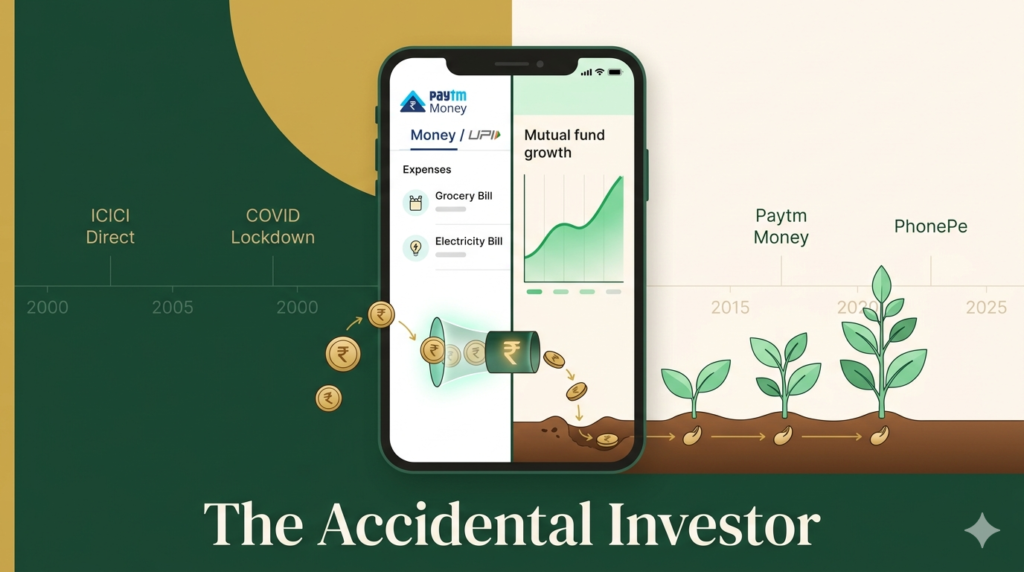

The Accidental Investor:
How My Spending Money Became a Silent Wealth Machine
A 25-year investing journey — from ICICI Direct to COVID-era pharma SIPs via Paytm Money & PhonePe
The Money That Almost Vanished
There is a particular kind of money that every Indian household knows intimately. It lives in your savings account — not the long-term savings, not the FD money, not the money earmarked for your child’s school fees. It is the shapeless, purposeless buffer money: the ₹4,000 that’s left over after the electricity bill, the ₹2,500 that survives the month-end grocery splurge, the stray ₹800 from a cancelled dinner plan.
This money has a very predictable destiny. It becomes chai at the corner tapri that you didn’t really need. It becomes an impulsive midnight order on Swiggy. It becomes an Amazon add-on that gathers dust. Or worse — it just sits there, eroding quietly under the invisible tax called inflation, until you barely remember it existed.
For over two decades, I watched this money. I studied it. I tracked it obsessively in my planned investments through ICICI Direct, where every SIP was deliberate, every equity fund selection was research-backed, every portfolio review was quarterly. I was, by any reasonable measure, a disciplined investor.
And yet, the shapeless money — the expense money — kept slipping through my fingers. Until, quite by accident, it stopped.
“The most powerful investing habit I ever built wasn’t intentional. It was accidental. And that might be the most important financial lesson of my life.”
2000: When It All Began — ICICI Direct and the Early Days
The year 2000 feels like ancient history in the context of Indian retail investing. The BSE Sensex had just crossed 6,000 points for the first time. Online trading was a novelty that very few people understood. Broadband was a luxury. And I, with more curiosity than capital, opened an account with ICICI Direct — one of the earliest online investment platforms in India.
Back then, investing online was an act of faith. You trusted a dial-up internet connection with your hard-earned money. You printed confirmation slips and filed them in physical folders. You read annual reports that arrived by post. It was nothing like the seamless UPI tap-to-invest experience of today. It required effort, patience, and a genuine belief that equities would reward you over the long term.
ICICI Direct Account Opened
Entered the world of online investing during the dot-com era. Early foray into equity mutual funds and direct stocks.
The Bull Run Years
Systematic investments in diversified equity funds. Saw the magic of compounding first-hand through the Sensex rally.
The Great Crash — and Staying Put
Markets fell nearly 60%. The discipline learned over 8 years paid off. Did not redeem. Stayed invested. Watched the portfolio recover and then some.
Two Decades of Compounding
Regular SIPs, annual rebalancing, tax-saving ELSS investments. The ICICI Direct portfolio grew steadily, methodically, intentionally.
The Accidental Chapter Begins
Lockdown, Paytm Money, a pharma fund SIP — and the discovery of a new kind of wealth-building.
My investment philosophy through ICICI Direct was always planned. Every rupee that went into the market was a conscious decision. I had a budget. I had a goal. I had a timeline. The mutual fund investments were as deliberate as a chess move — chosen, timed, executed.
What I never accounted for was the money I didn’t invest. The ₹3,000 here, the ₹5,000 there — the leaky bucket of expense money that had no strategic home.
Two Decades of Disciplined Investing — And the Gap Nobody Talks About
Ask any seasoned investor about their biggest regret, and they’ll rarely say they invested in the wrong fund. More often, they’ll say: “I wish I had invested more of the money I spent carelessly.”
I understood this intellectually. I had read about it. I had probably written about it. But understanding something and living it are very different things. My ICICI Direct account was a model of financial virtue. Monthly SIPs in large-cap funds. Sectoral bets taken only after research. Debt allocation adjusted as I aged. Tax planning done in advance, not in March’s last week.
Financial advisors will tell you that the savings rate — the percentage of your income you invest — matters more than which fund you pick. A modest fund invested consistently for 20 years will almost always beat the “best” fund invested irregularly.
And yet, I had a leak. Every month, I kept a buffer in my savings account and linked UPI accounts for day-to-day expenses. Groceries, fuel, utility bills, dining, random subscriptions, impulsive purchases — all paid through UPI. Through GPay. Through Paytm. The digital payments revolution that India experienced post-2016 (and turbocharged post-COVID) made spending dangerously frictionless.
With one tap, money would leave your account. No physical cash exchanged. No emotional weight of handing over notes. Just a beep, a green tick, and ₹500 gone. Multiplied across a month, across twelve months, across years — the expense buffer that I maintained was quietly being consumed by this frictionless spending culture.
Until COVID arrived and everything changed.
COVID Arrived, and So Did Paytm Money
March 2020. The world shut down. India went into one of the strictest lockdowns globally. Roads were empty. Offices were shut. And for the first time in two decades, my spending patterns were completely disrupted.
There was nothing to spend on. No restaurants. No petrol station visits. No weekend outings. No impulsive mall walks. The expense buffer in my UPI-linked account — the account I normally used through Paytm for daily transactions — was just… sitting there. More of it than usual, because the usual outlets for mindless spending had all been sealed shut.
And somewhere in the boredom of those lockdown evenings, scrolling through the Paytm app after making some payment, I noticed the Paytm Money tab.
Paytm Money, launched in 2018, allows users to invest in mutual funds directly through the Paytm app ecosystem. Because my UPI ID was already linked to Paytm, the onboarding was almost effortless — a few KYC steps, and suddenly, my spending account was also an investing account.
I didn’t plan this. I want to be very clear about that. There was no spreadsheet behind this decision. No risk assessment. No IRR calculation. I was a man in a lockdown, bored, browsing an app, when an investing option appeared in front of me. And something clicked.
The Pharma Bet: Logic Born in Lockdown
If there was one sector that seemed obvious during COVID, it was healthcare. Hospitals were overwhelmed. Pharmaceutical companies were racing to develop vaccines and antivirals. Medicine demand had spiked. The entire world was suddenly, acutely aware of the healthcare industry in a way it had never been before.
I am not a pharma analyst. I don’t read drug pipeline reports. But I understood one simple thing with absolute clarity during those lockdown days: the one thing the world cannot do without right now is medicines and hospitals.
So I started a small SIP in a pharma-focused mutual fund through Paytm Money. Not a large amount — the kind of amount that would have otherwise gone toward a Swiggy order or a random app subscription. The kind of amount that my expense buffer was always leaking anyway.
During COVID, Indian pharma companies — particularly API (Active Pharmaceutical Ingredient) manufacturers and generics exporters — saw unprecedented demand. Funds tracking the Nifty Pharma index delivered exceptional returns between 2020 and 2021. This wasn’t insider knowledge; it was visible, lived reality for anyone paying attention.
The SIP was small. But here is the beautiful, absurd truth about what happened next: I forgot about it.
Not deliberately. I didn’t set it and forget it as a strategy. I genuinely forgot. Life resumed after lockdown. Work picked up. The ICICI Direct account kept running on autopilot as always. And somewhere in the background, the Paytm Money SIP kept running too — drawing from the same account I used to pay for vegetables and internet bills.
Money that was budgeted for expenses. Money that, in any other month, would have been absorbed by the invisible friction of daily life. That money was now, quietly and without my supervision, being invested every single month.
The Ghost SIP — Money Investing Itself
Here is something that nobody in the financial industry will tell you directly, because it sounds almost too simple: the best SIP is the one you forget about.
When you track investments too closely, you develop opinions about them. You see a 3-month dip and feel the urge to pause. You read a bearish article and wonder if you should exit. You compare your fund’s returns to a benchmark and feel vaguely dissatisfied. Tracking creates anxiety. Anxiety creates action. Action, in most cases, creates poor returns.
My Paytm Money account became what I now call a Ghost SIP. It existed in my financial universe without demanding attention. It didn’t send me notifications I obsessed over. I didn’t add it to my portfolio tracker. I didn’t discuss it with my financial advisor. It just… ran. Month after month, in the background, like a slow river that doesn’t make noise but always moves forward.
“The money I was spending thoughtlessly became, accidentally, the money I invested thoughtlessly — and that thoughtlessness turned out to be its greatest advantage.”
I don’t know exactly how much it has grown. And I mean that literally — I have deliberately not checked. The amount would have been modest per SIP instalment. But compounding doesn’t care about per-instalment amounts. Compounding cares about time and consistency. And this account has had both, uninterrupted, since 2020.
What I do know is this: a portion of the money I had mentally written off as “expenses” — money I had budgeted to be spent — did not get spent. It got saved. And not just saved, but invested. There is a profound difference between money sitting in a savings account earning 3.5% and money in a pharma mutual fund that has navigated a global pandemic and returned to growth cycles.
Even ₹500/month invested consistently for 5 years at a 12% annualised return becomes approximately ₹41,000. At ₹2,000/month, that’s over ₹1.6 lakh. The amount per instalment matters far less than the years of consistent investment. Small SIPs from expense money, started and forgotten, can quietly build meaningful wealth.
PhonePe Joins the Party — A Second Ghost Account
If one accidental investing account was a curiosity, a second one became a pattern. And patterns, as any behavioural economist will tell you, are where the real insights live.
PhonePe — another UPI-linked payment app that had become as common in my daily life as a wallet — also has a built-in mutual fund investing feature. And sometime after the Paytm Money experiment, in a moment of very similar boredom-meets-curiosity, I set up a small SIP through PhonePe as well.
Again: not a planned decision. Not the result of a portfolio review or an asset allocation analysis. The app was open, the feature was there, and the friction to start was almost zero. A few taps, a UPI mandate authorisation, and done.
This one I also don’t track. Different account, different fund, same principle: expense money being quietly redirected into the wealth-building system, entirely without my active participation.
India’s UPI ecosystem was designed to make payments frictionless. What most people don’t realise is that this same frictionlessness can be weaponised for wealth creation. Apps like Paytm Money, PhonePe, Groww, and Zerodha’s Coin have embedded investing into the same ecosystem where people spend — creating a powerful opportunity to redirect the expense buffer into investments before it gets spent.
There is something quietly radical about this setup. Most investment advice asks you to save first, spend later. That’s the classical wisdom. Pay yourself first, automate your investments, treat SIPs like EMIs.
But this is something slightly different. This is investing within the expense budget. It’s not additional saving. It’s a quiet redirection — an investment account that lives inside the spending account ecosystem, drawing from the same pool of money that was always going to be used up anyway. Except now, some of it doesn’t get used up. It accumulates.
Key Insights: What 25 Years of Investing — Planned and Accidental — Taught Me
Intention ≠ Outcome
My most intentional investments were planned meticulously. My most surprisingly gratifying ones happened by accident. Both matter.
The Ghost SIP Principle
Investments you forget about are protected from your own worst impulses — timing the market, panic selling, overthinking.
Redirect, Don’t Restrict
You don’t have to cut spending to invest more. Sometimes you just need to redirect a fraction of what flows through your expense account.
Time > Timing
The pharma SIP started during COVID fear. The timing seemed risky. Time in market beat timing the market.
Low Friction = High Compliance
I invested consistently in accounts I almost forgot about. The lower the friction, the higher the consistency.
Plug the Leak
Every household has expense buffer money that evaporates. Even capturing 20% of it into a SIP transforms leakage into legacy.
What this journey describes is a real-world application of nudge theory and automated saving — concepts studied extensively by behavioural economists like Richard Thaler (Nobel Prize, 2017). When the environment makes saving the default behaviour and spending the exception, wealth accumulation happens naturally. The UPI ecosystem, inadvertently, became that environment.
A Real-World Scenario: What the Numbers Might Look Like
I said I haven’t tracked the exact returns. And that’s true. But let me illustrate what this pattern of investing could look like for someone in a similar situation — using conservative, realistic assumptions.
The Scenario
- Monthly expense buffer: ₹15,000 (money kept for daily UPI transactions)
- Amount that gets redirected to Ghost SIPs: ₹2,000/month (across two apps)
- Period: Starting April 2020 to April 2025 (5 years)
- Assumed annualised return: 12% (conservative for equity mutual funds over 5 years)
Total amount invested over 5 years: ₹2,000 × 60 months = ₹1,20,000
Estimated corpus at 12% annualised return: approximately ₹1,63,000+
Gain on money that would have been spent: approximately ₹43,000 — on top of the full capital being preserved.
This is the return on money that was, by every prior intention, going to be consumed by daily expenses. Its very existence as invested capital is itself the win.
But the real return isn’t the ₹43,000 of notional gain. The real return is the ₹1,20,000 of principal that still exists. Money that, in an alternate universe, was spent on things you no longer remember buying.
Common Mistakes to Avoid — Lessons From This Journey
Waiting for the “right” amount to start
Many people delay investing because they feel the amount is too small to matter. The pharma SIP started with what was essentially pocket change. Start with whatever you have — even ₹500/month from your expense buffer counts.
Tracking too obsessively and reacting
The Ghost SIPs worked partly because I didn’t watch them. The investor who checks portfolio value daily is far more likely to make emotional decisions than one who checks annually.
Keeping everything in one platform
Having investments across ICICI Direct, Paytm Money, and PhonePe isn’t a mistake — it’s actually useful diversification of behaviour. Different accounts serve different psychological purposes.
Assuming expense money can’t be invested
Most people mentally ring-fence their expense account and never question whether some of that buffer could be redirected. Question it. Even 15-20% redirection can compound significantly over years.
Ignoring sectoral logic during major economic events
The COVID-era pharma SIP was not a lucky guess — it was a reasonable, observable inference. You don’t need to be a stock analyst to notice that medicine demand spikes during a global health emergency. Observation is underrated.
Further Reading
From Investment Sutras
- Investment Sutras — Home: Your Guide to Investing in India
- How to Start a SIP in India: A Complete Beginner’s Guide
- Mutual Funds vs Fixed Deposits: Where Should You Put Your Money?
- Understanding Sectoral Funds: Risks and Opportunities
External Resources
Frequently Asked Questions
Yes. Both Paytm Money and PhonePe’s mutual fund investing features are SEBI-registered platforms. Your mutual fund units are held by the respective AMC (Asset Management Company), not the app. Even if the app were to shut down, your investments would remain intact and accessible through the AMC directly or through CAMS/KFintech registrars. Always ensure you complete proper KYC before investing on any platform.
Yes. You can invest in the same mutual fund through different platforms — the investments will show up as separate folios under the same AMC, all linked to your PAN. This is perfectly legal and manageable. For consolidation, you can view all investments across platforms using your PAN on the CAMS or KFintech websites.
Pharma mutual funds are sectoral funds that invest primarily in pharmaceutical and healthcare companies. They are higher risk than diversified equity funds because they concentrate exposure in a single sector, which can be volatile. Post-COVID, the sector has seen corrections after its 2020–21 surge. Whether they are worth investing in depends on your risk appetite and investment horizon. Sectoral funds are typically not recommended as the core of a portfolio — they work best as a tactical satellite allocation.
The easiest method is the Consolidated Account Statement (CAS), available free through CAMS (camsonline.com) or KFintech. You input your PAN and email, and you receive a single PDF showing all your mutual fund holdings across all platforms and AMCs. For real-time tracking, apps like Kuvera or INDmoney can aggregate all your mutual fund folios in one place.
Most platforms allow SIPs starting from as low as ₹100 per month for many funds, though some funds have a minimum of ₹500. The frictionless UPI integration means you can set up an auto-debit SIP mandate in under 5 minutes. There is genuinely no barrier to starting small.
The “forget it” approach works well for long-term, goal-agnostic SIPs — money you are building as a general wealth buffer. However, for goal-based investments (home purchase in 3 years, child’s education in 7 years), you should periodically review allocation and rebalance. The key insight from this story is that reducing unnecessary tracking reduces emotional interference — not that you should be permanently oblivious to your finances.
Conclusion: The Thought That Should Keep You Up at Night
Here is a question I want to leave you with, and I want you to sit with it seriously:
How much money has passed through your UPI accounts in the last five years?
If you are a working professional in India, the answer is probably somewhere between ₹15 lakh and ₹60 lakh over five years — payments, transfers, bill settlements, subscriptions, purchases. It flows in and it flows out. Most of it you cannot fully account for.
Now ask yourself: what if even 5% of that flow had been quietly, automatically, invisibly redirected to a mutual fund SIP? What would that corpus look like today?
“Every rupee that passes through your hands is a decision point. Most decisions happen by default — the money gets spent. The extraordinary thing about a Ghost SIP is that it changes the default.”
I did not set out to build a secret investment portfolio from my expense money. I stumbled into it. A pandemic. Boredom. An app I was already using. A sector that seemed obvious. A small SIP amount that I forgot to cancel — because I never needed to cancel it. The money was coming from an account I kept topped up for expenses anyway.
And that is the most honest financial story I can tell you: I did not sacrifice anything to build those Ghost SIP accounts. I did not cut my lifestyle. I did not deprive myself. I simply allowed a fraction of the money I was going to spend anyway to be rerouted, automatically, into the wealth-building system. And because I didn’t watch it too closely, I didn’t interfere with it either.
Twenty-five years of investing through ICICI Direct taught me the power of discipline. Four years of Ghost SIPs through Paytm Money and PhonePe taught me something subtler and perhaps more valuable: the power of designing systems that don’t require discipline at all.
The best savings habit isn’t the one that requires the most willpower. It’s the one that runs while you sleep, while you scroll, while you live your life — quietly, invisibly, patiently building a future you haven’t fully imagined yet.
Your expense money is moving. Right now, as you read this, it is flowing somewhere. The only question worth asking is: where is it going?
Open the Paytm Money or PhonePe app right now. Set up a SIP of ₹500 or ₹1,000 from your expense-linked account. Choose a diversified equity fund. Set the mandate. Then close the app and go live your life. Come back in three years and see what happened. You might be surprised by what you didn’t spend.