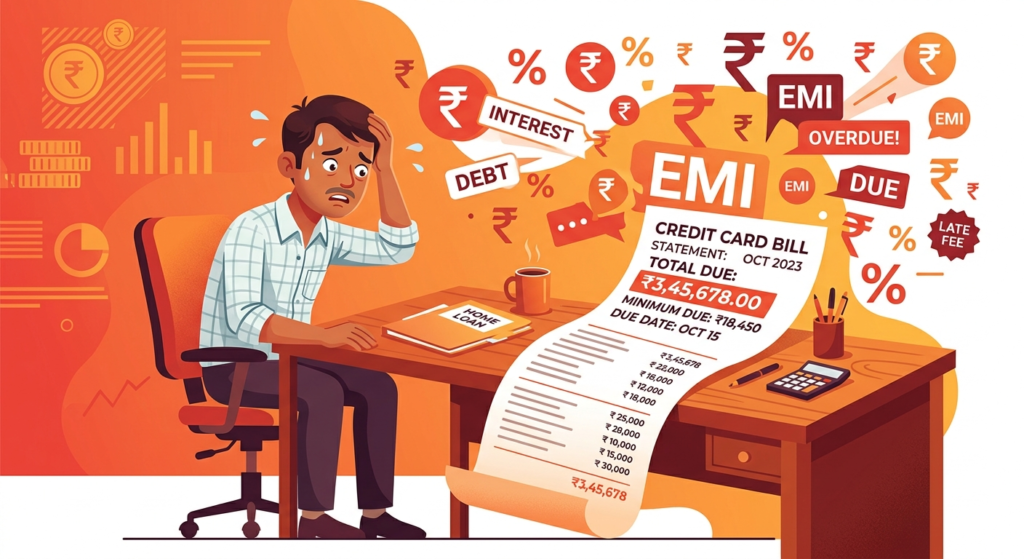

The Credit Card EMI Trap:
How Banks Are Quietly
Draining Your Wallet
Real numbers. Real shock. The ₹50,000 phone that quietly became ₹67,000 — and nobody told you.
Picture this: Ramesh, a 28-year-old software engineer from Pune, walks into a Croma store. He’s eyeing a gorgeous 55-inch 4K TV worth ₹60,000. His salary is ₹45,000 a month. The math doesn’t quite work — but then, like an angel descending from the heavens, the salesman whispers those three magical words:
“No-Cost EMI, sir.”
Ramesh’s eyes light up. “Bhai, ₹5,000 per month for 12 months? That’s nothing yaar!” He swipes his credit card with the confidence of a man who has definitely figured life out.
Six months later, Ramesh is staring at his credit card statement looking like he just discovered his horoscope was right all along. He has paid ₹32,000 already, and somehow still owes ₹34,000. The TV is still great, though. The EMI trap, even better.
Welcome, dear reader, to one of India’s most sophisticated and casually cruel financial instruments: the credit card EMI trap. Banks didn’t build those glass towers by giving you free money. Let’s find out exactly where your money went.
What Is the Credit Card EMI Trap?
At its core, a credit card EMI converts your large purchase into smaller monthly payments. Sounds helpful, right? Like a friendly uncle splitting a restaurant bill. Except this uncle charges you 18–28% annual interest, slaps a processing fee on top, adds 18% GST, and then waves cheerfully as you pay ₹15,000–₹20,000 more than the sticker price.
The credit card EMI trap works because of one powerful psychological trick: it makes large numbers feel small. ₹60,000 feels impossible. ₹5,000 per month? “Haan haan, koi baat nahi.” Your brain registers the monthly number, not the total. Banks know this. They’ve always known this.
The credit card debt India scenario is getting worse every year. According to RBI data, outstanding credit card dues crossed ₹2.7 lakh crore in 2024. That’s not a typo. And a significant chunk of that mountain is built, brick by brick, with EMIs on phones, TVs, laptops, and air conditioners that felt “totally manageable at the time.”
The Real-Life Example: ₹50,000 Phone That Cost ₹67,000
Let’s follow Priya, a marketing executive from Bengaluru, who decides to buy a ₹50,000 smartphone. Her bank offers her an EMI option at 15% per annum for 12 months with a 1% processing fee. Simple enough? Let’s do the actual EMI interest calculation.
Step 1: The Basic EMI Calculation
Banks in India typically use the flat rate method (not reducing balance) for most credit card EMIs. Here’s what that looks like:
Monthly Interest Rate = Annual Rate ÷ 12
= 15% ÷ 12 = 1.25% per month
Total Interest = Principal × Monthly Rate × Tenure
= ₹50,000 × 1.25% × 12
= ₹7,500
Monthly EMI = (Principal + Total Interest) ÷ Tenure
= (₹50,000 + ₹7,500) ÷ 12
= ₹57,500 ÷ 12
= ₹4,792 per month
So far, so visible. But here’s where the real drama begins.
Step 2: The Hidden Charges Revealed
| Charge Component | Calculation | Amount |
|---|---|---|
| Principal (phone price) | As-is | ₹50,000 |
| EMI Interest (flat 15% p.a.) | ₹50,000 × 1.25% × 12 | ₹7,500 |
| Processing Fee (1%) | ₹50,000 × 1% | ₹500 |
| GST on Interest (18%) | ₹7,500 × 18% | ₹1,350 |
| GST on Processing Fee (18%) | ₹500 × 18% | ₹90 |
| Lost Reward Points Value | ~1% of ₹50,000 | ₹500 (gone) |
| Total Actual Cost | ₹59,440 |
Extra paid on a ₹50,000 phone — that’s 18.9% more than the sticker price, for a “15% rate” loan.
But wait — we’re not done. The flat rate of 15% is not what you’re actually paying. Because in a flat rate system, you pay interest on the original full amount throughout the tenure, even as you keep repaying the principal. The effective annual rate is nearly double.
Effective Rate ≈ Flat Rate × 1.83 (approx. multiplier)
= 15% × 1.83
≈ 27.5% per annum (effective)
The “No-Cost EMI” Illusion — India’s Biggest Financial Magic Trick
Oh, you thought “No-Cost EMI” means free? Yaar, that’s adorable. Let’s investigate this together.
When a brand offers No-Cost EMI, someone has to pay the interest — and it isn’t the brand. Here’s how the trick works:
The Discount Stripping Method
Suppose a laptop is listed at ₹80,000, with a cash discount of ₹6,000 (final price: ₹74,000 if you pay upfront). Under No-Cost EMI for 6 months, you pay ₹80,000 ÷ 6 = ₹13,333/month with “zero interest.”
| Payment Method | You Pay | Effective Cost |
|---|---|---|
| Upfront (with discount) | ₹74,000 | ₹74,000 ✅ |
| “No-Cost” EMI (6 months) | ₹80,000 | ₹80,000 ❌ |
| Extra you paid | ₹6,000 (lost discount) | |
| Effective Interest Rate | ~15.2% p.a. (not zero!) |
SEBI and RBI have both flagged misleading “No-Cost EMI” marketing. The Reserve Bank of India has issued guidelines asking lenders to disclose the Annual Percentage Rate (APR) clearly — but the implementation in practice remains patchy. Always ask: “What is the upfront cash price vs the EMI price?”
Full Breakdown: 3-Month vs 6-Month vs 12-Month EMI on ₹1 Lakh
Let’s do the complete EMI interest calculation comparison across tenures for a ₹1,00,000 purchase at the standard bank rate of 15% flat p.a.:
| Tenure | Monthly EMI | Total Interest | Processing Fee + GST | Total Cost | Extra Paid |
|---|---|---|---|---|---|
| 3 months | ₹34,583 | ₹3,750 | ₹1,295 | ₹1,05,045 | ₹5,045 |
| 6 months | ₹17,917 | ₹7,500 | ₹1,295 | ₹1,08,795 | ₹8,795 |
| 12 months | ₹9,458 | ₹15,000 | ₹1,295 | ₹1,16,295 | ₹16,295 |
| 18 months | ₹6,736 | ₹22,500 | ₹1,295 | ₹1,23,795 | ₹23,795 |
| 24 months | ₹5,375 | ₹30,000 | ₹1,295 | ₹1,31,295 | ₹31,295 🔥 |
| *Processing fee assumed at 1% + 18% GST on interest + GST on fee. Flat rate 15% p.a. | |||||
Let that 24-month row sink in. You paid ₹31,295 extra on a ₹1 lakh purchase. That’s almost a third of the product’s price, just handed to the bank. You could have bought a second product at 31% discount. Or invested that ₹31,295 in a mutual fund and let it grow. But no — it’s funding your banker’s Goa trip.
Hidden Charges: The Full Autopsy
Let’s be thorough and expose every single charge that your bank statement buries in 6-point font:
1. Processing Fee (1–2% of Principal)
Charged upfront or added to the first EMI. On ₹1 lakh, that’s ₹1,000–₹2,000 — gone before you’ve watched a single episode on your new TV.
2. GST on Interest (18%)
The government gets 18% of whatever interest you pay. This is a tax on your interest — paying tax to borrow money. Capitalism-level boss fight right there.
3. GST on Processing Fee (18%)
Yes, there’s also GST on the processing fee. Taxception.
4. Foreclosure / Prepayment Penalty (2–3%)
Changed your mind? Want to close the EMI early? Many banks charge 2–3% of the outstanding principal as a penalty. The punishment for trying to escape the trap is a fine. Poetic, really.
5. Reward Points Forfeiture
Most banks do not award reward points on EMI transactions, or only award them on the principal, not the interest component. A 1% rewards credit card on a ₹1 lakh purchase could have given you ₹1,000 in points — poof, gone.
6. Credit Limit Lock-In
For the entire EMI duration, the full purchase amount is blocked on your credit limit. So that ₹1 lakh purchase on a ₹1.5 lakh limit card leaves you with only ₹50,000 of credit for emergencies. For months.
EMI vs Paying Upfront: The Honest Comparison
Here’s the comparison nobody in the banking industry wants printed on a billboard:
💳 EMI Route (12 months, 15% flat)
- Purchase price: ₹60,000
- Total interest: ₹9,000
- Processing + GST: ₹1,620
- Lost rewards: ₹600
- Total spent: ₹71,220
- Effective rate: ~27%
✅ Pay Upfront + Invest EMI Amount
- Purchase price: ₹60,000
- Invest ₹5,935/month in SIP at 12%
- Value after 12 months: ~₹75,200
- Net gain over EMI route: ₹14,000+
- Total cost: ₹60,000
- Reward points retained: ₹600
For those who want to understand the broader picture of debt management in India, this article on personal finance fundamentals at InvestmentSutras lays down the foundational thinking you need before touching any credit product.
When Is EMI Actually Okay? (Yes, There Are Exceptions)
We’re not monsters. There are genuinely valid use cases for credit card EMIs. Here they are — all three of them:
✅ Situation 1: True Medical or Emergency Expense
Your savings are wiped out and you need ₹80,000 for a hospital bill immediately. EMI at 18% is infinitely better than not getting treatment or borrowing from a moneylender at 36%. In emergencies, liquidity > cost.
✅ Situation 2: Business Investment with High Returns
You’re borrowing to buy equipment for your business that will generate 40% returns. If the EMI costs you 27% effective and the asset earns 40%, the arbitrage makes sense. Do the math first, always.
✅ Situation 3: Genuinely Zero-Cost with No Price Inflation
Rare, but occasionally real during mega-sales like Amazon Prime Day or Flipkart Big Billion Days — where both the discount AND the no-cost EMI apply simultaneously. Verify by checking the actual cash price vs EMI price before clicking.
Smart Alternatives to the Credit Card EMI Trap
Here’s how the financially savvy among us handle the same situations without falling into the trap:
1. Save First, Buy Later (The Radical Concept)
Start a dedicated savings goal in a liquid fund or high-interest savings account. Buy when you have the money. Radical? Yes. Revolutionary? Apparently.
2. Personal Loan Instead of Credit Card EMI
If you genuinely need to borrow, a personal loan from a bank typically runs at 10–14% effective rate — far cheaper than the 24–28% effective rate on credit card EMIs. Check rates on platforms like BankBazaar before deciding.
3. Buy Now, Pay in Full at Statement Date
Your credit card has a grace period of 20–50 days. Time your purchase right after your billing cycle cuts, and you get up to 50 days of interest-free float. Pay in full. Zero cost, zero trap.
4. Debit Card + Savings Discipline
The most boring and most effective advice: if it’s not in your account, don’t buy it. The “pain of payment” when swiping a debit card is your brain’s natural overspending protection — don’t override it with plastic.
For a detailed comparison of the best low-interest credit cards in India that minimise these charges, check out the credit card comparison guide at InvestmentSutras — it will save you more than this article scared you.
Also worth reading: the RBI’s Master Directions on Credit Card Operations — the regulator’s official framework for what banks can and cannot do with your credit card EMI.
🏁 The Final Verdict
The credit card EMI trap is not a conspiracy. It’s simply smart banking — smart for the bank, that is. When you choose EMI, you’re essentially paying the bank a significant premium for the privilege of not having money right now. Sometimes that’s okay. Often, it’s avoidable.
The next time a salesperson enthusiastically mentions “No-Cost EMI, sir/ma’am” — smile politely, ask for the upfront cash price, do the math, and then decide. Your future self will either thank you warmly or thank you desperately.
Rule of thumb: If you can pay in full within your billing cycle without hurting your emergency fund → always pay in full. If you can’t → maybe reconsider whether you need it right now at all.
Money, after all, is not just currency. It’s future freedom. Don’t trade it for a TV on EMI.
❓ Frequently Asked Questions