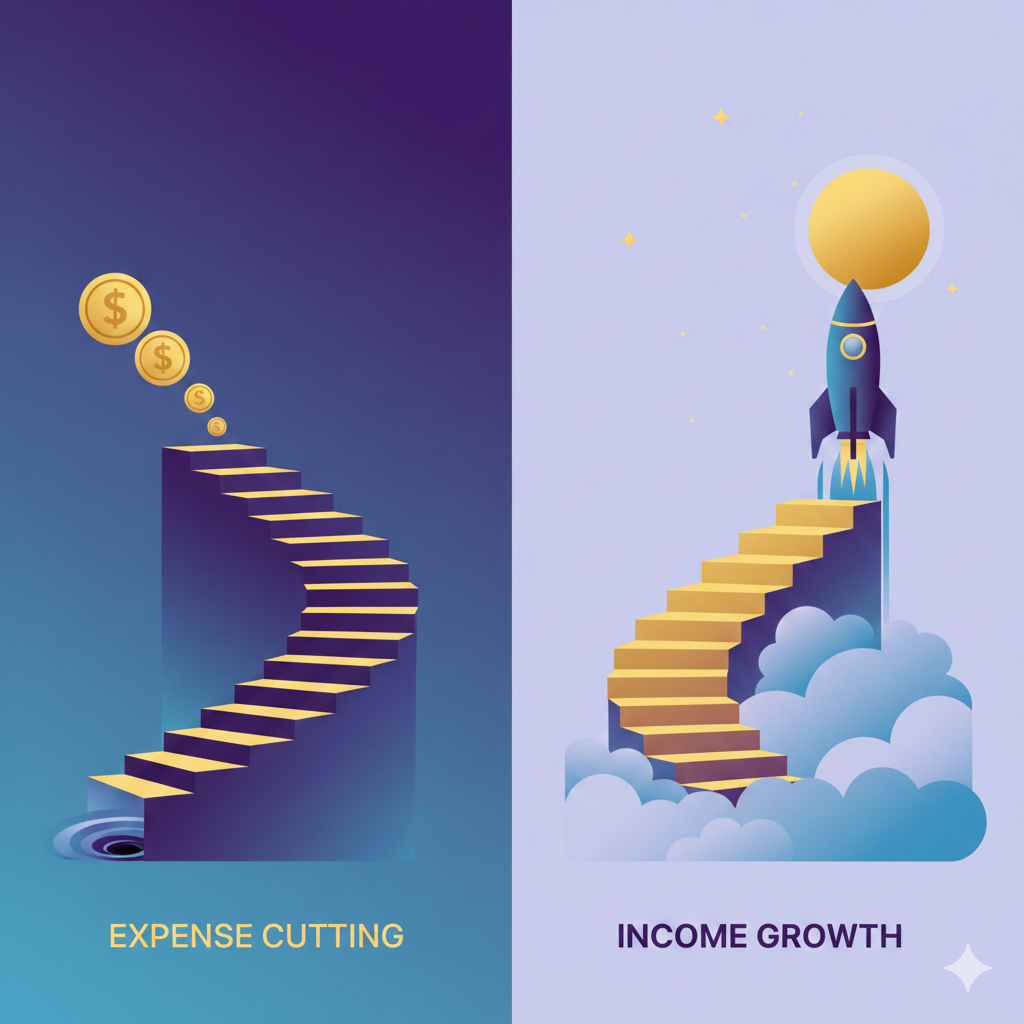

Why Increasing Income Matters More Than Cutting Expenses After a Point
Understanding the fundamental shift from scarcity thinking to abundance creation
In the world of personal finance, there’s a well-worn axiom that has dominated conventional wisdom for generations: spend less than you earn. While this principle forms the bedrock of financial stability, it tells only half the story. The truth is more nuanced and, for many people striving toward financial freedom, more liberating than they might imagine. After reaching a certain threshold of expense optimization, the real transformation in one’s financial life comes not from trimming another percentage point from the budget, but from dramatically expanding the top line of income.
The Mathematics of Diminishing Returns
Let’s begin with a fundamental mathematical reality that governs the expense-cutting approach: expenses have a floor, but income has no ceiling. This asymmetry is perhaps the most compelling argument for why income growth eventually supersedes expense reduction in importance.
Consider someone earning $50,000 annually with expenses of $45,000. Through diligent budgeting, coupon-clipping, and lifestyle adjustments, they might reduce their expenses to $40,000, creating a $10,000 annual surplus instead of $5,000. This represents a 100% improvement in savings—an impressive achievement. However, after cutting the obvious excess, each additional dollar saved becomes progressively harder to extract. Can they realistically cut expenses to $35,000? Perhaps. To $30,000? Unlikely without significant quality-of-life sacrifices. To $20,000? Nearly impossible while maintaining basic dignity and reasonable living standards.
Meanwhile, that same person could increase their income from $50,000 to $60,000 through a job change, from $60,000 to $75,000 by acquiring new skills, and potentially to $100,000 or beyond by switching careers or starting a business. The upward trajectory has no inherent limitation beyond one’s ambition, skills, and market opportunities.
The Psychological Toll of Perpetual Scarcity
Beyond mathematics lies psychology, and here the case for income growth becomes even more compelling. Living in a state of constant expense monitoring creates what researchers call a “scarcity mindset”—a mental framework where every decision is filtered through the lens of limitation. Should I buy this coffee? Can I afford this birthday gift? Is this grocery item worth the premium?
This perpetual calculus extracts a cognitive tax. Studies in behavioral economics have demonstrated that financial scarcity literally reduces cognitive bandwidth, leaving less mental energy for creative thinking, long-term planning, and the very strategic decisions that could lead to income growth. It’s a cruel irony: the more desperately someone focuses on cutting expenses, the less mental capacity they have to pursue the income-growing activities that could truly transform their situation.
A person earning $200,000 annually who spends “wastefully” at $150,000 is in a far better financial position than someone earning $50,000 who frugally spends only $40,000. The absolute gap—not the percentage saved—determines wealth accumulation over time.
Moreover, extreme frugality can backfire in subtle ways. Declining social invitations to save money can damage professional networks that might lead to better opportunities. Avoiding small investments in appearance or skills can limit career advancement. Choosing the cheapest tools or resources can reduce productivity and earning potential. The person who refuses to spend $30 on a professional development book might miss the insight that leads to a $10,000 raise.
The Compounding Power of Income Growth
Perhaps the most profound reason why income growth matters more than expense cutting is the principle of compounding. When you cut $5,000 from your annual expenses, you save $5,000 per year, every year, assuming your expenses remain constant. But when you increase your income by $5,000, the benefits multiply over time in ways that expense reduction cannot match.
First, income raises tend to be permanent and often lead to further raises. Moving from a $60,000 to a $70,000 position doesn’t just net you an extra $10,000 this year; it resets your baseline for all future negotiations and raises. A 10% raise next year on $70,000 is $7,000, not the $6,000 it would have been on your old salary. Over a 30-year career, this compounding effect creates wealth differences measured in hundreds of thousands of dollars.
Second, higher income creates opportunities for wealth-building that simple frugality cannot. The difference between saving $500 per month and $2,000 per month isn’t merely linear—it’s the difference between slowly building an emergency fund and rapidly accumulating capital for investments, business ventures, or real estate. Wealth compounds on wealth, and you need a certain critical mass before compound growth truly accelerates.
The Strategic Inflection Point
So when exactly does the inflection point occur—the moment when focusing on income becomes more valuable than cutting expenses? While individual circumstances vary, several indicators suggest you’ve reached this threshold.
First, if you’ve eliminated high-interest debt and built an emergency fund covering three to six months of essential expenses, you’ve likely optimized the most crucial aspects of your spending. Further cuts would mean reducing quality of life rather than eliminating waste.
Second, if your housing, transportation, and food costs are reasonable for your area and circumstances (typically under 50% of net income combined), additional expense reduction yields diminishing returns. A person spending 30% of their income on a safe apartment in a location that reduces commute time is not wasteful, even if they could technically find something cheaper.
Third, if tracking every dollar spent creates stress disproportionate to the savings achieved, you’ve crossed the line where frugality costs more in wellbeing than it returns in financial benefit. Financial health should serve life satisfaction, not undermine it.
The question isn’t whether to focus on income or expenses—it’s about sequencing. Early in one’s financial journey, expense control creates the foundation. But once that foundation exists, the house of wealth is built by increasing income.
The Opportunity Cost of Attention
Time and attention are finite resources, perhaps more precious than money itself. Every hour spent searching for cheaper insurance, every evening devoted to extreme couponing, every mental cycle spent agonizing over minor purchases represents time not spent on income-producing activities.
Consider the professional who spends five hours weekly managing expense optimization to save $100 per month. That’s roughly 20 hours of effort per month for $100, or $5 per hour of value created. That same person might invest those 20 hours in developing a high-income skill, building a side business, networking for a better position, or creating content that generates passive income. Even modest success in these areas could yield returns of $50, $100, or $200 per hour invested.
The most successful wealth-builders intuitively understand this trade-off. They’re not reckless spenders, but they’re more likely to ask “How can I earn more?” than “Where can I cut costs?” Their attention flows toward expansion rather than contraction.
The Quality of Life Equation
Finally, there’s a dimension that pure financial analysis often misses: the quality of life multiplier effect that adequate income provides. Beyond a certain baseline, cutting expenses almost invariably means reducing life quality, while increasing income creates options that enhance wellbeing without proportional cost increases.
Higher income allows for living in safer neighborhoods, accessing better healthcare, investing in education for oneself and one’s children, maintaining relationships through travel and social activities, and pursuing hobbies and interests that make life rich. These aren’t frivolous luxuries—they’re components of a life well-lived.
Moreover, adequate income provides resilience. When unexpected expenses arise—a medical emergency, a car breakdown, a family crisis requiring travel—higher income means addressing these situations without derailing financial progress or accruing destructive debt. The person who has optimized income can absorb life’s inevitable shocks; the person who has optimized expenses to the edge has no margin for error.
The Balanced Path Forward
The argument for prioritizing income growth over expense reduction after a certain point is not a license for financial recklessness. Basic financial discipline remains essential. The goal is not to spend everything one earns, regardless of income level, but rather to recognize that beyond basic optimization, energy directed toward earning more produces superior results to energy directed toward spending less.
The practical application is this: Achieve baseline expense control first. Eliminate waste, clear destructive debt, build essential savings. But once you’ve established this foundation, shift your primary focus to income expansion. Invest in skills that command higher market value. Build businesses or side ventures. Negotiate assertively for raises. Change jobs strategically for compensation increases. Network relentlessly. Create value at a scale that allows you to capture more value in return.
In doing so, you’ll discover a profound truth: abundance is not created by managing scarcity more efficiently, but by expanding capacity to generate value. The ceiling on expenses is low; the ceiling on income, with skill and effort, barely exists at all. That asymmetry, more than any other factor, explains why increasing income ultimately matters more than cutting expenses on the journey to financial freedom.