
Why Your Mutual Fund Returns Look Great, But Your Wealth Isn’t Growing
You open your mutual fund statement or portfolio tracker, and there it is: a handsome-looking “Annualized Return Since Inception” of 12%, 15%, or even more. The fund’s performance charts are a beautiful upward curve. Yet, when you check your actual account balance or calculate your real-world gains, something feels off. The promised wealth doesn’t seem to match the reality in your bank account. If this disconnect sounds familiar, you’re not alone. This is one of the most common, and frustrating, experiences for investors.
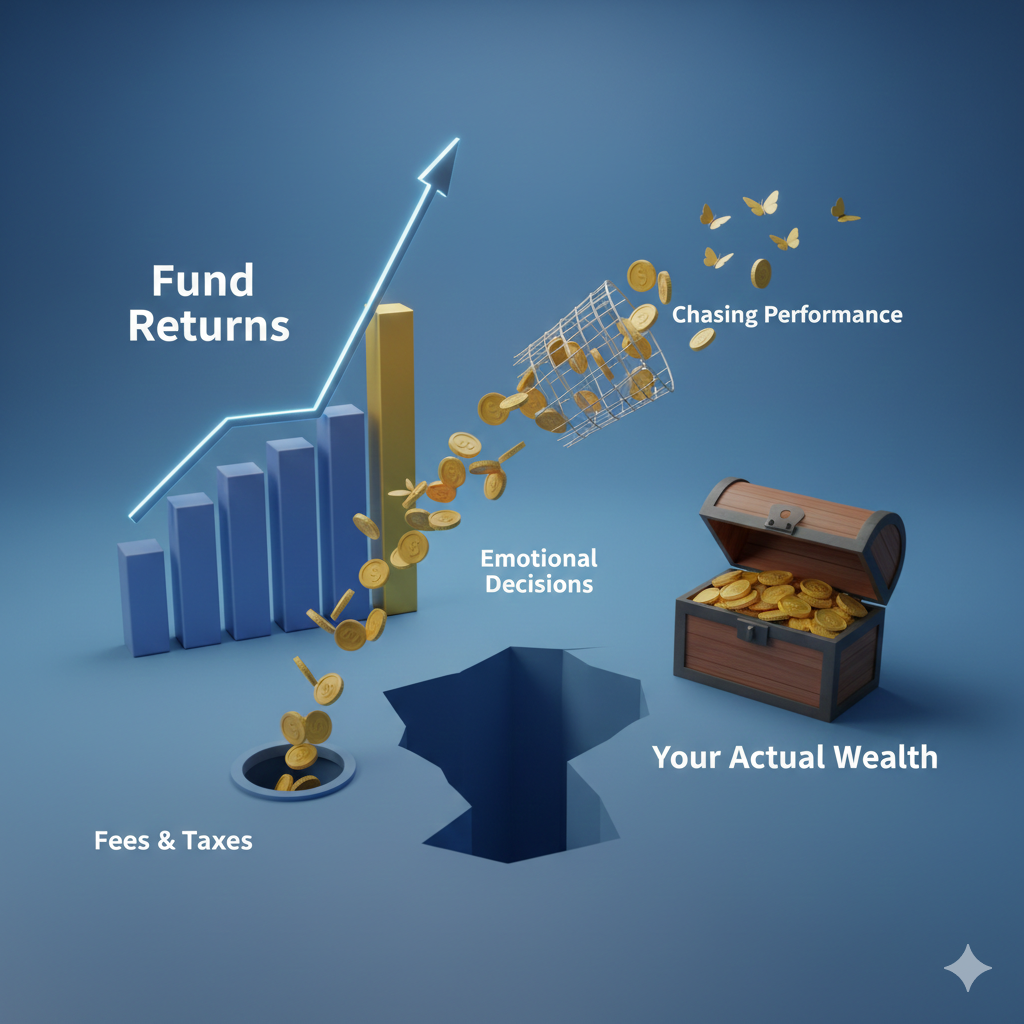
The truth is, the published returns of a mutual fund and the actual wealth you accumulate are often two very different things. This gap isn’t about fraud or poor fund management (necessarily); it’s about the hidden forces that erode your real-world returns. Let’s dive deep into the mechanics and psychology behind this puzzling phenomenon.
The Core Distinction
Fund Returns are Mathematical. Your Wealth is Behavioral. Fund returns are calculated on a notional, fully-invested amount over a specific time period, assuming no inflows or outflows. Your personal wealth accumulation is the messy result of your actions, emotions, fees, taxes, and timing.
The Illusion of the “Time-Weighted Return”
Mutual funds proudly advertise their Time-Weighted Return (TWR). This metric is designed to evaluate the fund manager’s skill in isolation. It removes the impact of your cash flows (your SIPs and withdrawals). Imagine a fund starts the year at ₹100 per unit, ends at ₹110. Its TWR is 10%, regardless of whether you invested a lump sum on day one or made erratic investments throughout the year.
Your reality is measured by the “Money-Weighted Return” (MWR) or Internal Rate of Return (IRR). This metric factors in the size and timing of your specific investments. If you invested most of your money just before a market dip, your MWR will be much lower than the fund’s glorious TWR. The fund’s report shows the 10% road, but you paid a toll (poor timing) to travel on it.
The Silent Wealth Eaters: A Detailed Analysis
1. The Behavioral Tax: Chasing & Panic Selling
This is the single biggest destroyer of investor wealth. Human psychology is wired against cool, rational investing.
- Chasing Performance: You see a fund topping charts for the last year. You invest a large sum. Often, you’re buying at a peak. When the cycle turns (as it always does), your high entry point decimates returns.
- Panic Selling in Downturns: A 20% market correction hits. The fund’s long-term chart still looks okay, but your fear triggers a sale. You lock in a permanent loss. When the market recovers, you’re on the sidelines. The fund’s “return” happily continues its climb, but you’re no longer participating.
2. The Compounding Leak: Expense Ratios & Transaction Costs
A 1.5% Expense Ratio (TER) doesn’t sound like much. But it’s a leaky pipe that drains the pool of your compounding returns.
The Math of Erosion: On a ₹10 lakh portfolio with a 12% gross return and a 1.5% TER, you’re losing ₹15,000 in year one. But the real damage is long-term. Over 20 years, that annual fee can consume over 25% of your potential terminal wealth. The fund’s published return is usually after TER, but it’s a net figure you often ignore. Compare funds with a 0.5% TER vs. a 2% TER on the same gross portfolio. The wealth difference is staggering.
3. The SIP vs. Lump Sum Paradox
SIPs are a fantastic discipline tool, but they can obscure your performance perception. If you start an SIP during a long bull market, your average cost keeps rising. The fund’s return from its inception date (years before you started) looks amazing. However, your personal return, calculated from your specific SIP dates and amounts, will be lower because you bought fewer units cheaply and more units expensively. The fund’s long-term stellar return includes a period you didn’t even participate in.
4. The Dividend Mirage
You invest in a “high-dividend” option. You receive regular payouts, feeling richer. But on the ex-dividend date, the fund’s NAV drops exactly by the dividend amount. You are simply getting your own money back. Your wealth hasn’t increased; it’s been transferred from the “investment” bucket to the “cash” bucket. Worse, these dividends are often taxed, creating a tax liability without real economic gain. The fund’s “returns” chart (typically for the growth option) shows compounding, while your dividend cash might be sitting idle in a savings account.
5. Over-Diversification & Fund Overlap
In an attempt to “play safe,” you own 7-8 equity funds. Unknowingly, your top holdings across these funds are the same 10-15 large-cap stocks. You haven’t diversified; you’ve merely duplicated costs and complexity. You pay multiple expense ratios for essentially the same portfolio. When these large-caps underperform, all your funds suffer. The returns of each individual fund might look decent in their category, but your overall portfolio return is mediocre and diluted by fees.
6. Ignoring the Impact of Taxes (Tax Drag)
Fund returns are pre-tax. Your wealth is post-tax. Selling equity funds within 12 months attracts a 15% Short-Term Capital Gains (STCG) tax. Selling after 12 months incurs 10% LTCG tax on gains over ₹1 lakh. Frequent churning or “profit booking” can significantly reduce your post-tax wealth. A 15% pre-tax return can quickly become a 12.75% return after STCG tax—a 15% reduction in your actual gain.
Putting It All Together: A Hypothetical Scenario
Fund’s Story (TWR): “XYZ Equity Fund delivered 14% CAGR over 5 years.”
Your Story (Likely MWR): You entered with a lump sum after a good year (buying high). You panicked and sold 30% during a 2020-style crash (selling low). You opted for the dividend payout, spending the cash. You hold 5 other funds with 80% overlap. Your expense ratio drag is 1.8% across the portfolio.
Result: The fund boasts 14%. Your actual wealth grew at a ~7-8% CAGR. The gap is your “behavioral tax” and “cost drag.”
How to Bridge the Gap: Aligning Returns with Real Wealth
- Focus on Your Portfolio Return, Not Individual Fund Returns: Use a portfolio tracker to calculate your personal XIRR (Excel’s function for IRR). This is your true money-weighted return. This is the only number that matters.
- Embrace Unsexy Discipline: Create a strategic asset allocation. Invest systematically (SIP/STP). Rebalance annually. Do not react to market noise. Write down your plan and stick to it.
- Radically Simplify Your Portfolio: Own 3-4 well-chosen, low-cost funds (e.g., a Nifty 50 Index Fund, a focused flexicap fund, an international fund). This reduces overlap, costs, and behavioral temptation.
- Choose “Growth” Over “Dividend”: Let compounding work its magic internally. Withdraw systematically when you need income, maintaining control over taxes and principal.
- Be a Fee-Conscious Investor: Hunt for low-cost index funds and ETFs. Every 0.5% saved in TER compounds into significant additional wealth over decades.
- Tax-Aware, Not Tax-Obsessed: Understand tax implications, but don’t let the “tax tail wag the investment dog.” Focus on post-tax returns, but prioritize a sound long-term strategy over short-term tax avoidance.
Final Thought: Redefining Success
The financial industry is engineered to make you focus on the wrong metric—the fund’s past return. True financial success is not about picking the top-performing fund last year. It’s about the disciplined accumulation of wealth in your account over the long term.
Stop comparing your portfolio to the latest “star fund” return. Instead, compare your progress toward your personal financial goals. Is your actual account balance on track to buy that house, fund that education, or secure that retirement? That is the only benchmark that counts. Close the behavioral gap, plug the cost leaks, and you’ll finally see the wealth on your statement transform into the wealth in your life.