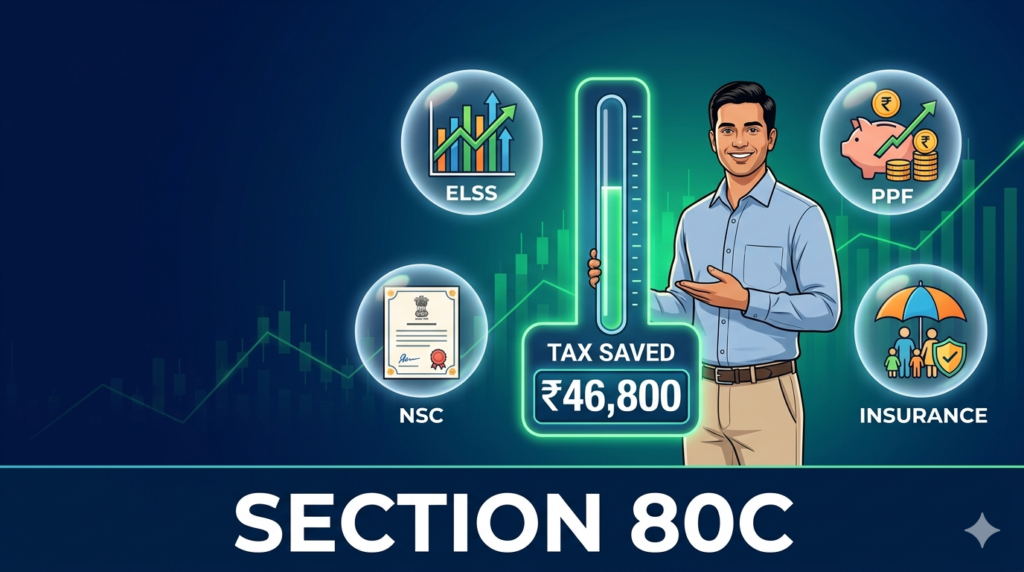

Best Tax Saving Options Under Section 80C in India (2026 Guide) — Save Up to ₹46,800 Without Wasting a Rupee
From ELSS to PPF, NSC to Home Loan repayments — here’s everything you need to know to make your ₹1.5 lakh 80C limit work hardest for your wealth.
- Introduction — The Tax Saving Problem Most Indians Have
- What is Section 80C?
- All 80C Tax Saving Options — Detailed Breakdown
- Comparison Table: Returns, Lock-in, Risk & Taxability
- Best 80C Investment Strategy by Age & Risk Profile
- Real-Life Example: How Rahul Saves ₹46,800 in Tax
- Common Mistakes to Avoid
- 80C vs 80D vs 80CCD — Beyond the Basics
- FAQs — Frequently Asked Questions
- Conclusion & Next Steps
The Tax Saving Panic That Hits Every March
Every year, somewhere around February, your HR department sends you an email that triggers mild panic: “Please submit your investment proofs by March 15.” Suddenly, you’re scrambling — frantically buying insurance policies you don’t need, parking money in fixed deposits that barely beat inflation, or worse, doing nothing and watching tens of thousands of rupees disappear as extra tax.
Sound familiar? You’re not alone. According to income tax filing data, millions of salaried Indians either don’t fully utilise their ₹1,50,000 Section 80C deduction limit or utilise it in the most wealth-destructive way possible.
The good news: Section 80C is genuinely one of the most powerful tax-saving tools available to Indian taxpayers. When used strategically, it not only reduces your tax outgo but also actively builds long-term wealth.
If you’re in the 30% tax bracket, maxing out your ₹1.5 lakh 80C limit saves you ₹46,800 in taxes every single year (including 4% health & education cess). Over 20 years, that’s nearly ₹9.36 lakh saved — just from knowing where to invest.
This guide will walk you through every 80C option available for FY 2025-26, help you compare them on what actually matters (returns, flexibility, risk, and taxability), and give you a personalised strategy based on your age and goals — all backed by current data and practical examples.
Note: This guide applies to the Old Tax Regime. If you’ve opted for the New Tax Regime for FY 2025-26, Section 80C deductions are not available to you. Read our detailed comparison of Old vs New Tax Regime on InvestmentSutras.
What is Section 80C? (Simple Explanation)
Section 80C is a provision under the Income Tax Act, 1961 that allows individual taxpayers and Hindu Undivided Families (HUFs) to claim deductions from their gross total income by investing in specified instruments or making certain payments.
In plain English: For every rupee you invest in approved 80C instruments (up to ₹1.5 lakh per year), that amount gets subtracted from your taxable income before tax is calculated. This directly reduces how much income tax you owe.
- Maximum deduction limit: ₹1,50,000 per financial year
- Applicable to: Individuals and HUFs under the Old Tax Regime
- Tax saved (30% bracket): ₹46,800 (including 4% cess)
- Tax saved (20% bracket): ₹31,200 (including 4% cess)
- Tax saved (5% bracket): ₹7,800 (including 4% cess)
- Governing Act: Income Tax Act, 1961 — incometax.gov.in
Importantly, the ₹1.5 lakh limit is combined across all 80C instruments. So if your EPF contribution is ₹80,000, you only have ₹70,000 left to invest across ELSS, PPF, and everything else. This makes strategic allocation critical.
Complete List of Best Tax Saving Options Under Section 80C
There are over 15 qualifying instruments under 80C, but the ones that genuinely matter for most Indian investors come down to nine. Let’s break each one down with hard data.
🏆 ELSS — Equity Linked Saving Scheme
ELSS is the undisputed champion of 80C investing for wealth creation. These are equity mutual funds with a mandatory 3-year lock-in — the shortest lock-in among all 80C instruments. Because they invest predominantly in stocks, they offer significantly higher potential returns than fixed-income options.
Historically, top-performing ELSS funds have delivered 12–14% annualised returns over 5–10 year periods. They can be invested via SIP (Systematic Investment Plan), making them highly accessible — you can start with as little as ₹500 per month.
Want to understand how SIP compounding works in practice? Read our deep-dive: I Did the Math on ₹10,000 SIP for 30 Years.
Investors under 45 years old who can tolerate short-term market volatility and want both tax saving and long-term wealth creation. If you could only pick one 80C instrument, ELSS is usually the answer.
ELSS funds are regulated by SEBI (Securities and Exchange Board of India) and must invest at least 80% of their corpus in equity. Gains above ₹1.25 lakh in a financial year are taxed at 12.5% as Long Term Capital Gains (LTCG) — a Budget 2024 update.
🏦 PPF — Public Provident Fund
PPF is the gold standard for safe, long-term, tax-free investing in India. The government reviews the interest rate quarterly; it currently stands at 7.1% per annum for Q1 FY 2026-27. The key feature that makes PPF exceptional is its EEE (Exempt-Exempt-Exempt) status: the investment qualifies for 80C deduction, the interest earned is tax-free, and the maturity amount is tax-free.
You can invest between ₹500 and ₹1,50,000 per year. The account matures after 15 years but can be extended in 5-year blocks. Partial withdrawal is allowed from the 7th year.
Risk-averse investors, those in the 30% tax bracket who want guaranteed tax-free returns, and anyone building a retirement corpus without equity exposure. Also excellent for children’s education planning over a 15-year horizon.
Effective post-tax return for someone in the 30% bracket: approximately 10.14% equivalent taxable return. That’s genuinely hard to beat with any other risk-free instrument.
👔 EPF — Employee Provident Fund
If you’re a salaried employee in a company with 20+ employees, EPF contributions are mandatory. Your contribution is 12% of your basic salary, matched by your employer. The employee’s contribution counts toward your 80C limit; the employer’s does not.
The EPFO declared an interest rate of 8.25% for FY 2024-25 — one of the highest guaranteed rates available in any fixed-income instrument in India. EPF enjoys EEE status as long as you withdraw after 5 years of continuous service.
Important for high earners: Interest on EPF contribution exceeding ₹2.5 lakh per year (₹5 lakh for government employees) is taxable from FY 2021-22 onwards.
Every salaried employee — you’re already contributing! The key insight is to track how much of your ₹1.5 lakh limit EPF has already used, before deciding how much to invest elsewhere.
You can check your EPF balance and track contributions at epfindia.gov.in.
📜 NSC — National Savings Certificate
NSC is a post office savings scheme offering a competitive 7.7% interest rate (Q1 FY 2026-27), compounded annually but paid at maturity. The unique feature: the interest accrued each year is deemed reinvested and qualifies for an additional 80C deduction in that year. This partially offsets the taxability of interest.
NSC requires a minimum investment of ₹1,000 with no maximum limit. It is available at all post offices and can also be held digitally. No TDS is deducted on NSC interest.
Conservative investors who want government-backed returns with a 5-year horizon, or those who want to squeeze additional 80C deductions from the deemed interest reinvestment. Also a good alternative to tax-saving FDs as NSC rates are slightly higher.
🏧 Tax Saving Fixed Deposits
Tax-saving FDs from banks qualify for 80C deduction. Interest rates currently range from 6.5% to 7.5% depending on the bank and whether you’re a senior citizen. Senior citizens typically get 0.25–0.5% extra. Unlike NSC, there is no premature withdrawal allowed under any circumstances during the 5-year lock-in.
The significant drawback: interest is fully taxable as per your income tax slab. For someone in the 30% bracket, the effective post-tax return drops to around 4.9–5.25% — well below inflation. This makes tax-saving FDs one of the weakest 80C options for high-income earners.
If you’re in the 20% or 30% tax slab, tax-saving FDs are generally not recommended as your primary 80C instrument. The post-tax real return is often negative after inflation. See our analysis: Your FD is Quietly Losing You Money.
🛡️ Life Insurance Premiums
Premiums paid for life insurance policies — whether term, endowment, or money-back — qualify for 80C deduction. However, the treatment differs significantly by policy type:
- Term Insurance: Pure protection; premium qualifies for 80C but there is no maturity benefit. This is the right reason to buy insurance. Read: ₹800/Month for ₹1 Crore Term Insurance
- Endowment/Money-Back: Combines insurance with savings, but delivers very poor returns (typically 4–5% IRR). Generally not recommended as a tax-saving vehicle.
- ULIP: Market-linked returns with insurance. After 5-year lock-in, gains above ₹1.25 lakh are now taxable (Budget 2021 amendment for premiums over ₹2.5 lakh/year).
Buy term insurance for protection (the premium qualifies for 80C). Do NOT buy endowment or money-back policies primarily for tax saving — the returns destroy wealth over the long term.
*Maturity proceeds from life insurance policies where annual premium exceeds 10% of sum assured are taxable under Budget 2023 amendments.
👧 Sukanya Samriddhi Yojana (SSY)
Sukanya Samriddhi Yojana is a government-backed savings scheme specifically designed for the education and marriage expenses of a girl child. At 8.2% p.a. with full EEE tax status, it currently offers the highest guaranteed risk-free return among all 80C instruments.
The account can be opened for a girl child below 10 years of age. You can invest between ₹250 and ₹1,50,000 per year. Partial withdrawal (50%) is allowed when the girl turns 18 for education expenses. The account matures when she turns 21.
Parents of girl children below 10 years. SSY is the single best fixed-income 80C instrument available for eligible investors. If you have a daughter, opening an SSY account should be a top priority.
🏠 Home Loan Principal Repayment
If you have a home loan, the principal repayment component of your EMI qualifies for 80C deduction up to ₹1.5 lakh per year. Additionally, stamp duty and registration charges paid for the property also qualify in the year of payment.
If you sell the house within 5 years of possession, the deduction claimed earlier is added back to your taxable income in the year of sale — a crucial clause to remember.
Many salaried homeowners with a ₹50–60 lakh loan find that their annual principal repayment alone exhausts much of their 80C limit, especially in the early EMI years when principal repayment is lower. Read: Before You Sign That Home Loan Paper.
📊 ULIPs — Unit Linked Insurance Plans
ULIPs combine insurance and investment in a single product. A portion of your premium goes toward life cover; the rest is invested in market-linked funds (equity, debt, or hybrid). Returns are market-linked but historically lower than pure ELSS funds after accounting for multiple charges (mortality charge, fund management charges, policy administration charges).
After Budget 2021 amendments, maturity proceeds from ULIPs where annual premium exceeds ₹2.5 lakh are taxable as capital gains. For premiums under ₹2.5 lakh, EEE status is retained.
For most investors, buying a separate term insurance + ELSS fund combination delivers superior results compared to a ULIP. ULIPs can make sense in very specific situations (legacy planning, disciplined long-term investors) but should not be chosen primarily for 80C.
Comparison Table: All 80C Options at a Glance (FY 2025-26)
| Instrument | Returns (Approx.) | Lock-in Period | Risk Level | Tax on Returns | Best Suited For |
|---|---|---|---|---|---|
| ELSS | 10–14% p.a. (historical) | 3 years | High | LTCG 12.5% (above ₹1.25L) | Wealth creation, young investors |
| PPF | 7.1% p.a. | 15 years | Nil | EEE (Fully Exempt) | Risk-averse, retirement planning |
| EPF | 8.25% p.a. | Till retirement | Nil | EEE (conditions apply) | Salaried employees (mandatory) |
| SSY | 8.2% p.a. | Till daughter turns 21 | Nil | EEE (Fully Exempt) | Parents of girl child (best fixed-income 80C) |
| NSC | 7.7% p.a. | 5 years | Nil | Interest taxable (deemed reinvestment = extra 80C) | Conservative investors, 5-yr horizon |
| Tax Saving FD | 6.5–7.5% p.a. | 5 years (no exit) | Very Low | Fully taxable (slab rate) | Senior citizens, lowest tax bracket |
| Life Insurance (Term) | 0 (pure protection) | Policy term | Nil | N/A | Everyone with dependents |
| Home Loan Principal | Asset creation | 5 years (no sale) | Medium | Clawback if sold within 5 yrs | Existing home loan borrowers |
| ULIP | 8–12% p.a. | 5 years | Medium–High | EEE if premium < ₹2.5L/yr | Specific long-term insurance+investment goals |
Best 80C Investment Strategy Based on Age & Risk Profile
There is no single “best” 80C instrument — the right allocation depends heavily on your age, risk appetite, financial goals, and existing investments. Here’s a framework used by experienced financial planners:
Aggressive Growth Strategy
Goal: Maximise long-term wealth creation while saving tax.
- ELSS: ₹70,000–₹1,00,000
- PPF: ₹30,000–₹50,000
- Term Insurance premium: ₹10,000–₹20,000
- Remaining: Already covered by EPF
70–75% equity exposure through ELSS is appropriate at this stage. Time horizon is long enough to absorb volatility.
Balanced Strategy
Goal: Balance growth with stability as responsibilities rise.
- EPF: Already contributing (e.g., ₹60,000)
- ELSS: ₹50,000
- PPF: ₹25,000
- Term Insurance: ₹15,000
If parents of a girl child, replace PPF with SSY for better guaranteed returns.
Conservative Protection Strategy
Goal: Capital preservation with tax efficiency as retirement nears.
- EPF: Already contributing
- PPF: ₹50,000–₹70,000
- NSC / Tax Saving FD: ₹30,000–₹50,000
- ELSS: Small allocation if any
Reduce equity exposure. Prioritise capital protection. Senior citizens get 0.5% extra on tax-saving FDs.
Always calculate your EPF contribution first — it automatically uses part of your 80C limit. Many people over-invest in ELSS or PPF without realising their EPF has already utilised ₹80,000–₹1,00,000 of their ₹1.5 lakh limit, leaving no additional room for other instruments.
Real-Life Example: How Rahul (Age 31) Saves ₹46,800 in Tax
Rahul’s Profile
- Annual CTC: ₹18,00,000
- Taxable salary (after standard deduction, HRA, etc.): ₹14,50,000
- Tax bracket: 30%
- EPF contribution (employee): ₹57,600/year (12% of basic ₹40,000/month)
Rahul’s 80C Allocation
| Instrument | Annual Amount | Reason |
|---|---|---|
| EPF (auto) | ₹57,600 | Already mandatory, counted automatically |
| ELSS SIP (₹5,000/month) | ₹60,000 | Wealth creation + tax saving |
| Term Insurance Premium | ₹15,000 | ₹1 crore cover, protection + 80C |
| PPF | ₹17,400 | Tops up to ₹1,50,000 limit |
| Total 80C | ₹1,50,000 | Limit fully utilised |
Tax Saving Calculation
- Taxable income before 80C: ₹14,50,000
- 80C deduction: –₹1,50,000
- Taxable income after 80C: ₹13,00,000
- Tax saved: ₹1,50,000 × 30% × 1.04 = ₹46,800
And Rahul isn’t just saving tax. His ELSS SIP of ₹60,000/year at 12% returns grows to approximately ₹12.5 lakh in 10 years, and his PPF earns guaranteed, tax-free returns of 7.1%. He’s simultaneously building retirement wealth, protecting his family with term insurance, and paying ₹46,800 less in tax every year.
Want to calculate exactly how your ELSS SIP will grow? Use our SIP calculator guide on InvestmentSutras.
Common 80C Mistakes to Avoid
These are the errors that cost Indian investors thousands of rupees every year:
Investing in random instruments in February–March just to show your HR department proof leads to poor decisions — often endowment policies or lump-sum FDs that destroy long-term returns. Start in April each year. SIP in ELSS throughout the year smooths out market volatility via rupee cost averaging.
Your monthly EPF deduction silently eats into your ₹1.5 lakh limit. A person earning ₹60,000 basic salary contributes ₹86,400/year to EPF — leaving only ₹63,600 for other 80C instruments. Calculate EPF first, then plan the rest.
Buying endowment, money-back, or ULIP policies as 80C investments is one of the costliest financial mistakes. These products deliver poor insurance + poor returns. Buy term insurance for protection; invest separately in ELSS or PPF for wealth creation.
Tax saving FDs in the 30% bracket give you a post-tax return of just ~4.9% — well below the 6–7% inflation rate. Your real return is negative. Read why FDs are quietly losing you money.
The New Tax Regime’s lower slab rates look attractive, but if you have significant 80C investments + HRA + home loan interest (80EE/24b) + NPS deductions (80CCD), the Old Regime often saves more tax. Always calculate both before filing.
The 3-year lock-in is a minimum, not a signal to withdraw. ELSS funds generate the most wealth when held for 7–10+ years. Most investors who exit at exactly 3 years leave significant compounding returns on the table.
Going Beyond 80C: Other Key Tax Saving Sections
Once you’ve exhausted your ₹1.5 lakh 80C limit, there are other sections that can further reduce your tax outgo significantly:
Section 80D — Health Insurance Premiums
- Deduction up to ₹25,000 for self, spouse, and dependent children
- Additional ₹25,000 for parents below 60 (₹50,000 if parents are senior citizens)
- Maximum deduction: ₹75,000 if you and your parents are senior citizens
- Also covers preventive health check-up expenses up to ₹5,000 (within the overall limit)
Combined with 80C, a person in the 30% bracket can potentially save over ₹70,000 in taxes annually.
Section 80CCD(1B) — NPS Additional Contribution
- Additional deduction of up to ₹50,000 for contributions to NPS (National Pension System) — over and above the ₹1.5 lakh 80C limit
- Invested in Tier 1 NPS account only
- Makes NPS the only instrument allowing deduction beyond the 80C cap
- Total potential additional tax saving (30% bracket): ₹15,600
NPS is regulated by PFRDA (Pension Fund Regulatory and Development Authority).
Section 24(b) — Home Loan Interest Deduction
- Interest paid on home loan for self-occupied property: up to ₹2,00,000 per year
- This is separate from the 80C deduction on principal repayment
- Combined (principal + interest), a homeowner can claim up to ₹3.5 lakh in deductions related to their home loan
80C (₹1.5L) + 80CCD(1B)/NPS (₹50K) + 80D (₹75K) + 24(b) Interest (₹2L) = ₹4.75 lakh in deductions
Tax saved at 30% + cess: approximately ₹1,48,200 per year. This is the maximum tax saving possible for most salaried individuals.
Frequently Asked Questions (FAQs) on Section 80C
Conclusion: Make Your ₹1.5 Lakh Work Harder This Financial Year
Section 80C is one of India’s most powerful wealth-building tools hiding in plain sight inside the Income Tax Act. It’s not just about saving tax — it’s about channelling money that would otherwise go to the government into instruments that compound and grow for you.
The key takeaways from this guide:
- ELSS is the best all-rounder for investors under 45 — shortest lock-in, highest potential returns, tax-efficient.
- PPF and EPF are your bedrock — guaranteed, tax-free, and sovereign-backed.
- Sukanya Samriddhi is the best fixed-income 80C instrument for parents of girl children.
- Avoid tax-saving FDs if you’re in a higher tax bracket — they destroy real wealth.
- Never mix insurance with investment — buy term cover, invest in ELSS/PPF.
- Calculate EPF first, then plan the rest of your 80C allocation.
- Start in April, not February — time in market beats timing the market.
The investors who build real wealth are those who stop treating 80C as a compliance task and start treating it as a strategic annual wealth-building exercise. 15 minutes of planning at the start of each financial year is all it takes.
For further guidance on building your investment portfolio beyond 80C, explore our resources on InvestmentSutras — India’s practical investment guide.
Ready to Start Investing Smarter?
Explore our in-depth guides on mutual funds, SIPs, FDs vs debt funds, and smart tax saving strategies — all written in plain, practical language for Indian investors.
Explore InvestmentSutras 📊 See SIP Math Results