
Credit Card Mistakes Indians Make (And How to Avoid Them in 2026)

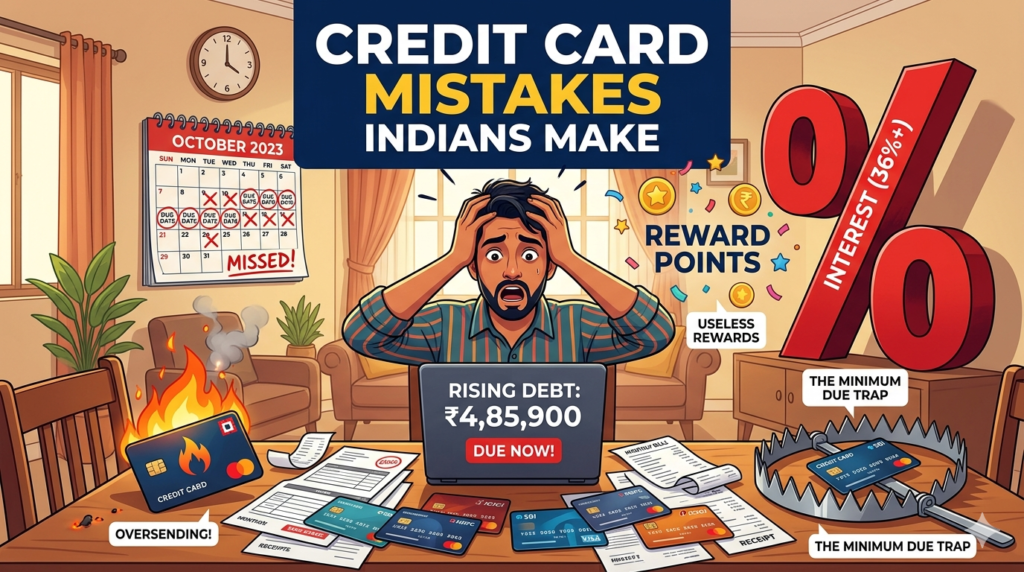
Credit Card Mistakes Indians Make
(And How to Avoid Them)
From paying “minimum due” forever to drowning in rewards-point delusion — the complete survival guide
“It’s free money, yaar.” — Every Indian who later cried at a 3.5% monthly interest rate.
Picture this: It’s late November. Ramesh, a 28-year-old software engineer from Pune, is browsing an e-commerce app at midnight. The sale banner screams “EXTRA 10% CASHBACK on HDFC Credit Cards!” His rational brain whispers — you don’t need a 65-inch TV. But his rewards-point-drunk brain goes: think of the cashback!
One tap. Done. ₹89,000 charged to the card. He’ll pay it next month, obviously. Except next month arrives with a rent hike, a medical bill, and a wedding gift for a cousin he barely knows. So he pays the “minimum due” — ₹2,225 — and sighs with relief. He didn’t default. He’s responsible.
What Ramesh doesn’t know: that ₹89,000 is now accruing interest at 42% per annum. In 18 months, he’ll have paid more in interest than the TV cost. The “free money” card just became a ₹1.2 lakh lesson.
This isn’t a rare story. Across India, millions of credit card holders are unknowingly committing the same expensive mistakes — overspending, misunderstanding interest, chasing rewards into debt, and ignoring the fine print with the enthusiasm reserved for reading WhatsApp forwards.
This article is your complete guide to the most common credit card mistakes in India — and more importantly, how you can sidestep every single one of them. Let’s get into it.
What Makes Credit Cards So Dangerous? (It’s Not What You Think)
Before we dive into the mistakes, let’s understand why so many smart, educated Indians fall into credit card traps. The answer isn’t greed or ignorance alone — it’s psychology.
When you pay cash, your brain registers the loss of money in real time. Neuroscience research calls this the “pain of paying.” Handing over ₹5,000 in notes at a showroom hurts a little. But swiping a credit card? Zero pain. The brain sees it as a future problem — and humans are wired to delay future pain.
Banks know this. That’s why they design rewards programs, welcome bonuses, and shiny airport lounges — not out of generosity, but because they profit enormously from our behaviour. The RBI has consistently flagged concerns about transparency in credit card interest and fee structures precisely because of how easily consumers get trapped.
Now that we understand the trap, let’s meet it face to face — mistake by mistake.
Mistake 01 Paying Only the Minimum Due
This is the single most expensive credit card mistake in India, and banks absolutely love that you do it.
When your statement arrives, you’ll see two amounts: the Total Outstanding and the Minimum Amount Due — typically 5% of the outstanding or ₹100–200, whichever is higher. Paying the minimum due is designed to feel responsible. You avoided a late fee. You didn’t default. Gold star for you!
Except here’s the brutal truth: the moment you don’t pay the full outstanding, interest is charged on the entire original balance from the day of each transaction — not just the remaining amount. There is no grace period when you revolve a balance. This is called retroactive interest, and most Indians have no idea it exists.
Priya from Bengaluru spends ₹50,000 in June on a mix of groceries, dining, and a quick Lenskart haul. Her statement arrives with a minimum due of ₹2,500. She pays it. Her bank — let’s say it’s an ICICI credit card at 3.49% per month — charges interest on the full ₹50,000 from the date of each purchase. By the time she clears the card over six months, she’s paid nearly ₹8,000–₹10,000 in interest alone. The kurta she bought at 40% “sale” discount just became full price plus a surcharge.
How to Avoid It
- Always pay the full statement balance before the due date.
- Set up an auto-debit for the full outstanding (not the minimum) linked to your savings account.
- If you genuinely can’t pay fully, pay as much above the minimum as possible to reduce interest accrual.
- Use your credit card only for amounts you already have in your bank account.
Mistake 02 Missing Payment Due Dates
India’s top three pastimes: cricket, chai, and forgetting credit card due dates. The consequences, however, are far less enjoyable than the first two.
Missing a due date triggers a late payment fee (typically ₹100 to ₹1,300 depending on the outstanding), interest at full rate on the entire balance, and perhaps most damagingly, a negative mark on your CIBIL credit score. Even a single missed payment can drop your score by 50–100 points — which can cost you a home loan approval years later.
Suresh, a government employee from Jaipur, forgot his SBI credit card due date in December because — Diwali hangover, office party, relative visiting from village. He paid just two days late. The ₹38,000 bill attracted a ₹1,000 late fee plus interest. Worse, his CIBIL score dropped from 760 to 688. Six months later when he applied for a car loan, he got a higher interest rate because of it. Two days of forgetfulness. Years of consequence.
How to Avoid It
- Set a Google Calendar reminder 7 days before the due date every month.
- Enable auto-pay for at least the minimum due as a safety net (then manually pay the rest).
- Choose a credit card where the billing cycle aligns with your salary credit date.
- Use apps like CRED or your bank’s app that send proactive payment reminders.
Mistake 03 Overspending to Earn Rewards and Points
Ah, the glorious trap of reward points. Nothing makes a middle-class Indian feel richer than watching reward points accumulate on an Axis Bank Magnus or HDFC Infinia card. “I’ll get a free flight ticket!” — said the person who just spent ₹3 lakhs for 15,000 points worth ₹3,750.
Rewards programs are brilliantly designed marketing machinery. They give you 1–5% back while quietly encouraging you to spend 30% more than you would have otherwise. Research consistently shows that reward card holders spend significantly more per month than non-reward card holders. The banks are not losing money on this deal. You are.
If you spend ₹1,00,000 extra annually to earn reward points worth ₹4,000 — and you revolve any portion of that balance at 3.5% monthly interest — you’ve paid more in interest than the rewards you earned. The only way rewards work is if you were spending that money anyway AND you pay the full balance every month.
Meena from Mumbai was obsessed with collecting reward points on her Amex card. To hit the next tier, she booked a premium hotel for a family trip she wasn’t planning, ordered food delivery more than she needed, and gifted cousins things they didn’t want — all to earn miles. Result: she earned a free domestic flight ticket worth ~₹6,000. Her unnecessary spending: over ₹40,000. Net outcome: a very expensive “free” ticket.
How to Avoid It
- Use rewards cards only for planned, regular expenses — groceries, utility bills, subscriptions.
- Never change your spending behaviour to chase points.
- Calculate the actual rupee value of reward points before getting excited (most are worth ₹0.25–₹1 per point).
- If you’re not clearing your balance fully, no cashback card is worth it.
Mistake 04 Not Understanding How Credit Card Interest Works
Quick quiz: Your credit card charges 3.5% per month. What’s the annual interest rate?
If you said 42%, congratulations — you’re in the minority. Most people see “3.5% monthly” and think “that’s not so bad.” But 3.5% per month = 42% per annum, compounded. That makes your credit card one of the most expensive forms of borrowing available — more expensive than personal loans, gold loans, and in some cases, loan sharks (almost).
The confusion is compounded (pun intended) by the way banks advertise interest. They quote monthly rates in fine print and call it APR — Annual Percentage Rate — in tiny font. The RBI has mandated clearer disclosure, but many consumers still don’t calculate the actual cost.
| Card Issuer (Indicative) | Monthly Interest | Effective Annual Rate |
|---|---|---|
| SBI Credit Card | 3.50% | ~42% |
| HDFC Bank | 3.49–3.75% | ~42–45% |
| ICICI Bank | 3.49–3.75% | ~42–45% |
| Axis Bank | 3.49–3.75% | ~42–45% |
| Standard Chartered | 3.49% | ~42% |
*Rates are indicative and subject to change. Always verify with your card issuer.
How to Avoid It
- Always calculate the annual cost of any credit card debt before deciding to carry a balance.
- Compare your credit card rate against a personal loan — personal loans often range 10–18% p.a., making them far cheaper for large planned purchases.
- Opt for EMI conversion at 12–18% p.a. for large transactions instead of revolving at 42%.
Mistake 05 Taking Cash Advances on Your Credit Card
If paying minimum due is a trap, cash advances on credit cards are a quicksand pit. And yet, desperate moments make it tempting: it’s 2 AM, your ATM card isn’t working, and you need ₹10,000 in cash immediately. Your credit card is right there.
Here’s what happens when you withdraw cash using a credit card:
- Cash advance fee: Typically 2.5–3% of the amount withdrawn (minimum ₹300–500).
- Interest starts immediately: No grace period. Interest accrues from the moment of withdrawal.
- High rate: Usually the same as regular purchase interest — 3.5%/month — but sometimes higher.
- ATM fee: Additional ₹10–25 per ATM transaction.
How to Avoid It
- Build a liquid emergency fund of 3–6 months expenses in a savings account or liquid mutual fund — this is your real financial safety net.
- If you need instant cash, explore overdraft facilities against savings accounts (much cheaper).
- Apps like KreditBee, MoneyTap, or short-term personal loans from your bank are far cheaper for genuine emergencies.
Mistake 06 Applying for Too Many Credit Cards
Welcome to India’s new favourite hobby: collecting credit cards like Pokémon. One for dining rewards. One for travel miles. One for shopping. One because a bank exec called and offered a lifetime-free card and you couldn’t say no. One more because it came with a free Amazon voucher.
Each credit card application results in a hard inquiry on your CIBIL report. Multiple hard inquiries in a short period signal to lenders that you’re “credit hungry” — which drops your score and makes future loan approvals harder. Multiple cards also increase the risk of overspending, forgotten due dates, and management chaos.
Vikram from Delhi applied for four credit cards in three months — HDFC Millennia, Amazon Pay ICICI, Axis Flipkart, and a Kotak PVR card. Each application triggered a hard inquiry. His CIBIL score dropped from 780 to 732 within two months. When he applied for a home loan six months later, his banker flagged his recent credit behaviour. He got the loan, but at a marginally higher rate. Small decisions, large consequences.
How to Avoid It
- Limit yourself to 2–3 well-chosen cards that cover your major spending categories efficiently.
- Space out new applications by at least 6 months.
- Before applying for a new card, ask yourself: “Do I genuinely need this, or am I just excited about the welcome bonus?”
- Use comparison tools like BankBazaar to research before applying — soft checks don’t affect your CIBIL score.
Mistake 07 Ignoring the Impact on Your Credit Score
Your CIBIL score is the financial equivalent of your class 10 marksheet — it follows you around for years and determines your future opportunities. Yet most credit card holders in India never check their credit score until the moment they need a loan and discover it’s in shambles.
Credit cards affect your score through multiple channels:
- Payment history (35%): Missed/late payments hurt badly.
- Credit utilisation (30%): Using more than 30% of your total credit limit negatively impacts your score.
- Credit age (15%): Older accounts in good standing boost your score.
- Credit mix (10%): Having both credit cards and loans is better than cards alone.
- New inquiries (10%): Too many applications hurt you.
How to Avoid It
- Check your CIBIL score free once a year at CIBIL’s official website, or use apps like OneScore, CRED, or Paisabazaar for monthly tracking.
- Keep credit utilisation below 30% per card and overall.
- Request a credit limit increase (without a hard inquiry) to improve your utilisation ratio without spending more.
Mistake 08 Not Reading Terms and Conditions
The terms and conditions of an Indian credit card are the most unread document in the country — right after insurance policy wordings and matrimonial profile disclaimers. They are long, written in a font that requires a magnifying glass, and filled with legal language designed to confuse a law professor.
But those T&Cs contain crucial information: the actual interest rate, the minimum repayment calculation method, the foreign transaction fee (typically 1.5–3.5% — absolutely brutal if you shop on international sites), the fee structure for add-on cards, how reward points expire, and crucially, when rewards programs change without notice — which they do, frequently.
Anjali in Hyderabad loved her Axis Magnus card for its fabulous travel rewards. She spent months accumulating points for a business-class flight. One fine day, Axis revised the reward rate downwards without warning — which they were legally permitted to do as per the T&C she never read. Her carefully accumulated points were worth 40% less than she’d planned for. The business class seat remained a dream.
How to Avoid It
- Before applying, read the Most Important Terms and Conditions (MITC) document — RBI mandates every bank provide this in simple language.
- Note down: interest rate, annual fee waiver conditions, foreign transaction fees, reward expiry dates, and late payment charges.
- Subscribe to your card issuer’s email/SMS alerts for any T&C changes.
Mistake 09 Closing Old Credit Cards Too Soon
Breaking up with an old credit card might feel liberating — especially if it has an annual fee you resent. But closing an old credit card can hurt your credit score in two specific ways:
- Reduced average credit age: Your oldest card anchors your credit history. Close it and your average age drops, potentially taking your CIBIL score with it.
- Reduced total credit limit: This increases your credit utilisation ratio automatically — even if your spending stays the same.
How to Avoid It
- Never close your oldest credit card — even if you don’t use it much. Make a small transaction every 3–6 months to keep it active.
- Call the bank and negotiate a fee waiver or downgrade before cancelling.
- If you must close cards, close the newest one with the smallest limit to minimise credit score damage.
Mistake 10 Falling for “Lifetime Free” Card Traps
The words “Lifetime Free Credit Card” have the same effect on a frugal Indian as “free samosa” at a wedding — irresistible. But lifetime free doesn’t mean “totally without cost.” It simply means no annual fee. Everything else — interest rates, forex charges, cash advance fees, and add-on card fees — remain firmly in place.
More importantly, many cards that are marketed as lifetime free are entry-level cards with limited rewards, lower credit limits, and fewer benefits. You might save ₹500–₹2,000 per year in annual fees while losing access to better reward rates, airport lounges, or insurance covers that premium cards offer.
Rajan from Chennai held onto a “lifetime free” card for years to avoid paying any fee. He spent ₹8 lakhs annually on the card but earned a measly 1% cashback. A friend with an HDFC Regalia (₹2,500 annual fee, waived above spend threshold) was earning 4X reward points plus lounge access on the same spends. Rajan’s “savings” on annual fee cost him tens of thousands in missed rewards.
How to Avoid It
- Calculate your annual spend and compare the cost-benefit of a premium card versus a lifetime-free card.
- Many premium cards waive the annual fee if you hit a minimum annual spend — check if you’d clear that threshold naturally.
- A ₹1,000–₹2,000 annual fee card that gives you ₹8,000 in rewards is a better deal than a “free” card giving ₹2,000 in rewards.
Smart Credit Card Usage Strategy: The Pro Playbook
Now that you know what not to do, here’s what the financially savvy 5% of Indians actually do with their credit cards:
The 1-Card-Per-Category Rule
Pick one card for dining/entertainment, one for travel/fuel, one for online shopping. No overlap, no chaos.
Time Your Purchases
Buy at the start of your billing cycle to get the maximum interest-free period (up to 50 days).
Treat It Like Debit
Never spend what you don’t already have in your bank. The credit card is just a payment instrument, not extra money.
Use EMI Wisely
For big purchases (laptops, appliances), use 0% EMI or low-cost EMI offers. Never let them revolve at full interest.
All Alerts ON
Enable every possible notification — spend alerts, due date reminders, suspicious transaction alerts. Zero exceptions.
Monthly Score Checks
Review your credit score monthly using free tools. Spot errors early and dispute them before they cost you a loan.
Psychological Hacks to Control Credit Card Spending
Willpower is overrated. If you’re relying on discipline alone to control credit card spending, you’ll eventually lose — everyone does. Here’s how to set up systems that work even when your willpower doesn’t.
- The 48-Hour Rule: For any non-essential purchase over ₹5,000, wait 48 hours before tapping the card. Most impulse desires disappear within a day. The TV doesn’t seem as urgent at 11 AM Tuesday as it did at midnight Sunday during a sale.
- Convert to Hours: Before spending, convert the price to “work hours.” If you earn ₹800/hour and something costs ₹16,000 — that’s 20 hours of your life. Worth it?
- Freeze the Card (Literally): For cards you want to keep active but not use impulsively, some people freeze them in a bag of water in the freezer. The time it takes to thaw gives you time to reconsider.
- Monthly Spending Cap: Set a self-imposed credit card usage cap at 60–70% of your take-home salary. Whatever remains, don’t touch it on credit.
- Separate “Wants” from “Needs” Billing: Pay all fixed expenses (utility bills, subscriptions, groceries) via credit card on auto-mode. For discretionary spending (dining out, entertainment), set a monthly cash envelope — once it’s gone, it’s gone.
- Celebrate Full Payments: This sounds silly, but psychologists recommend it. When you pay your full credit card bill, treat it as a “win.” Pair it with something small and enjoyable — your brain begins to associate full payment with reward, rather than associating the purchase itself with reward.
Tools and Apps Indians Can Use to Manage Credit Cards Better
Technology is your best ally in credit card discipline. Here’s a curated list of tools that work particularly well for the Indian context:
| Tool / App | Best For | Key Feature |
|---|---|---|
| CRED | Credit card bill payments | Bill reminders, credit score tracking, reward coins for on-time payments |
| OneScore | Credit score monitoring | Free monthly CIBIL updates, score improvement tips, dispute resolution |
| Walnut / Money View | Expense tracking | Auto-reads SMS to categorise spending; shows credit card spend vs budget |
| Paisabazaar | Credit card comparison | Soft-check eligibility, compare reward rates, apply for new cards wisely |
| Your Bank’s Official App | Account management | Real-time alerts, EMI conversion, auto-pay setup, reward tracking |
| ET Money / Groww | Budget + investment | Helps visualise how credit card interest eats into investment returns |
Key Takeaways: Your Credit Card Survival Checklist
- Always pay the full outstanding balance, never just the minimum due.
- Set up auto-pay and calendar reminders — missing a due date harms both your wallet and your CIBIL score.
- Reward points are great only if you never carry a balance. Otherwise, they’re expensive illusions.
- Credit card interest at 42% p.a. is one of the most expensive forms of borrowing. Treat it as a tool, not a lifeline.
- Never use cash advance on a credit card — the fees and immediate interest make it a financial own goal.
- Limit yourself to 2–3 strategically chosen cards. More is rarely merrier.
- Keep credit utilisation below 30% and monitor your CIBIL score monthly.
- Read the MITC document before applying — especially for interest rates, forex fees, and reward expiry terms.
- Don’t close your oldest card — downgrade instead. Preserve credit history.
- “Lifetime free” ≠ “best card.” Compare total value, not just the absence of annual fees.
Frequently Asked Questions (FAQs)
Most banks require a CIBIL score of 700 or above for standard credit cards. Premium or super-premium cards typically require 750+. A score below 650 makes approval difficult, though some banks offer secured credit cards (against a fixed deposit) for those building credit.
Having multiple cards is not inherently bad — it’s about how you manage them. Two to three well-managed cards can actually help your credit score by increasing your total credit limit. Problems arise when you have too many cards, can’t track due dates, or overspend across all of them.
Paying the minimum due on time technically counts as a “payment” and won’t directly hurt your payment history. However, it increases your credit utilisation ratio significantly, which can lower your score. The real damage is financial — the compounding interest on the remaining balance can trap you in a debt spiral.
Banks may deactivate or cancel an unused card after 12–18 months of inactivity, which can hurt your credit score by reducing your credit history and available limit. Make at least one small transaction every quarter and pay it off fully to keep the card active.
In India, banks typically quote the monthly interest rate (e.g., 3.49%) and the Annual Percentage Rate (APR). The APR is simply the monthly rate multiplied by 12 — which gives you 41.88% in this case. Always use the APR for comparison purposes, as it reflects the true annual cost of carrying a balance.
Yes — most banks in India offer an EMI conversion facility for outstanding balances or large transactions. The interest rate on EMI conversion (typically 12–24% p.a.) is significantly lower than the revolving interest rate (42% p.a.). This is a smart option if you genuinely cannot pay the full outstanding in one month. Call your bank or use their app to initiate this.
As of current tax provisions, credit card cashback and reward points used for purchases are generally not taxed as income for individuals. However, cashback received on business expenses may be treated differently depending on how it’s categorised. Consult a CA for specific advice relevant to your situation.
Raise a dispute directly with your bank within 30–60 days of the transaction appearing on your statement. You can do this via the bank app, net banking, or customer care. If the bank doesn’t resolve it satisfactorily, you can escalate to the RBI Banking Ombudsman — a free, accessible grievance redressal mechanism that the RBI operates.
Final Thoughts: The Credit Card Is Not Your Enemy
Credit cards are not evil. In fact, used correctly, they are one of the most powerful financial tools available to you — offering interest-free credit for up to 50 days, building your credit score, offering fraud protection, and yes, earning you genuine rewards on money you were going to spend anyway.
The problem has never been the card. The problem is a combination of inadequate financial education, brilliant bank marketing, and very human psychological biases that trip us all up. Ramesh from the introduction isn’t a fool — he just didn’t have the information you now have.
Use this guide as a reference. Bookmark it. Share it with that cousin who just got his first credit card and is already posting unboxing reels. The best time to learn these lessons is before you make the mistake. The second best time is right now.
Spend wisely. Pay fully. Invest the rest.
Explore these articles next: How to Build a 750+ CIBIL Score from Scratch · Best Credit Cards in India for 2025 (Ranked by Category) · Personal Loan vs Credit Card EMI: Which is Cheaper? · How to Create an Emergency Fund That Actually Works

Disclaimer: InvestmentSutras is an educational initiative. All articles and assessments are for educational and learning purposes only. This should not be treated as investment advice or recommendation. Please consult a registered investment advisor before acting on any suggestions.