Index Funds vs Mutual Funds: Where Should You Invest Your Money in 2026?
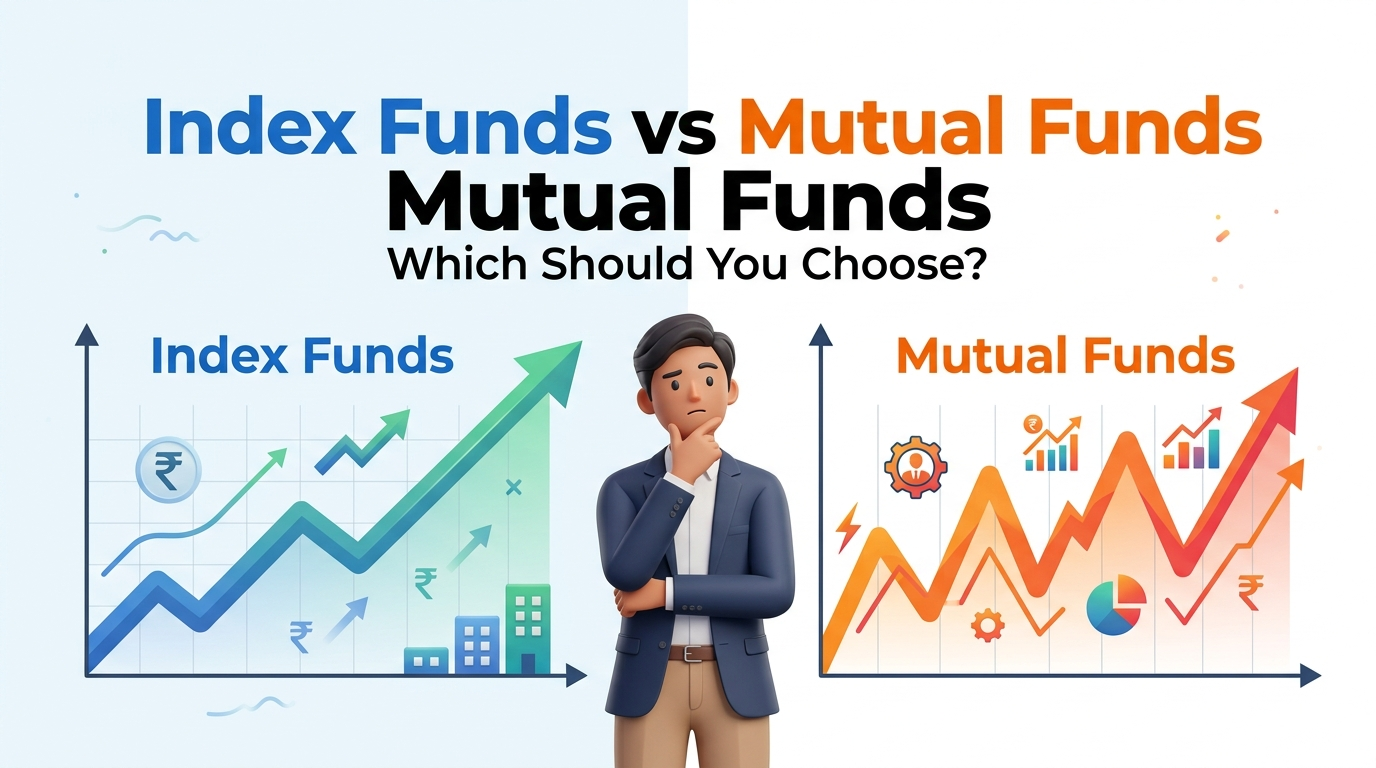

Index Funds vs Mutual Funds
What Should You Really Choose?
A no-jargon, India-first guide that cuts through the noise so you can invest with confidence — whether you are just starting out or ready to level up.
Introduction: The ₹50,000 Question Every Indian Investor Is Asking
Every week, thousands of first-time investors in India open their phones, type “should I invest in index funds or mutual funds?” into Google, and end up more confused than when they started. Finance influencers push index funds. Your CA uncle swears by actively managed funds. And somewhere in the middle, you are left wondering what is actually better for your money.
Here is the truth: both are mutual funds. Yes, you read that right. An index fund is a type of mutual fund. The real debate is between actively managed mutual funds — where a professional fund manager handpicks stocks trying to beat the market — and passively managed index funds — which simply mirror a market index like the Nifty 50 or Sensex.
By the time you finish this guide, you will clearly understand:
- Exactly how each type of fund works, with real Indian examples
- How their long-term returns, costs, and risks compare in 2026
- Which one suits your investing style, goals, and time horizon
- Common traps that trip up beginners — and how to avoid them
No jargon, no hype. Let us dig in.
What Are Mutual Funds?
Imagine you and nine of your friends each put ₹10,000 into a common kitty — ₹1 lakh total. You then hire a smart money manager to decide where to invest it: maybe 40% in Reliance, 20% in HDFC Bank, 15% in TCS, and so on. Every month, the manager actively studies the market, reads corporate earnings, and shifts the portfolio to try to earn you the highest possible return. That, in essence, is an actively managed mutual fund.
In India, funds like Mirae Asset Large Cap Fund, Parag Parikh Flexi Cap Fund, and HDFC Mid-Cap Opportunities Fund follow this model. A SEBI-registered Asset Management Company (AMC) pools money from thousands of investors, and a fund manager — aided by a team of analysts — makes all the buy and sell decisions.
How Does an Actively Managed Fund Make Money for You?
The fund manager’s goal is to beat the benchmark index (say, Nifty 50). If Nifty 50 returns 12% in a year and your fund returns 15%, that extra 3% is called alpha — the reward for active management. But here is the catch: beating the market consistently, year after year, is extraordinarily difficult. And the effort costs money — which comes straight out of your pocket via the expense ratio.
What Are Index Funds?
An index fund is like buying a slice of the entire Indian stock market in one shot. Instead of a fund manager deciding which stocks to hold, the fund simply replicates a market index — buying the same stocks in the same proportion as the index. If Nifty 50 has Reliance at 10% weight, the index fund holds 10% in Reliance. Simple as that.
Popular Indian index funds include UTI Nifty 50 Index Fund, HDFC Index Fund – Nifty 50 Plan, Nippon India Index Fund – Sensex, and Motilal Oswal Nifty Next 50 Index Fund. There are now also index funds tracking the Nifty Midcap 150, Nifty Smallcap 250, and even international indices like the Nasdaq 100.
Why Do Index Funds Even Exist?
The concept was pioneered by John Bogle (founder of Vanguard) in 1976 based on a simple, uncomfortable insight: most professional fund managers fail to consistently beat the market over long periods, especially after fees. If that is true, why pay them? Just buy the index. In India, this idea picked up momentum after 2018, and today index fund AUM has grown to over ₹10 lakh crore — a testament to how quickly Indian investors have embraced the philosophy.
Key Differences: Index Funds vs Mutual Funds at a Glance
| Factor | Actively Managed Mutual Funds | Index Funds |
|---|---|---|
| Management Style | Active — fund manager picks stocks | Passive — mirrors an index |
| Goal | Beat the benchmark (generate alpha) | Match the benchmark return |
| Expense Ratio | 0.5% – 2.5% per year | 0.05% – 0.30% per year |
| Fund Manager Role | Critical — manager skill matters | Minimal — follows rules mechanically |
| Portfolio Transparency | Monthly disclosure | Real-time (mirrors public index) |
| Flexibility | High — can shift sectors, go defensive | Low — must hold index constituents |
| Tracking Error | N/A | Low (aim for <0.5%) |
| Best For | Investors seeking market-beating returns | Investors seeking low-cost market returns |
| Risk of Manager Underperformance | High | None |
| Suitable for Beginners? | Moderate | Highly Suitable |
Returns Comparison: Mutual Funds vs Index Funds in India
This is where the conversation gets real. Looking at long-term data for Indian large-cap equity funds, the picture is striking.
| Period | Nifty 50 TRI Return | Average Large-Cap Fund Return | Funds That Beat Index |
|---|---|---|---|
| Last 3 Years | ~18.5% CAGR | ~16.8% CAGR | ~30% |
| Last 5 Years | ~16.2% CAGR | ~14.9% CAGR | ~28% |
| Last 10 Years | ~13.8% CAGR | ~12.6% CAGR | ~22% |
(Returns are approximate and based on publicly available NAV data for regular direct plans. Past performance is not a guarantee of future returns.)
But What About Mid-Cap and Small-Cap Active Funds?
The picture is more nuanced here. In the mid-cap and small-cap space, skilled fund managers have historically shown a better ability to add value, because these segments are less efficiently priced than large caps. Analysts cover fewer mid and small-cap companies, creating more opportunity for a sharp manager to find undervalued gems. Funds like Nippon India Small Cap Fund or Quant Small Cap Fund have at times significantly outperformed their benchmarks. However, this outperformance is not guaranteed, and mid/small-cap index funds are now emerging as strong alternatives even in these categories.
Risk Comparison
Both types of funds carry market risk — if the stock market falls, your NAV will fall too. That is unavoidable. But there are important differences in the types of additional risk each carries.
| Risk Type | Active Mutual Funds | Index Funds |
|---|---|---|
| Market Risk | Moderate to High | Moderate to High |
| Manager Risk | High (manager can leave or err) | None |
| Concentration Risk | Can be high (sector bets) | Low (diversified by design) |
| Tracking Error | N/A | Very Low (0.1–0.5%) |
| Style Drift Risk | Possible | None |
One underappreciated risk in active funds is manager change risk. When a star fund manager moves to another AMC (which happens often in India), the fund’s strategy and performance can change significantly. With an index fund, the strategy never depends on any individual.
Costs & Expense Ratio: The Silent Wealth Destroyer
The expense ratio is the annual fee the AMC charges you, expressed as a percentage of your investment. It is deducted from the fund’s NAV daily — so you never see it as a separate charge, which makes it easy to ignore. Do not ignore it.
• Active Fund (1.5% expense ratio) → Net ~12.5% → Final corpus: ~₹52 lakh
• Index Fund (0.15% expense ratio) → Net ~13.85% → Final corpus: ~₹67 lakh
That is a difference of ₹15 lakh — simply because of the cost gap. Compounding works in both directions.
SEBI’s TER (Total Expense Ratio) Limits in India (2026)
SEBI regulates the maximum expense ratio an AMC can charge. For actively managed equity funds, the TER can go up to 2.25% for smaller AUM slabs, while most large index funds charge between 0.10% and 0.30% under the direct plan. Always choose the Direct Plan over the Regular Plan to avoid the distributor commission embedded in the regular plan’s expense ratio.
Pro tip: When comparing two index funds tracking the same index, always choose the one with the lower expense ratio and lower tracking error. Those are the only two metrics that matter for passive funds.
Performance in Bull vs Bear Markets
In Bull Markets (Rising Markets)
During sustained bull runs — like India’s powerful rally from 2020 to 2024 — active fund managers face a classic paradox. When everything is going up, it is hard for a diversified active fund to meaningfully beat an index. Many managers hold cash or go defensive, which actually hurts performance versus a fully invested index fund. Studies show that during strong bull markets in India, fewer than 25% of large-cap active funds beat the Nifty 50 TRI.
In Bear Markets (Falling Markets)
Here, active funds theoretically have an edge. A skilled fund manager can reduce equity exposure, shift to defensive sectors (like FMCG or pharma), or hold higher cash when they see trouble ahead. During the COVID crash of March 2020, a few active funds did contain drawdowns better than the index. However, timing the market is notoriously difficult, and many active managers were just as surprised as everyone else. Index funds, by design, ride the wave both up and down — no second-guessing.
Taxation in India: What You Need to Know
Good news: taxation is identical for both index funds and actively managed equity mutual funds. Here is a quick summary as of FY 2025-26:
| Type | Holding Period | Tax Rate |
|---|---|---|
| Equity Funds (both types) | Less than 12 months | Short-Term Capital Gains (STCG) @ 20% |
| Equity Funds (both types) | More than 12 months | Long-Term Capital Gains (LTCG) @ 12.5% (above ₹1.25 lakh exemption) |
| Debt / Hybrid Funds | Any | Added to income, taxed at slab rate |
One advantage of index funds: they have very low portfolio turnover (they rarely buy/sell stocks), which means fewer capital gain triggers inside the fund compared to actively managed funds with higher turnover. This can be a small but real tax efficiency advantage over time.
Who Should Invest in Index Funds?
Index funds are not a compromise — for many investors, they are the smartest choice. You are a strong candidate for index funds if:
- You are a first-time investor who wants to get started without analysis paralysis
- You have a long investment horizon (7+ years) and want to grow wealth steadily
- You do not have the time or inclination to research and monitor active funds
- You want predictable, market-linked returns without surprises
- You are cost-conscious and understand the power of compounding lower fees
- You have read enough about index fund vs active fund India debates and prefer simplicity over complexity
- You are building a core portfolio and want a reliable, transparent foundation
A simple, proven strategy: invest 70–80% of your equity portfolio in a Nifty 50 or Nifty 500 index fund, and the remaining 20–30% in a Nifty Next 50 or Midcap 150 index fund. Rebalance annually. This beats most actively managed fund portfolios over the long run — and it takes about 10 minutes a year to manage.
Who Should Invest in Actively Managed Mutual Funds?
Active funds are not obsolete — they still have a valid place in certain portfolios. Consider active funds if:
- You are comfortable researching and selecting funds with strong long-term track records
- You want exposure to mid-cap or small-cap categories where active managers have historically added more value
- You are interested in thematic or sectoral funds (e.g., technology, healthcare) not easily covered by broad indices
- You have a medium-term horizon (3–7 years) and want a manager to navigate volatility
- You want the potential (though not guaranteed) to earn higher returns than the benchmark
- You are investing via a trusted financial advisor who actively monitors your portfolio
✓ Confirm the same fund manager has been managing the fund for at least 3–5 years
✓ Look at the expense ratio (prefer Direct Plan)
✓ Check fund house credibility (established AMC with strong research team)
✓ Avoid funds that have changed strategy or had frequent manager changes
Pros & Cons of Each
Index Funds
✅ Pros
- Very low expense ratio (0.05%–0.30%)
- No manager risk or style drift
- High transparency — you always know what you own
- Consistently match market returns
- Ideal for beginners; low maintenance
- Lower portfolio turnover = better tax efficiency
❌ Cons
- Cannot beat the market — returns capped at index performance
- Fully invested even in bad markets — no defensive moves
- Tracking error, though small, exists
- Limited options in niche themes or small-cap segments
- Includes all index stocks, including weak performers
Actively Managed Mutual Funds
✅ Pros
- Potential to beat the market (generate alpha)
- Manager can go defensive in bear markets
- Better suited for mid/small-cap alpha generation
- Wide variety of strategies and styles
- Covers themes and sectors not tracked by standard indices
❌ Cons
- Higher expense ratios eat into returns
- Manager dependency — performance tied to one person
- Majority underperform the index over 10+ years
- Less transparent (monthly portfolio disclosure)
- Higher portfolio turnover → more internal tax events
Common Mistakes to Avoid
- Choosing Regular Plans instead of Direct Plans: Regular plans include a distributor commission (typically 0.5%–1% per year extra expense). Always invest through Direct Plans on platforms like MF Central, Coin by Zerodha, or directly on the AMC’s website.
- Chasing last year’s top performers: A fund that returned 40% last year is likely to revert to mean. Recency bias is one of the biggest wealth destroyers in mutual fund investing.
- Ignoring tracking error in index funds: A poorly run index fund can lag the index by 0.5%–1% annually. Check tracking error before picking an index fund, especially for less popular indices.
- Over-diversifying across too many active funds: Owning 8–10 large-cap active funds does not reduce risk; it essentially recreates an expensive index fund. More funds ≠ more safety.
- Stopping SIPs during market crashes: Market falls are precisely when SIPs buy more units at lower prices. Stopping a SIP during volatility destroys the very advantage of rupee cost averaging.
- Not reviewing funds periodically: Even passive portfolios need a once-a-year rebalance to ensure your asset allocation stays aligned with your goals.
- Comparing absolute returns instead of risk-adjusted returns: A fund that returned 18% with extreme volatility may be worse than one that returned 14% smoothly. Look at Sharpe Ratio and Sortino Ratio for a fuller picture.
Expert Tips & Practical Advice
In India’s large-cap space, the data is quite clear — the Nifty 50 TRI has beaten the average large-cap active fund over most 10-year rolling periods. Investors should not view index funds as a fallback option; they should see them as a deliberate, evidence-based strategy. For most retail investors, a low-cost index fund is likely the most sensible starting point.
— Perspective aligned with SEBI’s AMFI data and global passive investing research (Vanguard, SPIVA India Scorecard)Practical Tips You Can Act On Today
- Start with the Nifty 50 Index Fund (Direct Plan): The UTI Nifty 50 Index Fund and HDFC Index Fund – Nifty 50 Plan both have expense ratios under 0.20% and minimal tracking error. This is where most beginners should start.
- Use the Core-Satellite approach: Build 70%+ of your portfolio in index funds (core) and allocate 20–30% to 1–2 carefully selected active funds in mid-cap or flexi-cap categories (satellite). This gives you market returns with a chance at alpha.
- Always compare on XIRR, not absolute returns: Platforms like Kuvera and Groww show XIRR (Extended Internal Rate of Return) which accounts for SIP timing — a far more accurate measure of your personal return than advertised fund returns.
- Check the SPIVA India Scorecard: Published by S&P every year, SPIVA shows what percentage of active funds beat their benchmark. The numbers are sobering — and will make you a more informed investor.
- Start a SIP, not a lumpsum, if you are new: SIPs automate discipline and remove the dangerous temptation to time the market. Even ₹500/month invested consistently beats sporadic large investments for most beginners.
Final Verdict: What Should You Choose?
After comparing returns, costs, risks, and real-world data, here is our clear, honest recommendation for Indian investors in 2026:
For most investors — especially beginners — index funds are the smarter default choice. The data consistently shows that low-cost Nifty 50 or Nifty 500 index funds outperform the majority of actively managed large-cap funds over the long run, primarily because of the cost advantage and the extreme difficulty of picking consistently outperforming active managers.
That said, actively managed funds still have a role — particularly in mid-cap, small-cap, and flexi-cap categories where skilled managers can genuinely add value, and for investors who have the expertise to identify and monitor those managers.
🎯 Choose Index Funds If…
You are a beginner, prefer low maintenance, want guaranteed market returns, or are building the core of a long-term wealth portfolio. Best option for beginners India — full stop.
🎯 Choose Active Funds If…
You are comfortable researching funds, want exposure to mid/small-cap alpha, or are building a satellite around a core index portfolio. Always pick Direct Plans and monitor annually.
The best investment is the one you understand, trust, and will stick with through market ups and downs. Consistency always beats cleverness in the long run.
Frequently Asked Questions
Is an index fund the same as a mutual fund?
Which gives better returns: index funds or mutual funds in India?
Can I lose money in index funds?
What is the best index fund for beginners in India (2026)?
Should I shift all my money from active funds to index funds?
What is tracking error and why does it matter for index funds?
Are index funds safe for long-term investment in India?

Disclaimer: InvestmentSutras is an educational initiative. All articles and assessments are for educational and learning purposes only. This should not be treated as investment advice or recommendation. Please consult a registered investment advisor before acting on any suggestions.