
Retirement Planning in India: Kitna Paisa Kaafi Hai… Ya Boss Ko Retirement Tak Jhelna Padega?

Retirement Planning in India: How Much Corpus Do You Really Need in 2026?
Picture this: It’s 7:30 AM in Bengaluru. Your alarm is blaring like a frustrated Ola driver stuck in Silk Board traffic. You try to get out of bed and — crack — your lower back makes a sound louder than the pressure cooker whistle at your mom’s house. You’re only 38, earning a decent ₹15 LPA, paying three EMIs (flat, car, and that sneaky education loan from 2012), and suddenly retirement doesn’t feel like “something that happens to uncles in white kurta-pyjama.”
Welcome to the very Indian reality of retirement planning in India. We grew up hearing “bachche sambhal lenge” and “pension milegi na.” Fast forward to 2026, and most of us are in private jobs with zero guaranteed pension, sky-high medical bills, and inflation that turns your ₹50,000 monthly expense into a ₹2 lakh+ monster in 25 years. Oof.
If you’re a salaried professional, freelancer, or middle-class parent juggling school fees and grocery bills while dreaming of that peaceful retirement in Coorg or Goa, this article is your wake-up chai. We’re diving deep into the one question that actually matters: how much corpus needed for retirement India in today’s (brutally honest) economy.
Why Retirement Planning Is No Longer Optional in India
Let’s be brutally honest. Our parents’ generation had it easier. Government jobs came with pensions. Joint families meant someone was always around to take care of elders. Life expectancy was lower. Today? Average life expectancy in India has crossed 72-76 years (and we’re planning till 90 because medical science is improving faster than our salaries). That means 25-30+ years of retirement for someone retiring at 60.
Inflation? RBI is targeting around 4-4.6% in the near term, but for long-term planning, every serious financial planner in India uses 6% as the conservative number. Why? Because vegetables, school fees, healthcare, and rent don’t follow RBI’s polite targets. Medical inflation alone is running at 8-14%.
And pensions? Unless you’re a government employee, forget it. NPS, EPF, and your own investments are all you’ve got. No safety net. No “beta will handle it.” Your kids have their own EMIs and avocado toast (okay, filter coffee and dosa) expenses.
Bottom line: If you don’t plan your retirement corpus India now, you’ll either be working till 75 or surviving on ₹20,000 a month while the world (and your grandkids’ Instagram stories) passes you by.
The Big Question: How Much Retirement Corpus Do You Really Need?
This is the part where most people Google “retirement planning calculator India” and get confused by 17 different answers. Let’s cut through the noise with simple, relatable math that actually works for Indian realities.
The golden formula most experts use in 2026 (based on real data and not 2010 nostalgia):
(25× for traditional retirement at 60 | 30-35× for early retirement / extra safety)
Why the range? Because India’s safe withdrawal rate is closer to 3-3.5% (not the famous 4% American rule). Higher inflation and longer lifespans demand a bigger buffer.
The Simple Step-by-Step Formula (No MBA Required)
- Current monthly expense: Let’s say ₹50,000 (very middle-class Bengaluru or Mumbai reality — rent/EMI ₹25k, groceries ₹10k, school ₹8k, chai & outside food ₹7k).
- Years to retirement: Say you’re 35 and want to retire at 60 → 25 years.
- Inflation assumption: 6% (the number every retirement planning India expert uses for safety).
- Future monthly expense = ₹50,000 × (1.06)25 ≈ ₹2.14 lakh per month.
- Annual expense at retirement ≈ ₹2.57 crore per year? Wait, no — ₹25.7 lakh per year.
- Corpus needed = ₹25.7 lakh × 30 (using 3.3% safe withdrawal rate) ≈ ₹7.7 crore.
See? Suddenly ₹1 crore doesn’t sound so impressive anymore, does it?
The ₹1 Crore Myth: Why It’s Laughably Outdated in 2026
Ah, the legendary ₹1 crore retirement dream. Your friendly neighbourhood uncle still swears by it. He bought his first flat for ₹8 lakh in 1995 and thinks the same logic applies today.
Let’s do the math with zero sarcasm (okay, minimal):
- ₹1 crore corpus at 3.5% safe withdrawal = ₹3.5 lakh per year or ₹29,000 per month.
- After 6% inflation for 10 years post-retirement? That ₹29k feels like ₹16k today.
- Add one heart surgery (₹8-15 lakh easily) or your parents’ medical needs… and poof. You’re back to work or moving in with the kids.
Real talk from 2026 data: For a comfortable middle-class retirement (₹1-1.5 lakh monthly in today’s money), you need ₹3.5-6 crore corpus depending on your age and risk appetite. Anything less and you’re playing Russian roulette with your golden years.
Remember Ramesh? 42 years old, ₹18 LPA software engineer in Hyderabad. He thought ₹1.5 crore was enough until he ran the numbers. Now he’s SIP-ing aggressively and laughing at his 2018 self.
How to Actually Build Your Retirement Corpus (Indian Edition)
Great. You know the number. Now how the hell do you reach it while paying for school fees, weddings, and the occasional Swiggy order?
The Power Trio Most Indians Underuse
- EPF/PPF: Free employer match (12% of basic) + tax-free + safe. This is literally free money. Max it out.
- NPS: Tax benefits under 80CCD(1B) + equity exposure + annuity option. The government literally gives you extra deduction.
- SIP in Mutual Funds: Equity + debt mix. This is where the magic of compounding happens. [Read: Best SIP Plans in India]
Asset allocation? Simple rule for most 30-45 year olds: 60-70% equity, 25-35% debt, 5-10% gold. As you near retirement, slowly shift to 40% equity.
Real estate? Only if it’s for living or rental income. Don’t park your entire retirement in one illiquid flat in Whitefield.
The Magic of Compounding: How Starting Early Changes Everything
Let’s bring two friends into the story — because nothing drives the point home like relatable desi drama.
Rahul (starts at 28): Invests ₹10,000 per month SIP at 12% average return for 32 years (till 60). Corpus at retirement? Roughly ₹4.8 crore.
Shalini (starts at 38): Same ₹10,000/month but only for 22 years. Corpus? Around ₹1.9 crore.
Same monthly amount. Different start. Difference of almost ₹3 crore. That’s the power of compounding — basically your money working harder than you during Mumbai local train hours.
Every year you delay costs you lakhs. Start today. Even ₹5,000 SIP is better than “I’ll start next month after Diwali shopping.”
Common Mistakes Indians Make (And How to Avoid Them)
- Relying on children: They love you, but they have their own lives, EMIs, and possibly parents-in-law to support too.
- Thinking FD = retirement plan: 6-7% returns before tax and inflation? You’ll barely beat inflation.
- Underestimating healthcare inflation: One hospitalization can wipe out years of savings.
- Delaying because “market is high”: Time in the market beats timing the market. SIPs love volatility.
- Ignoring lifestyle creep: That new iPhone and Zomato Gold membership? They add up faster than you think.
Sample Retirement Plan: Real-Life Scenario (Meet Priya)
Priya, 32, Bengaluru IT professional. Salary ₹12 LPA. Current monthly expense ₹45,000. Wants to retire at 58. Life expectancy planning till 90.
Assumptions (conservative 2026 numbers):
- Inflation: 6%
- Pre-retirement return: 12%
- Post-retirement return: 7-8%
- Safe withdrawal: 3.3%
Future monthly expense at 58: ≈ ₹2.1 lakh.
Corpus needed: ₹6.5-7.5 crore.
Monthly SIP required today: ₹22,000-25,000 (aggressive but doable if she increases 10% every year).
She’s already doing ₹15k SIP + full EPF + NPS. In 5 years she’ll be on track. You can be too.
Use any good retirement planning calculator India online (there are free ones on Groww, Zerodha, or our own tools) and plug in your numbers. The calculator will scare you into action — in a good way.
Retirement Isn’t Just About Money — It’s About Freedom
Imagine this instead of the scary version:
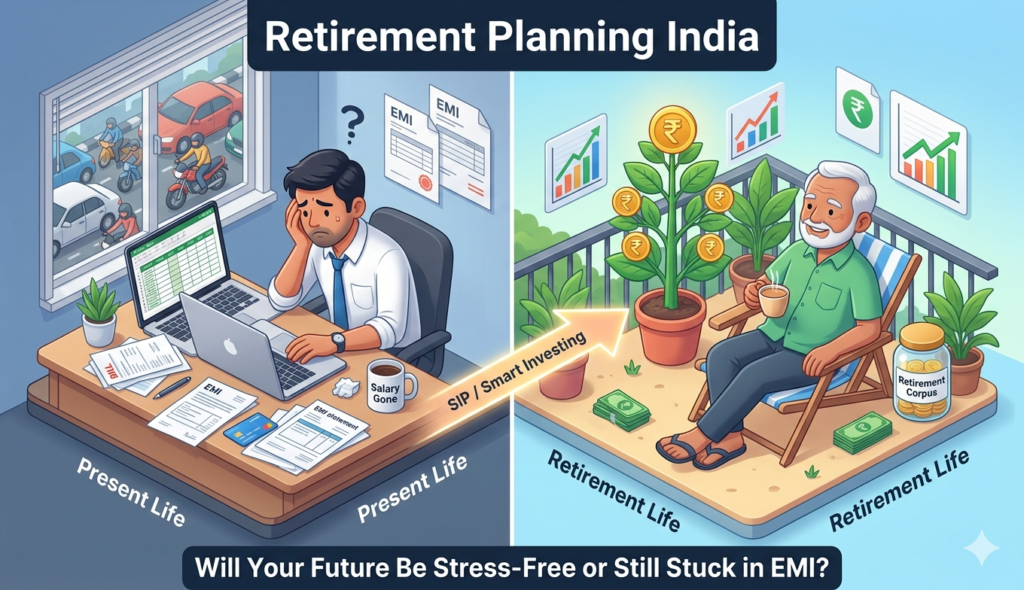
You wake up at 7 AM because you want to, not because of a boss’s meeting. You sip filter coffee on your balcony watching the sunrise. No EMI tension. No “beta, thoda paise bhej do” calls. You travel to Ladakh or Kerala whenever you feel like it. You finally learn that guitar you always wanted. Your health is decent because you could afford preventive check-ups.
Versus the other picture: Counting every rupee at 68, skipping medicines, and praying the kids don’t get irritated when you call.
The choice is yours. And it starts with one SIP today.
Open your demat account, set up that SIP, and review your numbers once a year. Your 65-year-old self will thank you while sipping chai in the hills.
Retirement planning India isn’t about fear. It’s about giving yourself the gift of choice.
Final Thought (With a Dash of Humour)
Retirement isn’t the end. It’s the beginning of the life you actually want to live — without bosses, deadlines, or Monday morning blues.
Stop treating it like a distant dream. Start treating it like the most important EMI you’ll ever pay — to yourself.
Because in the end, the best investment you can make isn’t in mutual funds or real estate.
It’s in your future peace of mind.
Now go calculate your number. And if it scares you… good. That fear is the first step to freedom.
Written with love (and mild sarcasm) for every Indian who’s ever wondered if they’ll ever truly retire.
Share this with your colleagues who are still saying “main toh 70 tak kaam karunga yaar.” They’ll thank you later.
Tags: retirement planning India | retirement corpus India | how much corpus needed for retirement India | FIRE India | SIP for retirement | inflation impact on retirement | retirement planning calculator India

Disclaimer: InvestmentSutras is an educational initiative. All articles and assessments are for educational and learning purposes only. This should not be treated as investment advice or recommendation. Please consult a registered investment advisor before acting on any suggestions.